 Nerve Blocks App
 Anesthesia Assistant App
 Ultrasound Pain App
 Pain Medicine Assistant App
 POCUS App
 IV Access App
 MSK Knee App
 VetRA App
 Nerve Block Manual
 Regional Anesthesia Updates
 Anesthesiology Manual
 Anesthesiology Review
 Anesthesia Updates 2025
 Anesthesia Updates 2026
 Pediatric Anesthesia Updates
 Airway Management Updates
 US Interventional Pain Manual
 Pain Medicine Updates
 Mastering Difficult IV Access
 PACU Nursing Manual
 RA Veterinary Manual
 Books
Books About
About

Learning objectives
- Understanding of Glycogen storage disorders (GSD)
- Pre- and perioperative management of GSD
Definition and mechanisms
- Glycogen storage disorders (GSD) are metabolic disorders caused by an enzyme deficiency affecting glycogen synthesis, glycogen breakdown, or glucose breakdown, typically in muscles and/or liver cells
- Glycogen in skeletal muscles provides a ready source of fuel during exercise, and hepatic glycogen helps maintain plasma glucose levels during fasting
- Attempts to maintain glucose homeostasis can result in muscle degradation as amino acids are used as an alternative substrate
- Patients are at risk of hypoglycemia
- GSD is hereditary and occurs in about 1/20 000 babies
- There are 14 types of GS, with type I being the most common
Types of GSD
| Disease and eponym | Inheritance and incidence | Organs affected | Clinical features |
|---|---|---|---|
| Type I (von Gierke disease) | Autosomal recessive, 1:100 000–200 000 | Liver (and renal) | Hypoglycemia, lactic acidosis, ketosis, hepatomegaly, truncal obesity, short stature, hypertriglyceridemia, hyperuricemia and gout, platelet dysfunction, renal dysfunction Good prognosis with supportive treatment |
| Type II (Pompe disease) | Autosomal recessive, 1:50 000 | Cardiac, muscle, liver | Hypotonia and skeletal muscle weakness, hypertrophic cardiomyopathy. Death from cardiorespiratory failure by 2 yr in severe infantile form |
| Type III (Cori disease) | Autosomal recessive, 1:100 000–150 000 | Liver, muscles | hypoglycemia, ketonuria, hepatomegaly, muscle fatigue Good prognosis |
| Type IV (Andersen disease) | Autosomal recessive, 1:500 000 | Liver | Failure to thrive, hypotonia, hepatosplenomegaly Hepatic cirrhosis leading to death by 5 yr |
| Type V (McArdle disease) | Autosomal recessive, 1:500 000 | Muscles | Exercise intolerance, muscle cramps, fatigability Good prognosis |
| Type VI (Hers disease) | 1:200 000 | Liver | Hepatomegaly, mild hypoglycemia, hyperlipidemia, ketosis Good prognosis |
| Type VII (Tarui disease) | Autosomal recessive, 1:500 000 | Muscles | Similar to GSD type V |
| Type VIII/IX (phosphorylase kinase deficiency) | Autosomal and X-linked | Liver | Similar to GSD type III, but no myopathy |
Signs and symptoms
General symptoms of GSD may include:
- Poor growth
- Heat intolerance
- Bruising too easily
- Hypoglycemia
- An enlarged liver
- A swollen abdomen
- Low muscle tone
- Muscle pain and cramping during exercise
- Fatigue
- Obesity
- Kidney problems
- Low resistance to infections
- Mouth sores
- Heart problems
- Gout
Symptoms for babies may include:
- Too much acid in the blood (acidosis)
- High blood cholesterol levels (hyperlipidemia)
Diagnosis
- A low blood glucose level
- Abdominal ultrasound to detect an enlarged liver
- Tissue biopsy
- Abnormal blood tests
- Gene testing
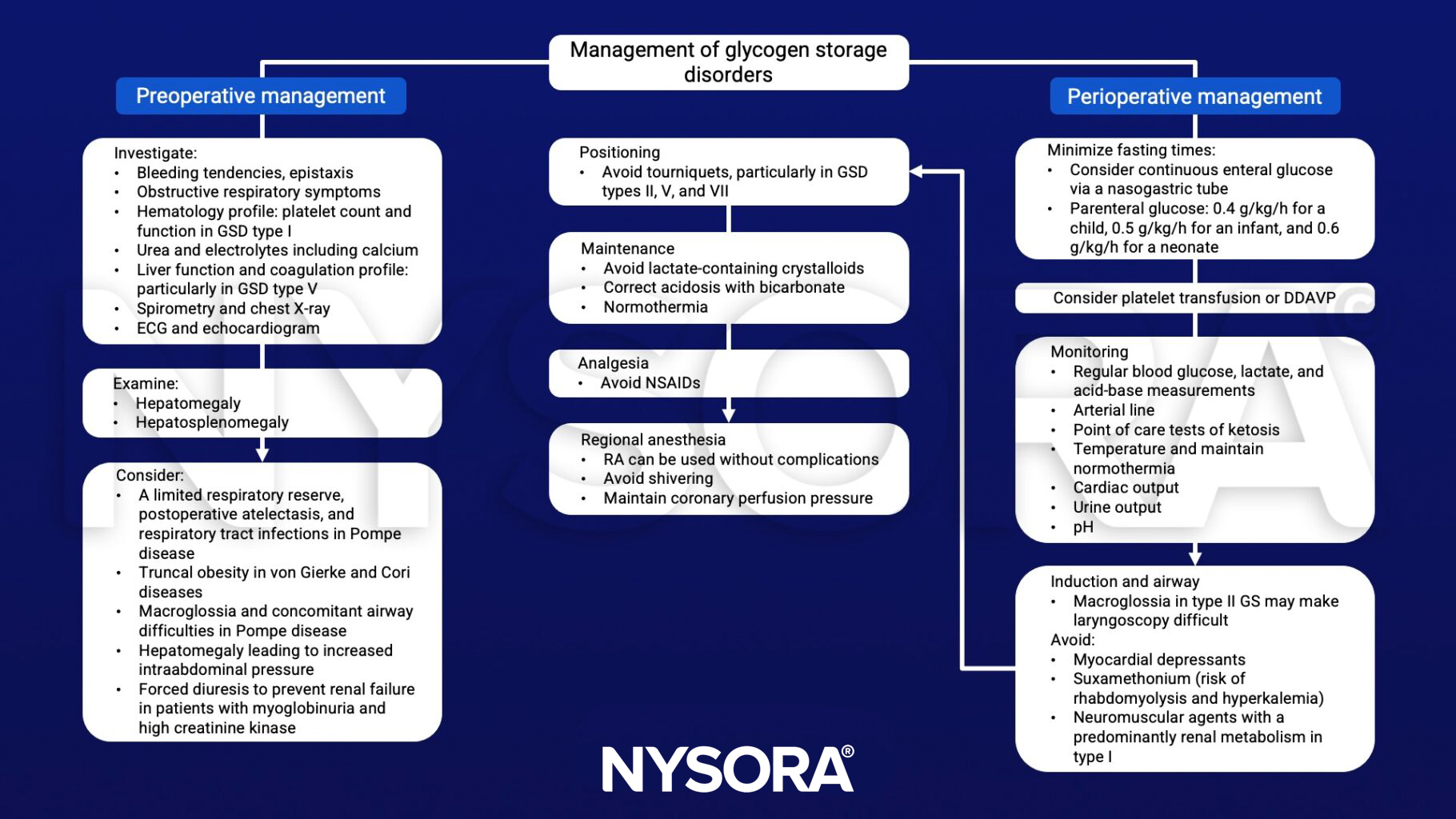
Management
Suggested reading
- Yeoh C, Teng H, Jackson J, et al. Metabolic Disorders and Anesthesia. Curr Anesthesiol Rep. 2019;9(3):340-359.
- Pollard BJ, Kitchen, G. Handbook of Clinical Anaesthesia. Fourth Edition. CRC Press. 2018. 978-1-4987-6289-2.
- Grant S, Nargis A. 2011. Perioperative care of children with inherited metabolic disorders. Continuing Education in Anaesthesia Critical Care & Pain.11:2;62-68.