 Nerve Blocks App
 Anesthesia Assistant App
 Ultrasound Pain App
 Pain Medicine Assistant App
 POCUS App
 IV Access App
 MSK Knee App
 VetRA App
 Nerve Block Manual
 Regional Anesthesia Updates
 Anesthesiology Manual
 Anesthesiology Review
 Anesthesia Updates 2025
 Anesthesia Updates 2026
 Pediatric Anesthesia Updates
 Airway Management Updates
 US Interventional Pain Manual
 Pain Medicine Updates
 Mastering Difficult IV Access
 PACU Nursing Manual
 RA Veterinary Manual
 Books
Books About
About

Learning objectives
- Describe Goldenhar syndrome
- Understand how Goldenhar syndrome affects the airway
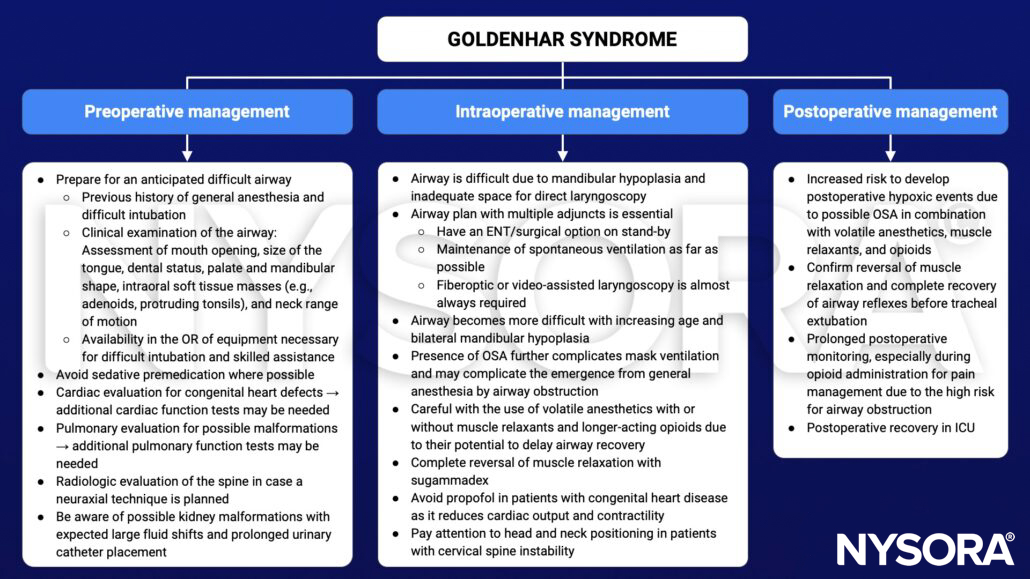
- Discuss the perioperative management of patients with Goldenhar syndrome
Definition and mechanisms
- Goldenhar syndrome (GS), also called oculo-auriculo-vertebral syndrome or hemifacial microsomia, is a rare disorder of craniofacial development
- Congenital malformation of the first and second branchial arches, resulting in the incomplete development of the ear, nose, soft palate, lip, and mandible (usually unilateral)
- It is characterized by the triad of mandibular hypoplasia resulting in facial asymmetry, ear and/or eye malformation, and vertebral anomalies
- Patients can also present with heart, kidney, and lung malformations, and central nervous system defects
- Male-to-female ratio 3:2
Signs and symptoms
- Mandibular hypoplasia (facial asymmetry)
- Eye anomalies: Microphthalmia, anophthalmia, epibulbar dermoids, and eyelid colobomas
- Ear anomalies: Preauricular tags, anotia (totally absent ear), and microtia (partially formed ear)
- Vertebral anomalies: Scoliosis, kyphosis, hemivertebrae, and cervical fusion
- Cleft lip and/or palate
- Wider than normal mouth
- Hydrocephalus
- Congenital heart defects in ⅓ of patients (most commonly septal and conotruncal defects, e.g., tetralogy of Fallot)
- Genitourinary malformations (e.g., ectopic or fused kidneys, renal agenesis, ureteropelvic junction obstruction, or vesicoureteral reflux)
- Partial or complete unilateral lung hypoplasia
- Developmental delay and autism spectrum disorder in some patients
Complications
- Vision problems and/or loss
- Hearing loss
- Feeding difficulties
- Speech difficulties
- Obstructive sleep apnea (OSA)
- Strabismus
- Pulmonary hypoplasia might increase the risk for respiratory infections, pulmonary hypertension, and pneumothorax
- Severe spinal deformities might cause restrictive lung disease and further decrease pulmonary function
Treatment
- Eyeglasses or surgery to improve vision
- Hearing aids or bone-anchored auditory implants
- Feeding assistance with special bottles or nasogastric feedings
- Speech therapy to increase language and communication skills
- Reconstructive surgery
- Surgery to correct a congenital heart defect, cleft lip or palate, obstructive sleep apnea, microtia, or spinal defect
Management
Suggested reading
- Sun YH, Zhu B, Ji BY, Zhang XH. Airway Management in a Child with Goldenhar Syndrome. Chin Med J (Engl). 2017;130(23):2881-2882.
- Goldenhar Syndrome. In: Bissonnette B, Luginbuehl I, Marciniak B, Dalens BJ. eds. Syndromes: Rapid Recognition and Perioperative Implications. McGraw Hill; 2006. Accessed February 09, 2023. https://accessanesthesiology.mhmedical.com/content.aspx?bookid=852§ionid=49517623
- Kaymak C, Gulhan Y, Ozcan AO, Baltaci B, Unal N, Safak MA, Oguz H. Anaesthetic approach in a case of Goldenhar’s syndrome. European Journal of Anaesthesiology. 2022; 19(11):836-838.