 Nerve Blocks App
 Anesthesia Assistant App
 Ultrasound Pain App
 Pain Medicine Assistant App
 POCUS App
 IV Access App
 MSK Knee App
 VetRA App
 Nerve Block Manual
 Regional Anesthesia Updates
 Anesthesiology Manual
 Anesthesiology Review
 Anesthesia Updates 2025
 Anesthesia Updates 2026
 Pediatric Anesthesia Updates
 Airway Management Updates
 US Interventional Pain Manual
 Pain Medicine Updates
 Mastering Difficult IV Access
 PACU Nursing Manual
 RA Veterinary Manual
 Books
Books About
About
Learning objectives
- Identify the risk factors associated with extravasation injuries
- Recognize the differential diagnosis of extravasation injuries
- Manage and prevent extravasation injuries
- Recognize warning signs of extravasation injuries
Definition and mechanisms
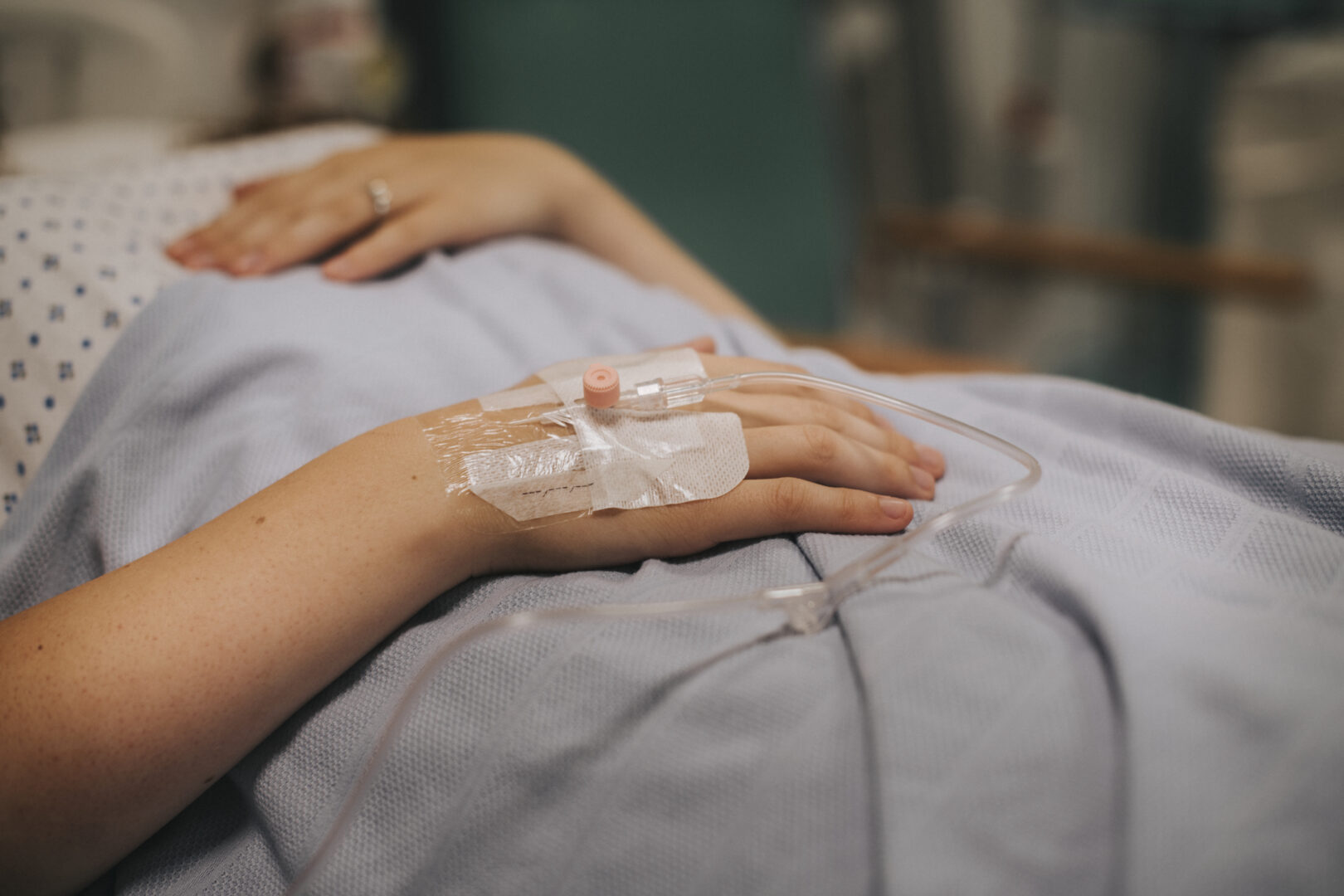
- The unintentional injection or leakage of fluid in the perivascular or subcutaneous space
- Resulting from solution cytotoxicity, osmolality, vasoconstrictor properties, infusion pressure, and regional anatomical peculiarities
- May cause significant tissue necrosis resulting in the amputation of an extremity
Risk factors
- Preexisting cutaneous, vascular or lymphatic pathophysiology
- Fragile or mobile veins
- Site of injection
- Toxicity of the drug
- Amount of agent extravasated
- Duration of tissue exposure
- Decreased vigilance of doctor or patient
Three categories of anesthetic/ICU agents causing extravasation injury
| 1) Hyperosmolar agents | 2) Acids/alkalis | 3) Vascular regulators |
|---|---|---|
| Calcium chloride | Aminophylline | Epinephrine |
| Calcium gluconate | Amiodarone | Dobutamine |
| Glucose > 10% | Amphotericin | Dopamine |
| Magnesium sulphate 20% | Co-trimoxazole | Metaraminol |
| Mannitol 10% and 20% | Diazepam | Norepinephrine |
| Parenteral nutrition | Erythromycin | Prostaglandin |
| Potassium chloride | Phenytoin | Vasopressin |
| Sodium bicarbonate | Thiopental | |
| Sodium chloride > 0.9% | Vancomycin | |
| X-ray contrast media |
Differential diagnosis
- Propofol, ondansetron, rocuronium, and cyclizine can all cause discomfort or pain on injection
- Venous spasms may occur and can lead to localized skin blanching
Management
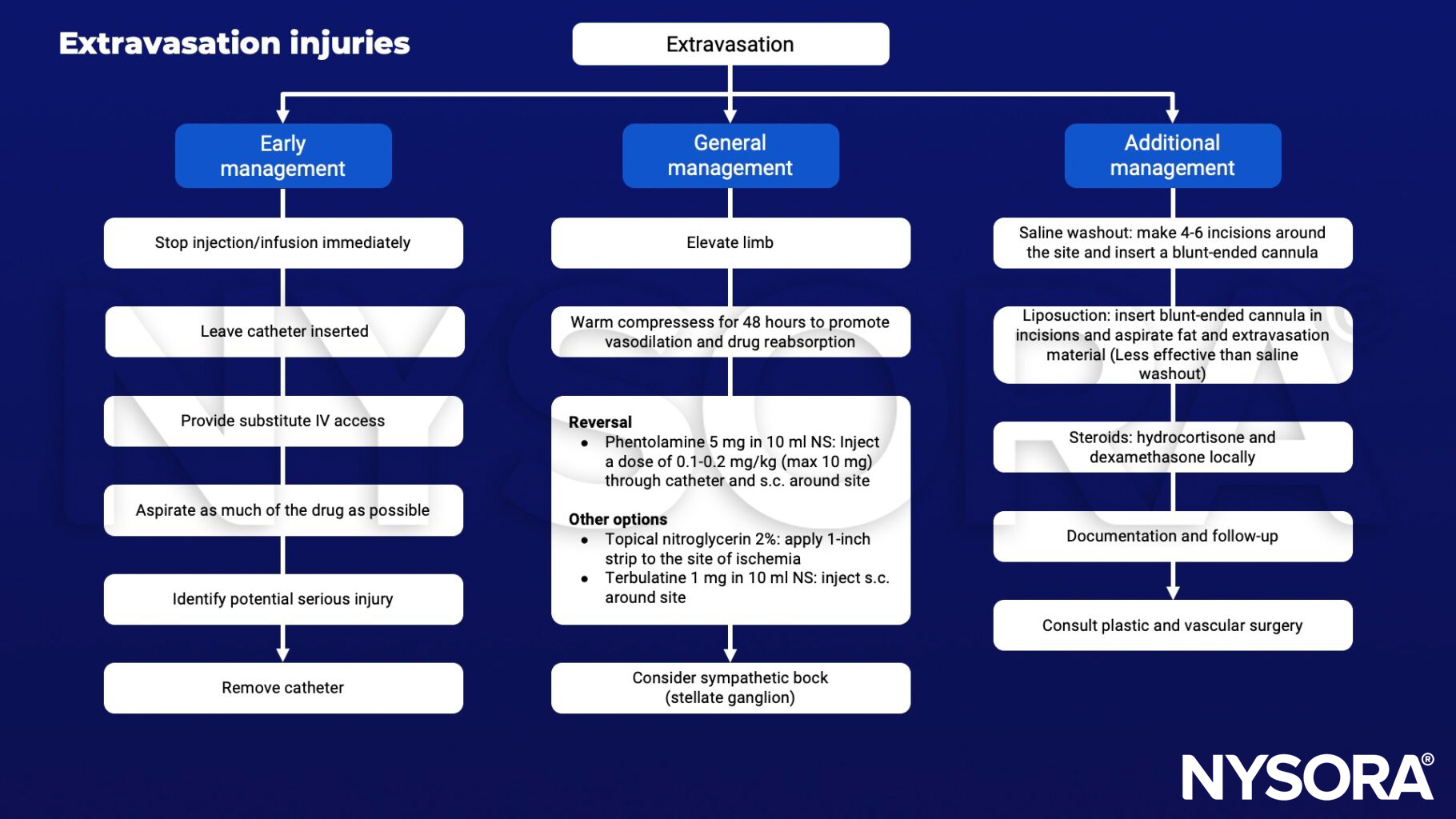
Prevention
- Avoid IVs in the hand/wrist as the most appropriate site is considered to be the forearm
- Careful insertion of peripheral venous catheters
- Flush catheter with sterile saline
- Apply a suitable dressing to prevent movement of the catheter and avoid unreassuring IVs
- Inspect the catheterization site regularly
- Regulated delivery of intravenous fluids from continuous infusion pumps
- Hyperosmolar fluids, acidic or alkaline solutions, or infusates with irritant or vesicant properties should be given through central venous lines, if possible, or should be diluted or neutralized
- For slow infusion of high-risk drugs, a central line or peripherally inserted central catheter (PICC) line should be used
- Keep antidotes and the worksheet in the room with the patient
- 10 mg of phentolamine mesylate can be added to each liter of solution containing norepinephrine (the vasopressor effect of norepinephrine is not affected)
Suggested reading
- Al-Benna S, O’Boyle C, Holley J. Extravasation injuries in adults. ISRN Dermatol. 2013 May 8;2013:856541.
- Lake C, Beecroft CL. Extravasation injuries and accidental intra-arterial injection, Continuing Education in Anaesthesia Critical Care & Pain, Volume 10, Issue 4, August 2010, Pages 109–113.
- Schummer W, Schummer C, Bayer O, Müller A, Bredle D, Karzai W. Extravasation Injury in the Perioperative Setting. Anesthesia & Analgesia: March 2005 – Volume 100 – Issue 3 – p 722-727.