 Nerve Blocks App
 Anesthesia Assistant App
 Ultrasound Pain App
 Pain Medicine Assistant App
 POCUS App
 IV Access App
 MSK Knee App
 VetRA App
 Nerve Block Manual
 Regional Anesthesia Updates
 Anesthesiology Manual
 Anesthesiology Review
 Anesthesia Updates 2025
 Anesthesia Updates 2026
 Pediatric Anesthesia Updates
 Airway Management Updates
 US Interventional Pain Manual
 Pain Medicine Updates
 Mastering Difficult IV Access
 PACU Nursing Manual
 RA Veterinary Manual
 Books
Books About
About

Learning objectives
- Identify and treat underlying causes of peripartum cardiac arrest
- Manage patients presenting with peripartum cardiac arrest
Background
- Peripartum cardiac arrest is a rare event with an incidence of one in 12,000 – 36,000 women per year
- A prompt, coordinated response by a multidisciplinary team is essential
- Need to consider two patients: The mother and de fetus
- The maternal cardiac arrest response team and protocols should be regularly reviewed with didactic and simulation sessions
- Strong leadership and teamwork are essential
Causes & treatments
| Cause of cardiac arrest | Treatment | |
|---|---|---|
| Complications of anesthesia | High neuraxial block | Treat hypotension aggressively (e.g., low-dose adrenaline) Support airway and breathing |
| Loss of airway, aspiration, respiratory depression | Support airway and breathing Difficult airway algorithm |
|
| Hypotension | Treat with vasopressors Lower head of bed to improve cerebral perfusion Volume replacement Obtain more intravenous access |
|
| Local anesthetic systemic toxicity (LAST) | Give intralipid Consider cardiopulmonary bypass or ECMO |
|
| Bleeding | Coagulopathy | Fibrinogen replacement Fresh frozen plasma Cryoprecipitate Platelets Consider tranexamic acid 1 g IV |
| Uterine atony | Give uterotonics Bakri balloon Compression suture Uterine artery embolisation Hysterectomy |
|
| Placenta accreta | Consider uterine artery embolisation Consider hysterectomy |
|
| Placental abruption | Delivery if indicated Monitor for coagulopathy |
|
| Placenta previa | Delivery if indicated Prepare for lower uterine segment atony |
|
| Uterine rupture | Uterine repair or hysterectomy | |
| Trauma | Call general surgeon Activate massive transfusion |
|
| Transfusion reaction | Stop transfusion Notify blood bank Adrenaline Steroids Send tryptase |
|
| Cardiovascular | Cardiomyopathy | Inotrope infusion Call for ECMO |
| Myocardial infarction | Inotrope infusion Call for ECMO Call for cardiac surgeon Call cardiac catheterization laboratory Send cardiac enzymes |
|
| Aortic dissection | Call cardiac surgeon Activate massive transfusion |
|
| Arrhythmias | Ventricular fibrillation: Defibrillate Unstable ventricular tachycardia: Amiodarone, lidocaine Torsade de pointes: Defibrillate, magnesium Stable ventricular tachycardia: Amiodarone, lidocaine Supraventricular tachycardia: Adenosine Atrial fibrillation: Amiodarone, cardioversion |
|
| Medications | Anaphylaxis | Adrenaline Steroids Diphenhydramine Ranitidine |
| Illicit | Opioid overdose: Naloxone Benzodiazepine overdose: Flumazenil Cocaine coronary vasospasm: Oxygen, aspirin, nitrates, thrombolytic therapy, or acute percutaneous coronary intervention |
|
| Drug error | Identify, discontinue agent and treat | |
| Magnesium toxicity | Stop magnesium Give calcium chloride 10 mL in 10% solution or calcium gluconate 30 mL in 10% solution |
|
| Insulin overdose | Give glucose/dextrose Glucagon |
|
| Oxytocin overdose | Treat hypotension | |
| Embolic | Pulmonary embolus | Call Interventional radiology Call cardiac surgeon Prepare catheterisation laboratory Echocardiography Start heparin IV Consider thrombolytics in cardiac arrest Nitric oxide |
| Coronary thrombus | Call cardiac surgeon Catheterisation laboratory Nitroglycerine |
|
| Amniotic fluid embolism/Anaphylactoid syndrome of pregnancy | Adrenaline Initiate cardiopulmonary resuscitation Call for extracorporeal membrane oxygenator Call for transesophageal echocardiography Prepare for coagulopathy and need for massive transfusion protocol Consider unproven ‘A-OK’ therapy: atropine, ondansetron, ketorolac Consider steroids Consider nitric oxide |
|
| Venous air embolism | Flood field if uterine venous sinuses open Internalise uterus |
|
| Fever | Infection, sepsis | Give broad spectrum antibiotics Fluids, volume replacement Vasopressors Place arterial line Perform echocardiogram Inotrope if low cardiac output |
| General non-obstetric causes of cardiac arrest | Hypotension | Treat with vasopressors Lower head of bed to improve cerebral perfusion Fluids, volume replacement Obtain more intravenous access Call for transthoracic echocardiography |
| Hypoxia | Airway control 100% oxygen |
|
| Hypothermia | Warm patient Warm fluids Blankets Increase room temperature |
|
| Hyperkalemia | Calcium Insulin and glucose Furosemide Albuterol Sodium bicarbonate to correct acidosis Intubate and hyperventilate Polystyrene sulphonate (potassium binder) Consider hemodialysis |
|
| Hypoglycemia | Give glucose/dextrose Glucagon |
|
| Hypercarbia/acidosis | Intubate trachea and optimize ventilation Determine cause of acidosis Sodium bicarbonate |
|
| Thrombus | See pulmonary embolus above | |
| Trauma | Call general or trauma surgeon | |
| Toxin | Give antidote if agent known |
|
| Tension pneumothorax | Needle decompression Insert chest tube |
|
| Tamponade | Call for ECMO Call cardiac surgeon |
|
| Hypertension | Pre-eclampsia/eclampsia/HELLP | Antihypertensive agents: labetalol (avoid in asthmatics), hydralazine, nicardipine Magnesium |
| Intracranial hemorrhage with increased intracranialpressure | Call neurosurgeon Blood pressure goal: systolic <140 mmHg Elevate head of bed 30° Reverse coagulopathy if present Hypertonic saline/mannitol |
ECMO, extracorporeal membrane oxygenation; HELLP, hemolysis, elevated liver enzymes, low
platelet count.
Management
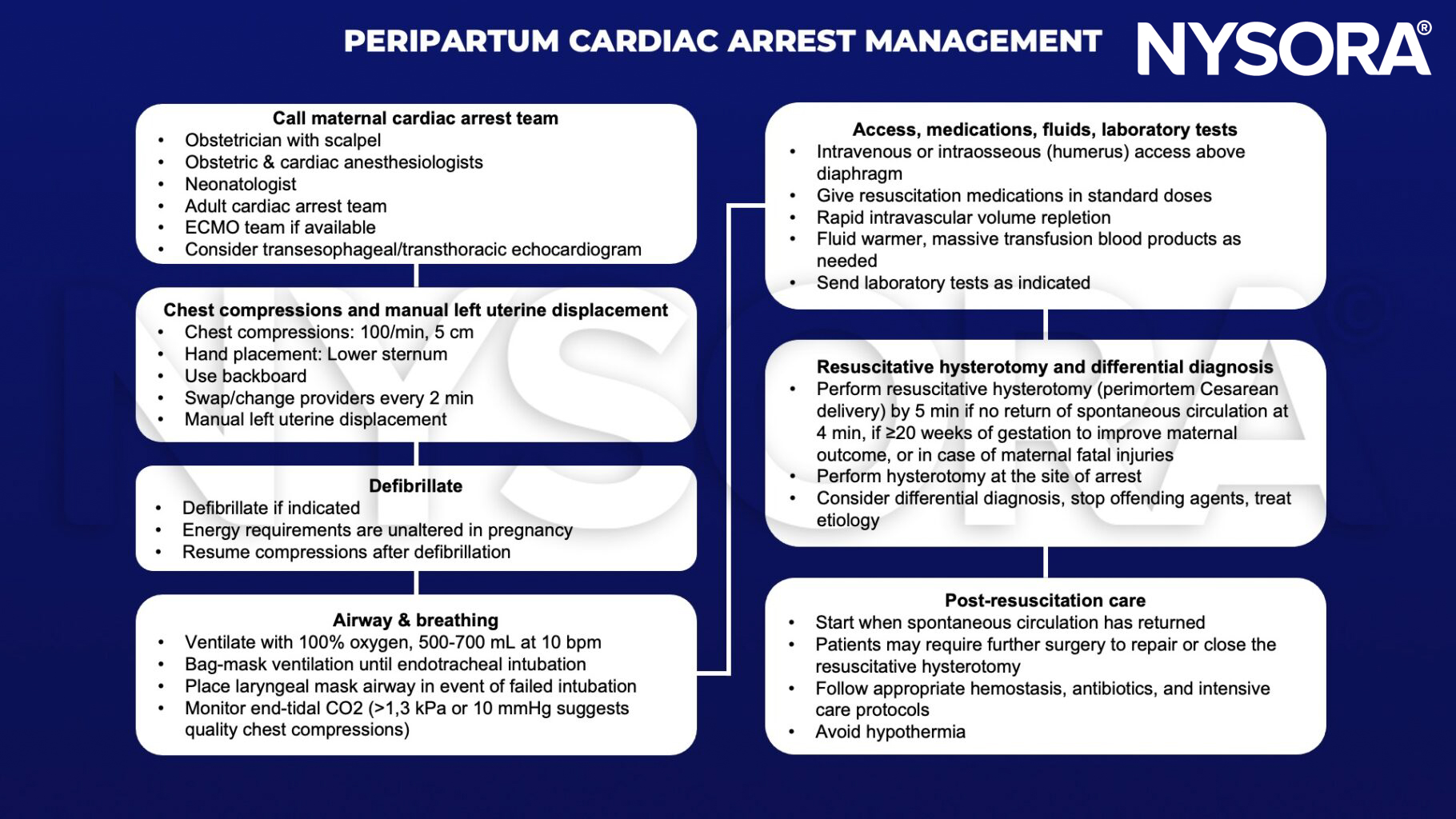
ECMO, extracorporeal membrane oxygenation.
Suggested reading
- Madden AM, Meng ML. Cardiopulmonary resuscitation in the pregnant patient. BJA Educ. 2020;20(8):252-258.
- Jeejeebhoy FM, Zelop CM, Lipman S, Carvalho B, Joglar J, Mhyre JM, et al. Cardiac Arrest in Pregnancy. Circulation. 2015;132(18):1747-73.
Clinical updates
Furdyna et al. (Anesthesiology, 2026) report a contemporary U.S. incidence of peripartum, peri-anesthetic maternal cardiac arrest of 11.2 per 100,000 deliveries (≈1 in 9,000), based on over 778,000 deliveries across 60 institutions, with hemorrhage (40%) and amniotic fluid embolism (31%) as the leading etiologies. Anesthetic complications accounted for 11.5% of arrests, most commonly high neuraxial block, with overall return of spontaneous circulation in 77% and 30-day survival in 68%, while nearly one in five cases showed potential deviations from ACLS-in-pregnancy guidelines, particularly delayed resuscitative hysterotomy and medication dosing errors.