 Nerve Blocks App
 Anesthesia Assistant App
 Ultrasound Pain App
 Pain Medicine Assistant App
 POCUS App
 IV Access App
 MSK Knee App
 VetRA App

 Nerve Block Manual 2027
 Nerve Block Manual
 Regional Anesthesia Updates
 Anesthesiology Manual
 Anesthesiology Review
 Anesthesia Updates 2025
 Anesthesia Updates 2026
 Pediatric Anesthesia Updates
 Airway Management Updates
 US Interventional Pain Manual
 Pain Medicine Updates
 Mastering Difficult IV Access
 PACU Nursing Manual
 RA Veterinary Manual
 Books
 About

 Back to News
 8 min read
Introduction
Cesarean delivery is one of the most common surgical procedures worldwide, yet roughly 30% of women still experience severe acute pain afterward, even when intrathecal morphine is part of a multimodal regimen. That matters beyond the first postoperative day. Severe early pain after cesarean delivery has been linked to a 2.5-fold higher likelihood of persistent pain and a three-fold higher likelihood of postpartum depression compared with mild pain.
Intrathecal morphine (ITM) remains the standard of care, but it comes with a cost: dose-dependent nausea, vomiting, and pruritus can erode the quality of recovery at a time when new mothers need to bond with and care for their newborns. Fascial plane blocks offer an opioid-free alternative. Among them, the lateral quadratus lumborum block (QLB, also called QL1) stands out because it can be performed supine at the end of surgery and has outperformed both the posterior and anterior QL approaches in a recent network meta-analysis.
Few trials, however, had directly compared lateral QLB with ITM. A new randomized, double-blind, two-center trial published in the British Journal of Anaesthesia set out to fill that gap, testing lateral QLB alone, ITM alone, and the two combined after cesarean delivery under spinal anesthesia. The results challenge some assumptions about where opioid-free regional techniques fit.
Study objective and methods
The primary aim was to test whether lateral QLB is noninferior to ITM for quality of recovery (QoR) at 24 hours after cesarean delivery. Secondary aims were to assess noninferiority at 48 hours, compare a wider range of analgesic outcomes between QLB and ITM, and determine whether adding QLB to ITM improves outcomes over ITM alone.
The trial was conducted at two Canadian university centers (IWK Health, Halifax, and Maisonneuve-Rosemont Hospital, Montreal) between 2017 and 2023.
Participants
- Non-laboring women undergoing elective or semi-urgent cesarean delivery under planned spinal anesthesia
- ASA physical status 2, age 18 years or older, singleton term pregnancy (37 weeks or more)
- Excluded: BMI of 35 kg/m² or more, significant obstetric or neonatal comorbidities, opioid or benzodiazepine use, NSAID intolerance, or illicit drug use
Standardized spinal anesthesia (all groups)
- 0.75% hyperbaric bupivacaine 12 mg plus fentanyl 10 µg
- Intraoperative ondansetron 4 mg and metoclopramide 10 mg IV after delivery
- At the end of surgery: ketorolac 30 mg IV and acetaminophen 1300 mg PR
Study groups
- QLB group: bilateral lateral QLB with 20 mL of 0.5% ropivacaine per side at the end of surgery, no ITM
- ITM group: 100 µg preservative-free intrathecal morphine plus bilateral sham QLB with 20 mL saline
- ITM+QLB group: 100 µg ITM plus bilateral lateral QLB with 20 mL of 0.5% ropivacaine
Block technique
The lateral QLB was performed supine. A linear transducer was placed at the mid-axillary line above the iliac crest, then slid posteriorly until the three abdominal muscle layers tapered and the transversalis fascia and quadratus lumborum muscle came into view. The needle was advanced in-plane from anterior to posterior, and local anesthetic was deposited at the lateral border of the QL muscle. Every operator completed standardized training, watched a procedural video, and had performed at least 20 independent QLBs. For a full anatomical walk-through, see NYSORA’s chapter on ultrasound-guided transversus abdominis plane and quadratus lumborum blocks.
Postoperative care and outcomes
- Regular naproxen 500 mg every 12 hours and acetaminophen 1 g every 6 hours; oxycodone 5–10 mg orally as needed for breakthrough pain
- Primary outcome: QoR-40 score at 24 hours (range 40–200)
- Secondary outcomes: QoR-40 at 48 hours; rest, cough, and worst pain scores (0–10 NRS); oxycodone consumption; nausea, vomiting, and pruritus; satisfaction with pain control
- Noninferiority margin: 10 QoR-40 points; significance threshold P<0.017 to account for three-group comparisons
Participants, postoperative care providers, data collectors, block operators, and the anesthesiologist delivering the spinal were all blinded to allocation.
Key findings
Of 644 women screened, 60 were randomized and 58 were analyzed (QLB 18, ITM 21, ITM+QLB 19). The trial was stopped early because of COVID-19-related recruitment challenges and exhausted funding, well short of the planned 90 participants. Baseline characteristics were similar across groups, and around three-quarters of women in each group were having a repeat cesarean delivery.
Quality of recovery (primary outcome)
- At 24 hours, noninferiority of QLB vs ITM was inconclusive (90% CI for the mean difference −0.9 to 13.5, crossing the 10-point margin).
- At 48 hours, QLB met the criteria for both noninferiority and equivalence with ITM (90% CI −6.5 to 5.9).
- Adding QLB to ITM did not significantly change QoR-40 at 24 hours (176.6 vs 172.6) or 48 hours (181.6 vs 183.0).
Pain, opioid use, and satisfaction
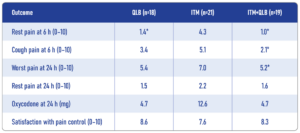
Statistically significant vs ITM alone (P<0.017), confirmed with both Welch’s t-test and Mann-Whitney U test. Values are means.
- QLB vs ITM: QLB lowered resting pain at 6 hours by 2.9 points (95% CI 1.3 to 4.5; P<0.001). No other pain or opioid outcome differed significantly.
- ITM+QLB vs ITM: the combination lowered resting pain at 6 hours by 3.3 points, coughing pain at 6 hours by 3.0 points, and worst pain at 24 hours by 1.8 points.
- Oxycodone consumption at 24 hours was numerically lower in both block groups (4.7 vs 12.6 mg), but the difference narrowly missed the strict significance threshold.
- By 48 hours, pain scores were similar across all three groups.
Adverse effects
- Nausea and vomiting did not differ between groups.
- Pruritus was unexpectedly more frequent in the QLB group at 24 hours (39% vs 0% with ITM) and in the ITM+QLB group at 6 and 24 hours.
- Most pruritus was mild, and the need for pruritus treatment did not differ between groups at any time point.
Clinical implications
This trial does not dethrone ITM, but it sharpens the role of the lateral QLB in post-cesarean analgesia. The clearest signal is in the first 6 hours, when patients who received a lateral QLB, with or without ITM, reported markedly less pain than those who received ITM alone. That early window is when ITM is still building toward its peak effect and when women are first mobilizing, feeding, and holding their newborns.
The findings contrast with earlier work on other QL approaches. A previous systematic review found no added benefit of QLB over spinal morphine, but most included trials used the posterior (QL2) approach, which appears less effective. NYSORA has previously covered a trial comparing posterior QLB with intrathecal morphine after scheduled cesarean section, and another showing that a TAP block with intrathecal fentanyl did not match ITM. The lateral approach, performed in a less vascular plane, may explain the stronger effect seen here.
Several practical scenarios follow from these results:
- Patients at high risk of severe postoperative pain may benefit from adding a lateral QLB to ITM, given the lower early and worst pain scores with the combination.
- Patients who cannot receive or tolerate ITM (for example, those with a history of severe opioid-related pruritus or nausea, or where post-neuraxial opioid monitoring is limited) may be reasonable candidates for lateral QLB as an alternative.
- Busy delivery units should factor in the extra operating room time needed to perform bilateral blocks after surgery.
The findings should still be interpreted cautiously. The study enrolled only 58 of the planned 90 participants, raising the risk of false-negative results, and most secondary outcomes were exploratory. The unexpected pruritus signal in the QLB-only group, which received no ITM, may reflect random variation in a small sample. Finally, the study used the generic QoR-40 rather than the obstetric-specific ObsQoR-11, which was validated after the trial began.
Clinical pearls
- Approach matters. Lateral QLB (QL1) deposits local anesthetic at the lateral border of the QL muscle and outperforms posterior and anterior QL approaches for post-cesarean analgesia. Don’t extrapolate negative posterior QLB data to the lateral technique.
- The supine position is a practical advantage. Unlike the anterior QLB, the lateral QLB can be performed supine at the end of surgery, with no need to reposition a patient after spinal anesthesia.
- Early pain is where blocks shine. The biggest gains were at 6 hours, with resting pain roughly 3 points lower than with ITM alone. By 48 hours, the groups converged.
- Combination beats ITM alone for worst pain. ITM+QLB reduced worst pain at 24 hours from 7.0 to 5.2, a meaningful gain for patients expected to have severe pain.
- Modern ITM dosing reduces side effects. At 100 µg, ITM produced less pruritus than expected. Lower contemporary doses are associated with fewer opioid-related adverse effects than historical higher doses.
- Training is achievable. Operators reached consistency with standardized training, a procedural video, and a minimum of 20 independent blocks, but identifying the lateral margin of the QL muscle can still be challenging.
- Respect the dose ceiling. Bilateral 20 mL of 0.5% ropivacaine adds up; the study capped the total at 3 mg/kg.
Conclusion
This randomized, double-blind, two-center trial is one of the first to compare lateral QLB directly with intrathecal morphine after cesarean delivery. Noninferiority of QLB for quality of recovery at 24 hours could not be confirmed, although the two approaches produced equivalent recovery scores at 48 hours. More striking was the early analgesic benefit: lateral QLB reduced resting pain at 6 hours compared with ITM, and adding QLB to ITM further lowered early resting and coughing pain as well as worst pain at 24 hours. Nausea, vomiting, and opioid consumption did not differ significantly, while pruritus was more common but mostly mild in the block groups. Because the trial stopped short of its planned sample size, these results are best viewed as hypothesis-generating. Larger, adequately powered trials are needed to define whether lateral QLB should be an alternative to ITM for selected patients or a routine add-on for those at high risk of severe pain.
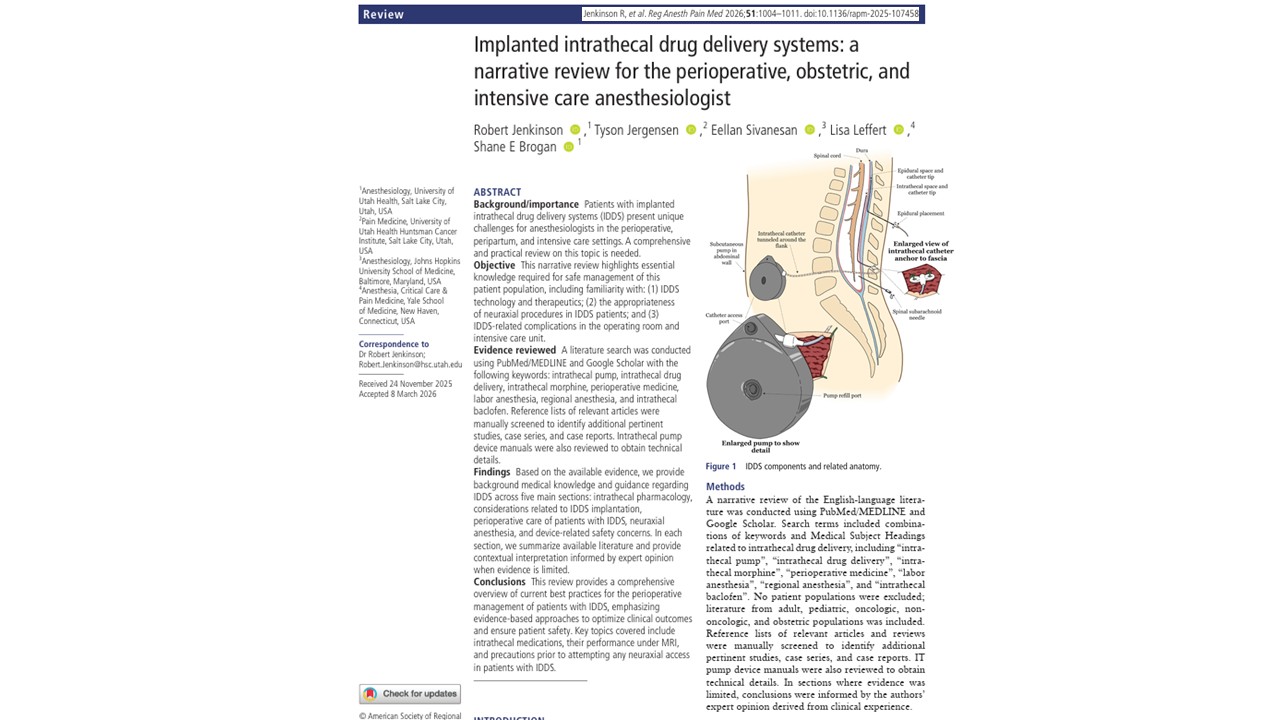
Reference: Uppal V et al. Comparison of intrathecal morphine, lateral quadratus lumborum block, and their combination for analgesia and quality of recovery after Caesarean delivery: a randomised, double-blind, two-centre clinical trial. Br J Anaesth. 2026;137:764-772.
Read more about the lateral quadratus lumborum block and other truncal fascial plane blocks in the NYSORA Nerve Blocks App, your step-by-step guide to the most frequently used nerve blocks, with practical tips and video demonstrations you can take straight to the bedside.