 Nerve Blocks App
 Anesthesia Assistant App
 Ultrasound Pain App
 Pain Medicine Assistant App
 POCUS App
 IV Access App
 MSK Knee App
 VetRA App

 Nerve Block Manual 2027
 Nerve Block Manual
 Regional Anesthesia Updates
 Anesthesiology Manual
 Anesthesiology Review
 Anesthesia Updates 2025
 Anesthesia Updates 2026
 Pediatric Anesthesia Updates
 Airway Management Updates
 US Interventional Pain Manual
 Pain Medicine Updates
 Mastering Difficult IV Access
 PACU Nursing Manual
 RA Veterinary Manual
 Books
 About

 Back to News
 8 min read
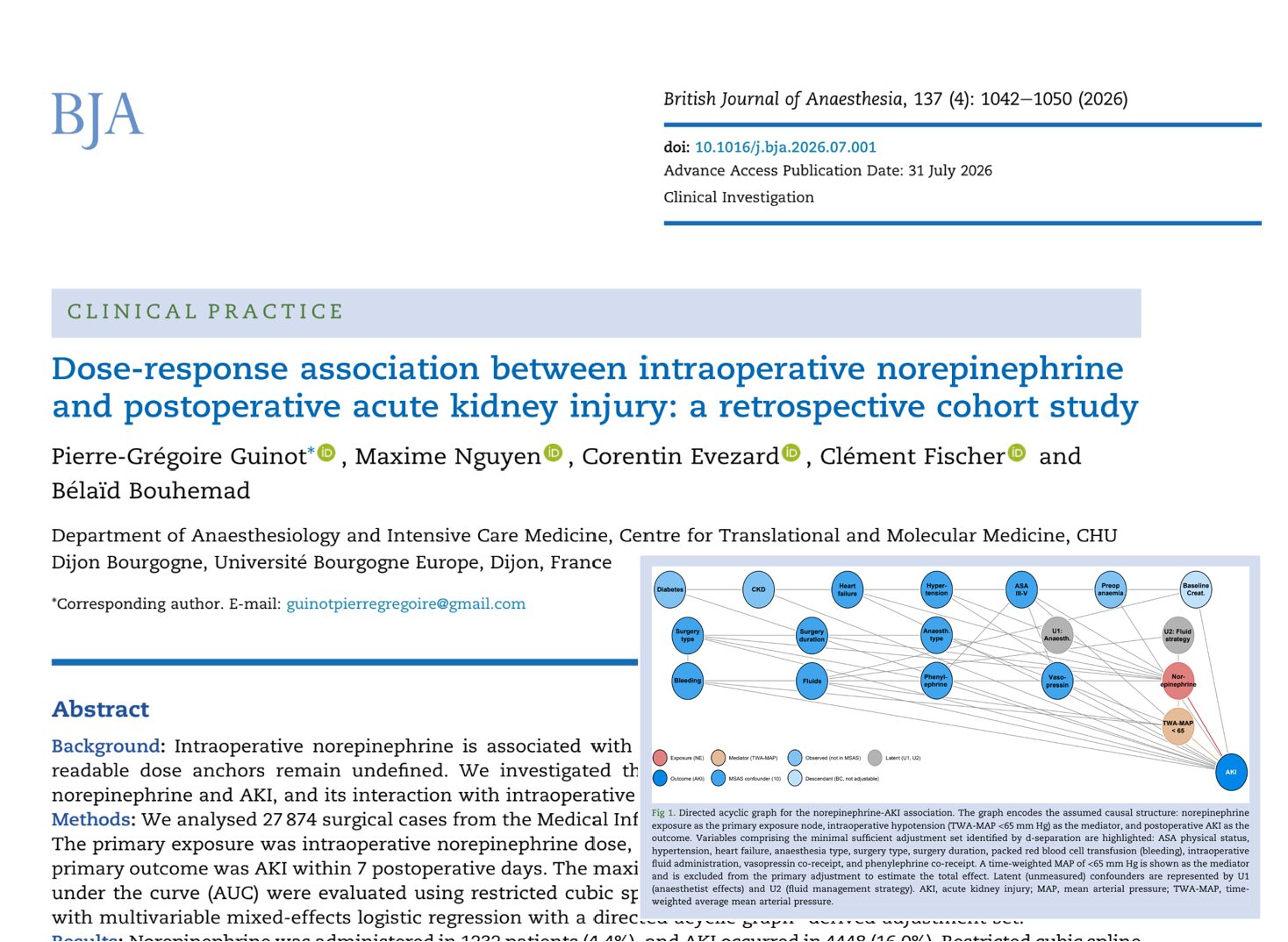
Postoperative acute kidney injury (AKI) affects 10–20% of patients after major noncardiac surgery and is linked to higher mortality, longer hospital stays, and progression to chronic kidney disease. For years, the hemodynamic conversation has centered on one culprit: intraoperative hypotension. The usual response is a vasopressor, and in Europe, and increasingly in North America, that vasopressor is norepinephrine. But a growing body of evidence suggests the treatment itself may carry renal risk. Earlier cohorts linked cumulative norepinephrine dose to AKI, yet none told clinicians what dose, for how long, should make them pause. That gap matters at the bedside, where decisions are made minute by minute and a vague “less is better” offers little guidance. A new retrospective cohort study by Guinot and colleagues, published in the British Journal of Anaesthesia, tackles this problem directly. Using nearly 28,000 surgical cases, the authors modeled how peak dose, average intensity, duration, and cumulative exposure relate to AKI, and whether these effects are simply a stand-in for hypotension. The result is a practical, two-tier framework built on two bedside-readable dose anchors. Here is what the study found, how to interpret it, and how it might change the way you watch the infusion pump during your next long case.
Study objective and methods
The primary objective was to define the dose-response relationship between standardized intraoperative norepinephrine exposure and postoperative AKI. The secondary objectives were to identify dose anchors linked to higher AKI risk, evaluate the role of exposure duration, and test whether dose, duration, and hypotension interact or simply add up.
The authors analyzed the Medical Informatics Operating Room Vitals and Events Repository (MOVER), a public perioperative database from a single North American center covering 2015 to 2022.
Population
- Adults (≥18 years) having noncardiac surgery under general anesthesia
- Excluded: cardiac or transplant surgery, ASA physical status 6, chronic dialysis, and missing vasopressor or creatinine data
- Final cohort: 27,874 surgical cases in 16,243 unique patients
Exposure: four norepinephrine metrics
All doses were standardized as norepinephrine base in µg/kg/min, which matters because many formulations are labeled as the bitartrate salt. Single boluses were assigned a minimum effective duration of 5 minutes.
- Maximum dose: the peak infusion rate during anesthesia
- Intensity: the time-weighted mean dose during the infusion
- Duration: total minutes of administration
- Area under the curve (AUC): cumulative exposure (intensity × duration), in µg/kg
Phenylephrine and vasopressin were recorded separately as co-vasopressors. Hypotension burden was captured as the time-weighted average area under a mean arterial pressure (MAP) of 65 mm Hg.
Outcome
AKI within 7 postoperative days, using KDIGO serum creatinine criteria (a ≥50% rise from baseline or need for renal replacement therapy). Urine output was not used, as it was not consistently recorded.
Statistical approach
- Restricted cubic splines to test whether each metric relates to AKI in a linear or curved way
- Two anchors per metric: the Youden index (best sensitivity-specificity trade-off) and the inflection point of the spline curve, both validated with 1,000 bootstrap resamples
- Mixed-effects logistic regression adjusted for confounders chosen with a directed acyclic graph (ASA status, hypertension, heart failure, surgery type and duration, anesthesia type, transfusion, fluids, and co-vasopressors)
- A coefficient attenuation analysis, adding hypotension to the model to see how much of the norepinephrine effect it explains
- Two-dimensional generalized additive models to test dose × duration and dose × hypotension interactions
- Eight sensitivity analyses, including overlap weighting, doubly robust estimation, and E-values
Key findings
Patients who exceeded a peak norepinephrine dose of 0.029 µg/kg/min had 76% higher odds of AKI, and correcting for hypotension barely changed that.
Who received norepinephrine?
- Norepinephrine was given in only 1,232 cases (4.4%); phenylephrine was the dominant agent (49.8%)
- AKI occurred in 16.0% of the whole cohort, but in 34.9% of norepinephrine-exposed patients versus 15.1% of unexposed patients
- Exposed patients were sicker: 73% were ASA 4–5, 44% also received vasopressin, and 71% were transfused
- Among exposed patients, the median peak dose was 0.047 µg/kg/min and the median duration was 69 minutes
Two kinds of dose behavior
The metrics split into two families. Rate-based metrics (peak dose and intensity) showed a curved relationship with AKI, suggesting a zone where risk accelerates. Time-based metrics (duration and AUC) rose in a straight line, consistent with risk accumulating steadily over time.
The dose anchors
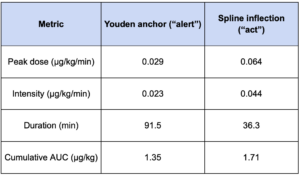
The peak-dose anchors of 0.029 and 0.064 µg/kg/min are the headline numbers, because they can be read straight off the pump.
Independent of hypotension
- A peak dose above 0.029 µg/kg/min was independently associated with AKI (OR 1.76; 95% CI 1.41–2.20)
- Adding hypotension burden to the model reduced this only slightly (OR 1.71; 95% CI 1.36–2.15), a 5.1% attenuation
- Hypotension itself remained an independent, smaller risk factor (OR 1.05 per unit; 95% CI 1.01–1.09)
Additive, not synergistic
Neither the dose × duration interaction (P = 0.286) nor the dose × hypotension interaction (P = 0.298) was significant. Dose, duration, and hypotension each appear to add their own share of risk. All eight sensitivity analyses pointed in the same direction, although the effect was smaller after excluding vasopressin co-exposure.
Clinical implications
The main message is not “avoid norepinephrine.” It is “watch how much you are giving, and treat rising requirements as information.” The authors propose a two-tier vigilance framework rather than hard ceilings.
- Alert tier (peak dose >0.029 µg/kg/min): a signal that renal risk is rising. Confirm the blood pressure target is appropriate and ask why the patient needs support.
- Act tier (peak dose >0.064 µg/kg/min): the point where the dose-response curve bends. Prompt a formal hemodynamic reassessment, including cardiac output, fluid responsiveness, anesthetic depth, and bleeding.
These anchors sit within doses many clinicians use routinely. That is the point: as norepinephrine becomes first-line for perioperative hypotension, low-dose infusions are increasingly given to patients without true vasoplegia, who may be more exposed to its direct renal vasoconstrictive effects.
The findings also help explain a puzzling pattern in recent trials. Studies of norepinephrine-based MAP optimization, including IMPROVE-multi and the hypotension prediction index trial, hit their pressure targets without reducing AKI. If vasopressor exposure carries its own risk, a strategy that trades hypotension for more vasoconstriction may simply move the problem. Good hemodynamic management may need to balance perfusion pressure against cumulative vasopressor load, not just chase a number on the monitor.
Keep the limits in view. This is a single-center, observational study, and confounding by indication is unavoidable: patients who need norepinephrine are sicker. Norepinephrine use was uncommon in this phenylephrine-dominant cohort, so the anchors need validation in European settings where norepinephrine is first-line. The results are hypothesis-generating and do not prove that lowering the dose protects the kidney.
Clinical pearls
- Remember two numbers: 0.03 µg/kg/min to alert, 0.06 µg/kg/min to act. For a 70 kg patient, that is roughly 2 µg/min and 4.5 µg/min of norepinephrine base.
- Check your salt. Doses reported as norepinephrine bitartrate are about twice the base dose. Know which your pump and protocol use before comparing against published thresholds.
- Peak dose and time both count. Short spikes and long, low infusions each add risk. Beyond about 90 minutes of exposure, ask whether ongoing support is still needed.
- Fixing the MAP is not the whole job. Hypotension and norepinephrine added risk independently, so a normal pressure on high vasopressor support is not a “safe” state.
- Rising requirements are a diagnostic clue. Look for hypovolemia, bleeding, excessive anesthetic depth, or low cardiac output before turning the infusion up again.
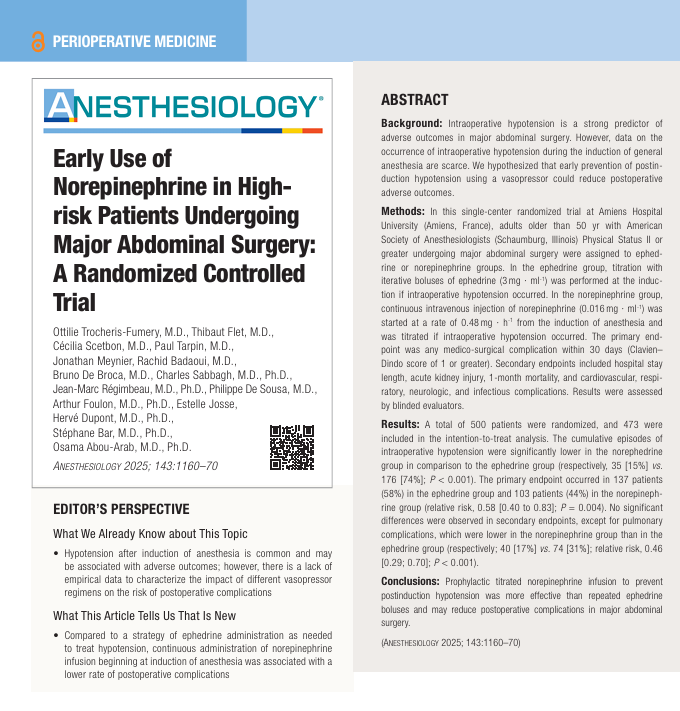
- Bolus versus infusion matters for exposure. See how continuous and bolus norepinephrine compare when planning your strategy.
- Think kidney-protective as a bundle. Combine sensible vasopressor use with avoiding nephrotoxins and fluid overload, and keep an eye on emerging renal protection strategies.
Conclusion
This large retrospective cohort adds an important layer to the debate on intraoperative norepinephrine and acute kidney injury. Norepinephrine exposure was independently associated with postoperative AKI, with risk accelerating at higher infusion rates and building steadily with longer exposure. Strikingly, correcting hypotension explained only about 5% of this association, and dose, duration, and hypotension each contributed risk in an additive way. The two peak-dose anchors, 0.029 and 0.064 µg/kg/min, offer a simple alert-and-act framework that clinicians can apply at the bedside today. They are not hard limits and should never delay treatment of dangerous hypotension. Instead, they signal that vasopressor needs are exceeding the expected range and that it is time to look for the cause. Because the design is observational and confounding by indication cannot be fully excluded, prospective validation and randomized trials of anchor-guided management are the essential next step. Until then, these findings support a more integrated approach that weighs pressure, flow, and cumulative vasopressor load together.
Read more about vasopressor management and perioperative kidney protection in our Anesthesiology Module on NYSORA360, an essential learning resource for residents with practical, up-to-date guidance.
Reference: Guinot PG et al. Dose-response association between intraoperative norepinephrine and postoperative acute kidney injury: a retrospective cohort study. Br J Anaesth. 2026;137:1042-1050.