 Nerve Blocks App
 Anesthesia Assistant App
 Ultrasound Pain App
 Pain Medicine Assistant App
 POCUS App
 IV Access App
 MSK Knee App
 VetRA App
 Nerve Block Manual
 Regional Anesthesia Updates
 Anesthesiology Manual
 Anesthesiology Review
 Anesthesia Updates 2025
 Anesthesia Updates 2026
 Pediatric Anesthesia Updates
 Airway Management Updates
 US Interventional Pain Manual
 Pain Medicine Updates
 Mastering Difficult IV Access
 PACU Nursing Manual
 RA Veterinary Manual
 Books
Books About
About
 Back to News
 4 min read
What makes an AI tool genuinely useful to an anesthesiologist?
Not simply how much information it can provide, but how effectively it can turn that information into a practical clinical plan.
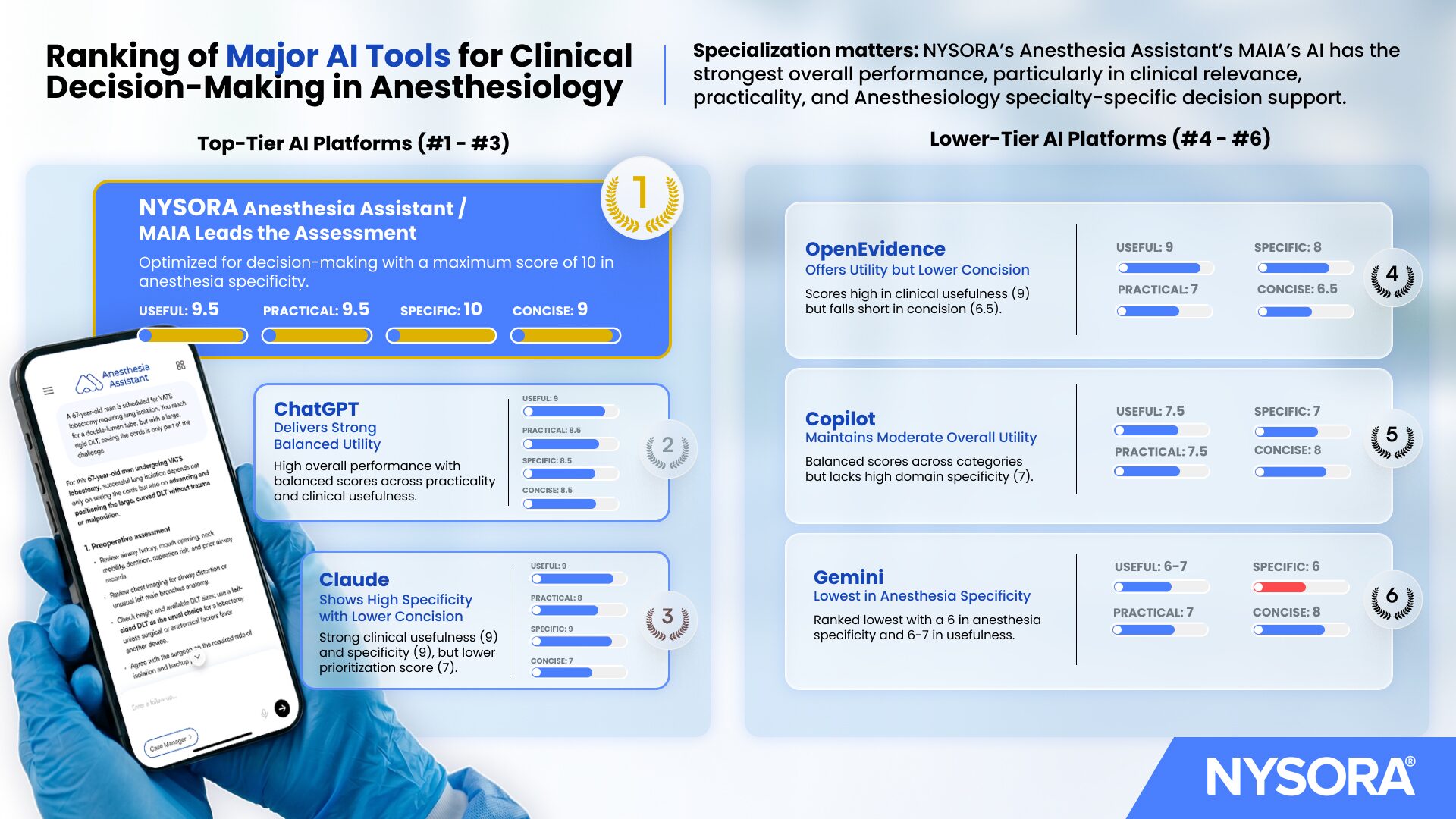
That question was at the center of recent student-led research at Yale comparing MAIA, the AI clinical assistant within NYSORA’s Anesthesia Assistant App, with five widely used AI platforms: OpenEvidence, ChatGPT, Claude, Gemini, and Copilot.
The goal was practical: to evaluate how well each platform could support the type of decision-making anesthesiologists face in everyday clinical practice.
Five cases. Six AI platforms. The same clinical challenge.
Each AI platform was given the same five evolving perioperative cases.
Rather than presenting the complete case at once, new clinical information was introduced step by step. At each stage, the AI was asked to produce a concise anesthesia management plan in order of priority.
In other words, the assessment tested whether each platform could help answer three questions that become increasingly important as a case develops:
What matters now? What should I do next? How should the plan change as new information emerges?
The platforms were assessed across key dimensions of clinical usefulness, including practicality, anesthesia specificity, and concision, alongside their ability to provide clinically useful guidance.
The focus was not simply on whether an AI could retrieve medical information or summarize the evidence. It was on whether that information could be translated into clear, prioritized guidance for anesthesia decision-making.
MAIA ranked first overall
The assessment placed MAIA first among the six AI platforms evaluated.
MAIA received particularly strong scores for clinical usefulness and practicality, with 9.5/10 in both categories, and received the highest score in the assessment for anesthesia specificity at 10/10. Its concision was rated 9/10.
ChatGPT and Claude followed in second and third place, while OpenEvidence, Copilot, and Gemini ranked fourth through sixth in this assessment.
The results point to an important distinction: specialization matters.
General-purpose AI tools can retrieve, synthesize, and explain large amounts of medical information. But anesthesiologists often need something more specific at the point of care: information prioritized around the patient, the procedure, and the decisions that need to be made next.
That is the context MAIA was designed for.
From information to clinical action
MAIA was built specifically around anesthesia workflows.
Its purpose is not simply to provide another way to search for information. It is designed to help clinicians move from patient information to an organized anesthesia plan – particularly when a case is complex, circumstances change, or time is limited.
This distinction became especially relevant in the evolving-case format of the assessment.
As new information was introduced, the task was not simply to produce another answer. Each platform needed to recognize what had changed, determine what was now clinically important, and provide guidance that remained practical and relevant to anesthesia care.
The findings suggest that MAIA’s anesthesia-specific design translated into an advantage in exactly these areas.
The research tells one part of the story. Clinical practice tells the other.
A structured assessment can show how an AI performs across standardized clinical scenarios. But ultimately, a clinical tool has to prove useful in the reality of everyday practice.
That is why feedback from anesthesiologists actually using MAIA is equally meaningful.
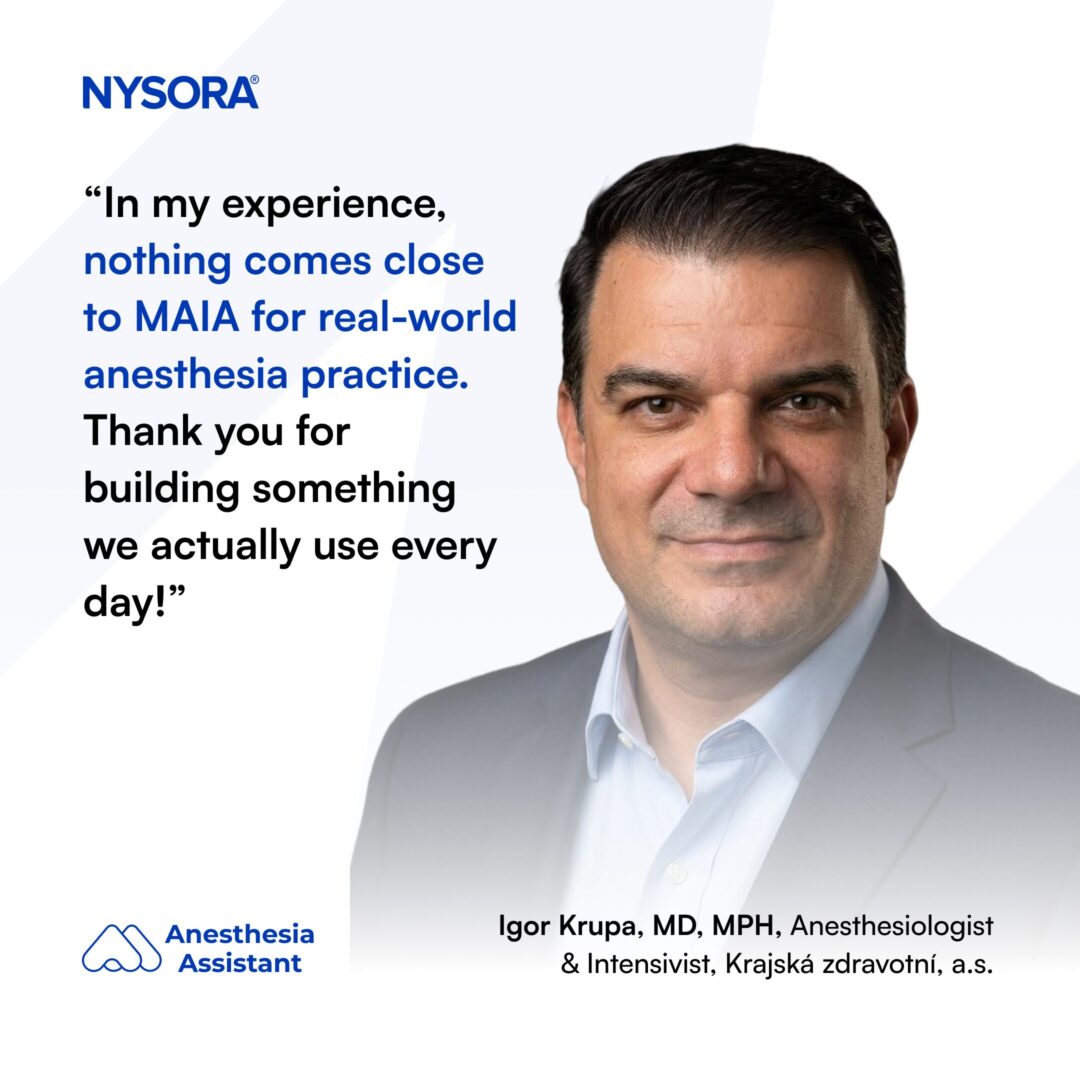
Igor Krupa, MD, MPH, Anesthesiologist & Intensivist at Krajská zdravotní, a.s. – Teplice Hospital in the Czech Republic, described his experience with MAIA:
“In my experience nothing comes close to MAIA for real-world anesthesia practice. Thank you for building something we actually use every day!”
His feedback reflects the same idea explored in the assessment from a different perspective.
The value of clinical AI is not measured only by what it knows. It is measured by whether that knowledge becomes useful when a clinician is managing a real patient, during a real case, with limited time.
Built for the realities of anesthesia practice
Busy clinical practice rarely leaves time to work through pages of information before deciding what comes next. The challenge is often not access to information. It is identifying what matters, prioritizing it, and turning it into an actionable plan.
That is the problem MAIA was built to address.
The results of this assessment are an encouraging validation of that approach. And hearing from clinicians who have made MAIA part of their everyday practice gives those results even greater meaning.
As MAIA continues to develop, the goal remains the same: make clinical guidance more relevant, practical, and easier to use when anesthesiologists need it.
Built for anesthesia. Built for clinical practice.