 Nerve Blocks App
 Anesthesia Assistant App
 Ultrasound Pain App
 Pain Medicine Assistant App
 POCUS App
 IV Access App
 MSK Knee App
 VetRA App
 Nerve Block Manual
 Regional Anesthesia Updates
 Anesthesiology Manual
 Anesthesiology Review
 Anesthesia Updates 2025
 Anesthesia Updates 2026
 Pediatric Anesthesia Updates
 Airway Management Updates
 US Interventional Pain Manual
 Pain Medicine Updates
 Mastering Difficult IV Access
 PACU Nursing Manual
 RA Veterinary Manual
 Books
Books About
About
 Back to News
 8 min read

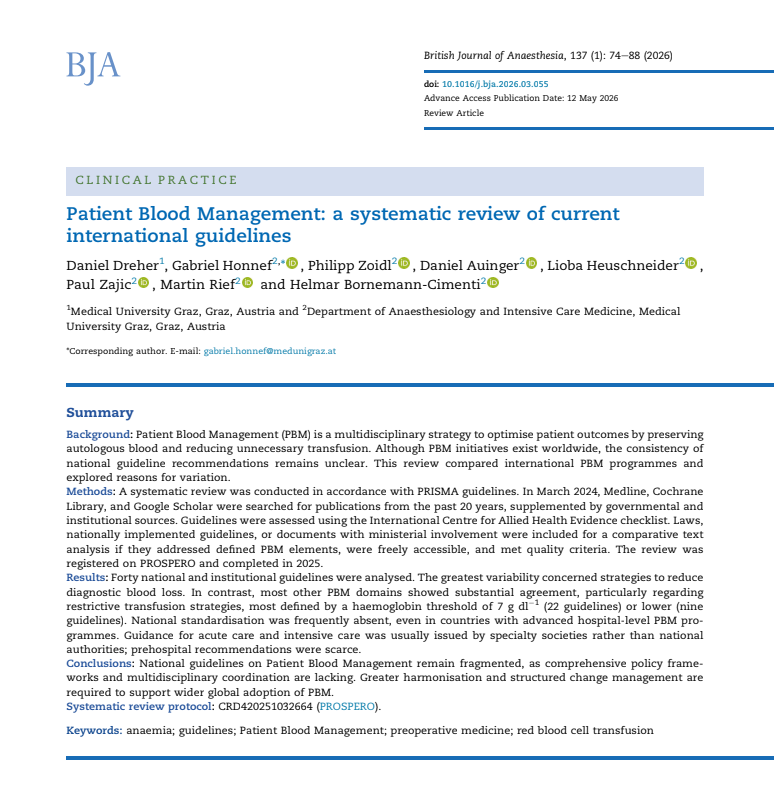
A new systematic review published in the British Journal of Anaesthesia has found substantial international agreement on several core principles of Patient Blood Management (PBM), particularly restrictive red blood cell transfusion strategies. However, national implementation remains fragmented, and major differences persist in how countries approach blood conservation, diagnostic blood loss and multidisciplinary coordination.
The review, by Dreher and colleagues, analysed 40 national and institutional guidelines covering Patient Blood Management and related transfusion practices. The authors found that relatively few countries have comprehensive national PBM programmes spanning all three established pillars of PBM.
The findings highlight a striking contrast: clinicians and organisations often agree on important clinical principles, but health systems have not consistently translated those principles into coordinated national policy.
What is Patient Blood Management?
Patient Blood Management is defined as a patient-centred, systematic and evidence-based approach designed to improve outcomes by managing and preserving a patient’s own blood while promoting patient safety and empowerment.
PBM is not simply an attempt to avoid blood transfusion. Instead, it addresses the factors that increase the likelihood that a patient will require transfusion in the first place.
The approach is organised around three pillars:
- Optimising red cell mass, including identifying and treating anemia.
- Minimising blood loss and bleeding, including perioperative blood conservation and hemostatic management.
- Harnessing physiological tolerance of anemia, including appropriate and restrictive use of transfusion.
These measures aim to reduce unnecessary transfusion and associated healthcare costs while maintaining or improving clinical outcomes.
The issue has international significance. The review notes that anemia affected an estimated 1.95–2.36 billion people worldwide in 2021, while demographic change and increasing demand for blood products are placing additional pressure on blood supplies.
Researchers analysed 40 guidelines
Guidelines were evaluated using the International Centre for Allied Health Evidence quality checklist. Documents scoring below 10 of 14 points, equivalent to less than approximately 71%, were excluded.
Of the 40 included documents, 22 had been developed under the leadership of, or with involvement from, national ministries of health, with some incorporated into national legislation.
National implementation remains surprisingly limited
Despite international promotion of PBM for more than two decades, comprehensive national implementation remains uncommon.
The researchers identified 13 countries, including nine high-income countries, with national programmes established to varying degrees. A further 14 high-income countries and five low- and middle-income countries were reported to be developing programmes.
Australia was highlighted as a leading example, with six national guideline modules that have been widely referenced internationally.
Within Europe, national programmes were identified in countries including France, Great Britain, Italy and Romania, with more limited national approaches in Austria, Poland and the Netherlands.
Italy was identified as the first European country to introduce official ministerial support for PBM.
There is an uneven global distribution of PBM guidance. Large areas of the world have little or no representation among the included national programmes and guidelines.
The authors also found an important gap outside hospitals: only one guideline addressed PBM elements relevant to the prehospital setting.
Pillar one: treating anemia before transfusion becomes necessary
The first PBM pillar focuses on optimising red cell mass.
Most of the evaluated guidelines contained recommendations concerning perioperative anemia diagnosis and treatment.
For iron-deficiency anemia, most documents recommended oral iron as first-line treatment.
Intravenous iron was generally reserved for circumstances including:
- Intolerance or contraindications to oral iron.
- Malabsorption or inadequate response to oral treatment.
- Functional iron deficiency.
- Need for rapid iron replacement.
- Patients receiving erythropoiesis-stimulating agents.
- Selected patients with renal or cardiac comorbidity.
- Postoperative patients.
A minority of guidelines recommended intravenous iron as first-line therapy, while intravenous treatment was more frequently recommended during pregnancy and the postpartum period.
Recommendations for erythropoietin, erythropoiesis-stimulating agents and vitamin supplementation were less consistent.
Several organisations and countries also explicitly recommended establishing anemia clinics to identify and optimise patients before elective surgery.
However, the review found considerable variation in recommendations about postponing elective procedures until anemia has been corrected. Anemia diagnostics and treatment are commonly covered, whereas recommendations concerning postponement of elective interventions vary substantially between guidelines.
Pillar two: blood conservation produces the greatest disagreement
The second PBM pillar concerns minimising blood loss and bleeding.
This was the area with the greatest international heterogeneity.
One particularly inconsistent topic was diagnostic blood loss. Recommendations varied regarding measures such as:
- Targeted blood sampling.
- Small-volume collection tubes.
- Non-invasive monitoring.
- Strategies to reduce repeated diagnostic phlebotomy.
The relevance of these measures also differed according to patient population. Some sources considered diagnostic blood loss relatively unimportant in adults outside intensive care, whereas the issue can be more significant in intensive care and pediatric populations.
Only a limited number of guidelines addressed blood-conserving surgical techniques such as minimally invasive extracorporeal circuits, off-pump coronary artery bypass grafting, video-assisted procedures, electrocautery, ultrasound dissectors, embolisation and avoidance of routine suction drainage.
There was stronger agreement in several other areas.
Point-of-care testing, including viscoelastic hemostatic assays, was consistently represented, as were recommendations concerning autologous blood conservation techniques.
Most documents also contained clinical or organisational frameworks for managing massive hemorrhage.
Management of perioperative antithrombotic therapy and coagulopathy has also become an increasingly prominent component of PBM guidance.
Pillar three: restrictive transfusion is the clearest area of consensus
The strongest agreement emerged in the third PBM pillar: optimising physiological tolerance of anemia and making appropriate transfusion decisions.
A central message was that clinicians should not make red blood cell transfusion decisions solely on the basis of hemoglobin or hematocrit values.
Instead, the patient’s overall clinical condition should be considered, including physiological reserve, medical history and expected clinical trajectory.
Restrictive transfusion strategies were consistently recommended.
Among the guidelines analysed, 22 specified a hemoglobin threshold of 7 g/dL and another nine specified thresholds below 7 g/dL.
Importantly, several guidelines emphasised that reaching a numerical hemoglobin threshold does not automatically mean that transfusion is mandatory when the patient has adequate compensatory mechanisms.
Where an upper adult threshold was provided, it was commonly around 10 g/dL, above which red blood cell transfusion would generally be inappropriate or inadvisable except in specifically justified circumstances.
Some patients require different thresholds
A universal hemoglobin trigger is not appropriate for every patient.
The review found that guidelines frequently modify thresholds according to clinical circumstances.
For example, patients with acute brain injury or acute coronary syndrome may have somewhat higher transfusion thresholds than otherwise stable adults, while neonates and infants may require different thresholds according to clinical status and organ-support requirements.
This reinforces one of the central conclusions of modern PBM: transfusion decisions should combine laboratory measurements with clinical assessment rather than treating hemoglobin as an isolated trigger.
What could improve global PBM guidance?
The researchers suggest several potential approaches to reducing fragmentation.
- Develop broad national frameworks. National authorities could establish overarching PBM standards while allowing specialist societies to provide detailed recommendations for individual clinical settings.
- Create multidisciplinary national guidelines. Relevant professional organisations could jointly develop comprehensive national clinical practice guidelines, although the authors caution that this approach can produce extremely long documents.
- Adopt living guidelines. Continuously updated recommendations could reduce inconsistencies caused by guidelines being published at different times and therefore relying on different generations of evidence.
Some guidelines included in the review already exceed 500 pages, highlighting the challenge of producing recommendations that are simultaneously comprehensive and practical.
Why national coordination matters
PBM is inherently multidisciplinary.
Successful implementation may involve anesthesiology, surgery, hematology, transfusion medicine, intensive care, nursing, laboratory medicine, pharmacy and hospital administration.
That complexity may partly explain why recommendations vary.
The researchers suggest that geopolitical and cultural factors, healthcare-system structure, guideline methodology, evidence appraisal and consensus processes can all contribute to differences between countries.
Resource limitations are another major issue.
In low- and middle-income countries, implementation can be constrained by inadequate infrastructure, limited funding and insufficient training or continuing professional education.
As a result, simply publishing a guideline does not guarantee that PBM principles will become routine clinical practice.
What clinicians and health systems can take from the findings
The review suggests several practical priorities for organisations seeking to strengthen PBM:
- Identify anemia early, particularly before elective surgery.
- Determine and treat the underlying cause rather than relying on transfusion as the default response.
- Reduce avoidable blood loss, including unnecessary diagnostic sampling where clinically relevant.
- Use structured hemostatic and massive-hemorrhage protocols when significant bleeding occurs.
- Apply restrictive transfusion principles, while considering symptoms, physiological reserve and the patient’s clinical condition.
- Coordinate PBM across disciplines, rather than treating transfusion practice as the responsibility of a single specialty.
- Develop national or institutional implementation frameworks capable of translating guideline recommendations into routine practice.
These points summarise themes identified across the reviewed guidelines and should not be interpreted as an individual treatment protocol.
The bigger picture
More than 25 years after PBM and blood-conservation principles began gaining international attention, the global policy landscape remains incomplete.
The encouraging finding is that many guidelines now converge on fundamental clinical principles, particularly restrictive transfusion and patient-specific decision-making.
The more difficult challenge is implementation.
Dreher and colleagues conclude that broader harmonisation, comprehensive policy frameworks, multidisciplinary coordination and structured change management will be required if PBM is to achieve wider global adoption.
For healthcare systems facing increasing demand for blood products, prevalent anemia and pressure on limited blood supplies, PBM therefore represents more than a transfusion strategy. It is a coordinated approach to preserving a patient’s own blood, managing anemia and bleeding, and ensuring that transfusion is used when the overall clinical situation supports it.
Reference: Dreher D et al. Patient Blood Management: a systematic review of current international guidelines. Br J Anaesth. 2026;137:74-88.
Read more about recent evidence like this in NYSORA’s Anesthesia Assistant app. Simulate case, check dosages and search through NYSORA knowledge database!