 Nerve Blocks App
 Anesthesia Assistant App
 Ultrasound Pain App
 Pain Medicine Assistant App
 POCUS App
 IV Access App
 MSK Knee App
 VetRA App
 Nerve Block Manual
 Regional Anesthesia Updates
 Anesthesiology Manual
 Anesthesiology Review
 Anesthesia Updates 2025
 Anesthesia Updates 2026
 Pediatric Anesthesia Updates
 Airway Management Updates
 US Interventional Pain Manual
 Pain Medicine Updates
 Mastering Difficult IV Access
 PACU Nursing Manual
 RA Veterinary Manual
 Books
Books About
About
 Back to News
 6 min read
Brachial plexus blocks have become a cornerstone of multimodal analgesia for upper limb surgery, offering excellent postoperative pain control while reducing opioid requirements and facilitating earlier recovery. However, one persistent limitation remains: the duration of analgesia. Even with long-acting local anesthetics and commonly used adjuncts such as dexamethasone, the analgesic effect of a single-shot brachial plexus block rarely extends beyond 24 hours. As the block resolves, many patients experience rebound pain, which can increase opioid consumption and negatively impact recovery.
Liposomal bupivacaine was developed to address this challenge. Its extended-release formulation is designed to prolong local anesthetic effects for up to 72 hours, theoretically reducing postoperative pain, minimizing opioid use, and improving patient recovery. Since its introduction, several randomized controlled trials have investigated its use in brachial plexus blocks, yet their findings have been inconsistent. While some studies reported improved analgesia, others found little or no meaningful clinical benefit, raising ongoing questions about whether its substantially higher cost is justified.
To provide a clearer answer, Shing and colleagues conducted the first systematic review and meta-analysis focused exclusively on liposomal bupivacaine administered via brachial plexus blocks. By pooling data from 21 randomized controlled trials involving nearly 1,500 patients, the authors evaluated whether the statistical benefits reported in individual studies translate into clinically meaningful improvements in postoperative recovery. Their findings offer valuable insights for clinicians considering the routine use of liposomal bupivacaine in upper limb surgery.
Study methods
Literature search
The investigators searched:
- PubMed
- EMBASE
- Web of Science
- Cochrane Library
- ClinicalTrials.gov
Randomized controlled trials published up to June 2024 were eligible.
Included studies
The final analysis included:
- 21 randomized controlled trials
- 23 treatment comparisons
- 1,478 patients
Most studies evaluated patients undergoing shoulder surgery using ultrasound-guided interscalene brachial plexus blocks. Liposomal bupivacaine was compared with conventional long-acting local anesthetics, primarily plain bupivacaine or ropivacaine.
Key findings
Pain scores improved—but the clinical benefit was modest
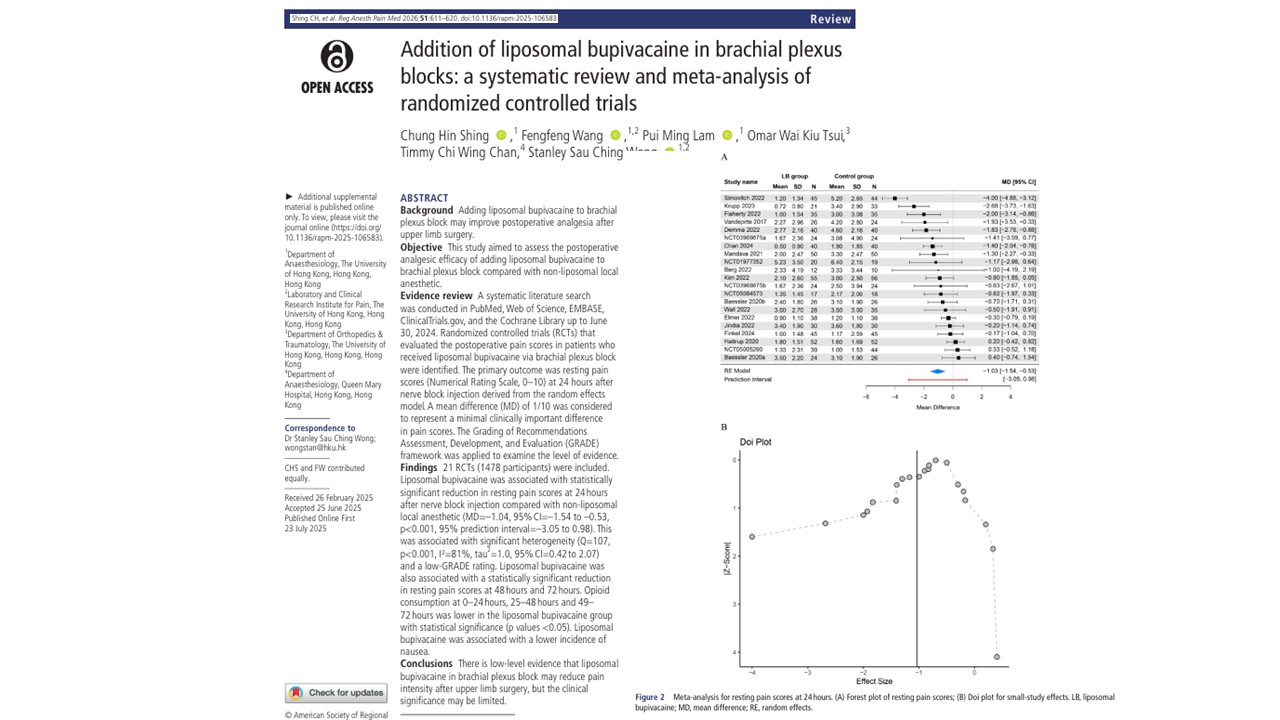
Liposomal bupivacaine significantly reduced resting pain scores at:
- 24 hours
- 48 hours
- 72 hours
At 24 hours, the pooled reduction in resting pain was 1.04 points on a 0–10 pain scale, slightly exceeding the predefined minimal clinically important difference (MCID) of one point.
However, after removing statistical outliers in a sensitivity analysis, the treatment effect decreased to 0.88 points, falling below the predefined threshold for clinical importance. This suggests that while the reduction in pain was statistically significant, many patients may not perceive a meaningful difference in practice. Furthermore, substantial heterogeneity across studies reduced confidence in the overall findings.
Opioid consumption decreased
Patients receiving liposomal bupivacaine required significantly fewer opioids during all postoperative periods:
- 0–24 hours
- 25–48 hours
- 49–72 hours
Although statistically significant, the reductions were relatively small, amounting to less than 8 mg morphine equivalents per day. Whether this translates into clinically meaningful improvements for most patients remains uncertain.
Less postoperative nausea
Liposomal bupivacaine was associated with a lower incidence of postoperative nausea compared with conventional local anesthetics.
However, no significant differences were observed for:
- Dizziness
- Dyspnea
- Hoarseness
- Horner syndrome
- Rash
- Other block-related adverse events
These findings suggest that liposomal bupivacaine maintains a similar safety profile while offering a modest reduction in opioid-related nausea.
Hospital stay was slightly shorter
Across five studies, patients receiving liposomal bupivacaine had a modest reduction in hospital length of stay.
Although statistically significant, the average reduction was approximately 1.6 hours, making its practical impact dependent on local discharge pathways and institutional workflows.
No improvement in several patient-centered outcomes
Despite reductions in pain and opioid consumption, liposomal bupivacaine did not significantly improve:
- Overall Benefit of Analgesia Score (OBAS)
- Patient satisfaction
- Time to first analgesic request
These findings suggest that the measurable statistical improvements did not consistently translate into better patient-perceived recovery.
Why do these findings matter?
One of the most important messages from this review extends beyond liposomal bupivacaine itself.
The study highlights the difference between statistical significance and clinical significance.
Although pooled analyses demonstrated statistically significant reductions in pain scores, the benefits became less convincing after sensitivity analyses, and the certainty of evidence was rated as low to moderate because of considerable heterogeneity between studies.
For clinicians, this reinforces the importance of looking beyond p-values when evaluating new therapies. Small statistical improvements may not always justify higher costs or changes in clinical practice.
Clinical implications
This meta-analysis suggests that liposomal bupivacaine can modestly improve postoperative analgesia following brachial plexus blocks, while reducing opioid use and postoperative nausea.
However, routine use should be considered carefully.
The authors emphasize that:
- Clinical benefits appear relatively small.
- Improvements in pain are not consistently clinically meaningful.
- Patient satisfaction does not improve.
- The evidence remains low to moderate in certainty.
- Cost may outweigh benefit in many healthcare systems.
Liposomal bupivacaine may therefore be most appropriate for carefully selected patients at high risk of severe postoperative pain or when prolonged analgesia is particularly desirable, rather than for routine use in every upper limb procedure.
Future research
Future randomized trials should focus on:
- Identifying patients most likely to benefit from liposomal bupivacaine.
- Comparing liposomal bupivacaine directly with optimized multimodal analgesic regimens using dexamethasone.
- Evaluating cost-effectiveness across different healthcare systems.
- Assessing long-term patient-centered outcomes, including quality of recovery and functional rehabilitation.
- Determining whether specific surgical procedures derive greater benefit than others.
Clinical pearls
- Liposomal bupivacaine modestly reduced postoperative pain after brachial plexus blocks.
- Opioid consumption and postoperative nausea were also reduced.
- Pain reduction at 24 hours fell below the predefined MCID after sensitivity analysis.
- Patient satisfaction and overall analgesic benefit were not significantly improved.
- Evidence quality ranged from low to moderate due to substantial study heterogeneity.
- Routine use should balance potential benefits against the significantly higher cost of liposomal bupivacaine.
Conclusion
This systematic review and meta-analysis provides the most comprehensive assessment to date of liposomal bupivacaine for brachial plexus blocks. While liposomal bupivacaine consistently reduced postoperative pain, opioid consumption, postoperative nausea, and hospital length of stay, these improvements were generally modest. Importantly, the reduction in pain at the primary endpoint no longer reached the predefined threshold for clinical importance after sensitivity analysis, and no improvements were observed in patient satisfaction or overall analgesic benefit.
For clinicians, the key takeaway is that statistically significant findings should always be interpreted alongside clinical relevance, evidence quality, and cost. Liposomal bupivacaine may have a role in selected high-risk patients, but current evidence does not strongly support its routine use for all brachial plexus blocks.
Practical tip
When evaluating new analgesic techniques, consider not only whether they produce statistically significant improvements, but also whether those improvements are meaningful for your patients and justify the additional cost. Evidence-based decision-making requires balancing efficacy, patient outcomes, safety, and healthcare resources.
For more information, refer to the full article in RAPM.
Shing CH, Wang F, Lam PM, Tsui OWK, Chan TCW, Wong SSC. Addition of liposomal bupivacaine in brachial plexus blocks: a systematic review and meta-analysis of randomized controlled trials. Reg Anesth Pain Med. 2026 Jun 5;51(6):611-620. doi: 10.1136/rapm-2025-106583.
Download the Nerve Blocks App HERE for in-depth insights on brachial plexus blocks. Prefer a physical copy? The bestselling NYSORA Nerve Blocks App is available in book format, an essential resource for mastering nerve blocks!