 Nerve Blocks App
 Anesthesia Assistant App
 Ultrasound Pain App
 Pain Medicine Assistant App
 POCUS App
 IV Access App
 MSK Knee App
 VetRA App
 Nerve Block Manual
 Regional Anesthesia Updates
 Anesthesiology Manual
 Anesthesiology Review
 Anesthesia Updates 2025
 Anesthesia Updates 2026
 Pediatric Anesthesia Updates
 Airway Management Updates
 US Interventional Pain Manual
 Pain Medicine Updates
 Mastering Difficult IV Access
 PACU Nursing Manual
 RA Veterinary Manual
 Books
Books About
About
 Back to News
 7 min read
A ventilation strategy that tailors positive end-expiratory pressure (PEEP) to the individual patient may reduce postoperative pulmonary complications in adults undergoing minimally invasive thoracic or abdominal surgery, according to a new systematic review and meta-analysis published in the British Journal of Anaesthesia.
The analysis by Abbott and colleagues included 30 studies and 3,295 participants. Compared with conventional lung-protective ventilation using fixed PEEP, individualised PEEP was associated with both fewer postoperative pulmonary complications and lower intraoperative driving pressure.
Importantly, however, the investigators describe the certainty of evidence for postoperative pulmonary complications as moderate and caution that the findings do not establish causality.
Why ventilation remains challenging during minimally invasive surgery
Minimally invasive surgery offers important advantages, including less postoperative pain, faster recovery and improved pulmonary function. Nevertheless, postoperative pulmonary complications remain an important cause of morbidity after surgery.
Mechanical ventilation can be particularly challenging during laparoscopic and thoracoscopic procedures.
During laparoscopy, pneumoperitoneum and Trendelenburg positioning can decrease functional residual lung volume and promote alveolar collapse. Thoracic surgery introduces different challenges, particularly when one-lung ventilation is required.
These physiological changes can contribute to atelectasis, impaired oxygenation and other postoperative respiratory complications.
Lung-protective ventilation typically combines relatively low tidal volumes with PEEP. However, the optimal PEEP is unlikely to be identical for every patient.
The new analysis therefore examined whether individualising PEEP according to respiratory physiology, rather than applying a fixed level, could improve outcomes.
What are PEEP and driving pressure?
PEEP is the positive pressure maintained in the respiratory system at the end of expiration during mechanical ventilation.
Appropriate PEEP can help prevent alveolar collapse. However, insufficient PEEP may permit atelectasis, whereas excessive pressure can contribute to pulmonary overdistension.
This is one reason why an individualised approach is attractive.
Driving pressure is defined as the difference between plateau pressure and PEEP:
Driving pressure = plateau pressure − PEEP
Driving pressure reflects dynamic lung strain in relation to the functional size of the ventilated lung. Previous evidence has suggested that lower driving pressure may be an important component of lung-protective ventilation.
Individualised PEEP can therefore be titrated with the aim of improving respiratory mechanics and reducing driving pressure.
Meta-analysis included 30 studies
The researchers systematically searched Medline, Central, LILACS, Embase and Scopus.
Studies were eligible when they evaluated adults undergoing minimally invasive thoracic or abdominal surgery and compared an individualised PEEP strategy with conventional lung-protective ventilation.
Both groups received low tidal volumes of 6–8 ml kg−1, but the intervention groups had PEEP individually titrated according to respiratory parameters.
The final analysis included:
- 30 studies
- 27 randomised controlled trials
- 3 observational studies
- 3,295 participants
- 2,004 patients undergoing laparoscopy
- 1,291 patients undergoing thoracoscopy
- 1,673 patients receiving individualised PEEP
- 1,622 patients receiving lung-protective ventilation
How was PEEP individualised?
There was no single method used across all studies.
The investigators identified several approaches for selecting individualised PEEP, including:
- Respiratory-system compliance
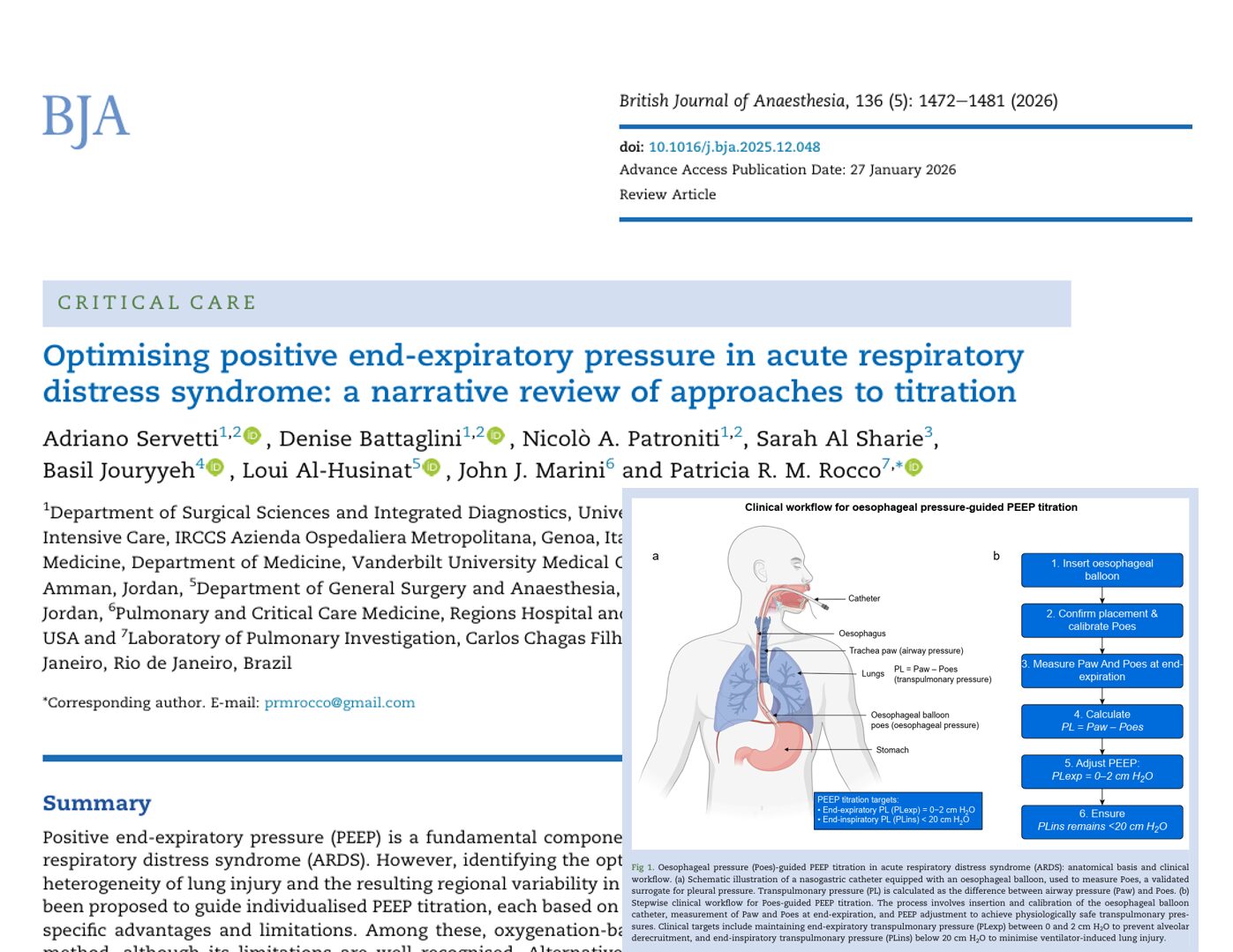
- Transpulmonary pressure
- Electrical impedance tomography
- Lung ultrasonography
- Driving pressure
Compliance-based titration was the most common approach. Twelve studies selected PEEP by targeting the highest respiratory compliance.
Other studies used oesophageal manometry to assess transpulmonary pressure, electrical impedance tomography to examine regional ventilation, or lung ultrasonography to identify atelectasis.
Four studies titrated PEEP specifically according to driving pressure.
Pulmonary complications fell from 19.3% to 12.4%
The primary outcome was postoperative pulmonary complications, including conditions sharing common pulmonary pathophysiology such as atelectasis, pneumonia, acute respiratory distress syndrome and pulmonary aspiration.
Seventeen studies involving 2,556 participants reported this outcome.
Postoperative pulmonary complications occurred in:
- 12.4% of patients receiving individualised PEEP (161/1,298)
- 19.3% of patients receiving lung-protective ventilation with fixed PEEP (243/1,258)
Individualised PEEP was associated with a 33% relative reduction in risk:
RR 0.67; 95% CI 0.56–0.79
Statistical heterogeneity was very low (I²=0.4%).
Benefits appeared in abdominal and thoracic surgery
The association was not restricted to one type of minimally invasive surgery.
Among patients undergoing abdominal surgery, postoperative pulmonary complications occurred in 15.0% of the individualised PEEP group compared with 22.5% of the conventional lung-protective ventilation group.
The pooled risk ratio was 0.69 (95% CI 0.56–0.85).
For thoracic surgery, complications occurred in 9.7% versus 15.4%, respectively, corresponding to a risk ratio of 0.62 (95% CI 0.46–0.84).
There was no statistically significant difference between the abdominal and thoracic subgroups.
Individualised PEEP lowered driving pressure
A major physiological finding concerned driving pressure.
Among studies reporting this measurement, weighted mean driving pressure was:
- 11.47 cm H₂O with individualised PEEP
- 14.24 cm H₂O with lung-protective ventilation
Individualised PEEP was associated with a mean reduction in driving pressure of approximately 3.17 cm H₂O.
Individualisation generally required higher PEEP
Lower driving pressure did not mean that airway pressures were universally lower.
In fact, individualised strategies used substantially more PEEP.
Across 29 studies, individualised PEEP was approximately 7 cm H₂O higher than fixed PEEP, with a pooled mean difference of 7.13 cm H₂O.
In abdominal surgery, PEEP in the individualised groups ranged from 9.7 to 16.9 cm H₂O, compared with 3.9 to 9.1 cm H₂O in the conventional groups.
In thoracic surgery, individualised PEEP ranged from 5.9 to 12.9 cm H₂O, compared with approximately 5.0 cm H₂O in conventional ventilation.
The authors emphasise that higher PEEP can recruit collapsed alveoli and improve compliance. Consequently, plateau pressure can increase while driving pressure decreases.
Indeed, individualised PEEP was associated with higher plateau pressure despite improved respiratory compliance.
Atelectasis and hypoxemia were also reduced
Several secondary respiratory outcomes favoured individualised PEEP.
The meta-analysis found associations with:
- Less atelectasis: RR 0.60 (95% CI 0.40–0.89)
- Less hypoxemia: RR 0.48 (95% CI 0.35–0.66)
- Improved respiratory-system compliance
- Higher PaO₂/FIO₂ ratios
The authors propose that improved alveolar recruitment may help explain these findings. Restoring functional lung volume could decrease atelectasis, reduce intrapulmonary shunting and consequently improve oxygenation.
However, individualised PEEP was not associated with statistically demonstrated reductions in pulmonary infection, supplemental oxygen requirements or hospital length of stay.
What could this mean for clinical practice?
The results suggest that intraoperative ventilation may benefit from being tailored to the patient’s respiratory physiology rather than relying exclusively on a predetermined PEEP value.
A practical approach examined frequently in the included literature was:
- Use lung-protective tidal volumes of approximately 6–8 ml kg−1 as specified by the studies in this review.
- Assess respiratory mechanics during mechanical ventilation.
- Titrate PEEP individually using an established physiological method.
- Evaluate compliance and driving pressure rather than interpreting PEEP or plateau pressure in isolation.
- Reassess after physiological changes, such as pneumoperitoneum or changes in surgical positioning.
These steps describe the approaches evaluated in the literature and should not be interpreted as a universal clinical protocol or patient-specific recommendation. The review did not establish a single optimal PEEP value or driving-pressure threshold.
Important limitations remain
Despite encouraging findings, several limitations prevent the results from proving that individualised PEEP itself causes better postoperative outcomes.
Most studies were randomised trials, but three observational studies were included. However, restricting the analysis to randomised controlled trials produced a similar association with postoperative pulmonary complications.
The individualisation methods also varied considerably. Most of the evidence was driven by compliance-based strategies, while comparatively little evidence was available for approaches based on electrical impedance tomography, ultrasound or driving pressure alone.
There was substantial statistical heterogeneity for several physiological outcomes, including driving pressure, PEEP, compliance and oxygenation.
The investigators also had only study-level rather than individual-patient driving-pressure data. Consequently, the meta-analysis cannot establish an optimal driving-pressure threshold for minimally invasive surgery.
Finally, many endpoints were physiological or surrogate outcomes. The authors call for future studies focusing on clinically important and patient-relevant outcomes.
The bottom line
This systematic review provides evidence that individualising PEEP during minimally invasive abdominal and thoracic surgery is associated with fewer postoperative pulmonary complications and lower driving pressure than conventional lung-protective ventilation using fixed PEEP.
The findings were accompanied by reductions in atelectasis and hypoxemia and improvements in respiratory compliance and oxygenation.
However, the evidence for the primary outcome was rated as moderate, individualisation strategies varied between studies, and causality remains uncertain.
The results therefore support further investigation of patient-specific intraoperative ventilation, particularly easily implemented compliance-based PEEP titration, while highlighting the need for larger trials examining clinically meaningful outcomes.
Reference: Abbott M et al. Individualised positive end-expiratory pressure to minimise driving pressure and postoperative pulmonary complications in minimally invasive thoracic and abdominal surgery a systematic review and meta-analysis. Br J Anaesth. 2026;137:231-243.
Read more about recent evidence like this in NYSORA’s Anesthesia Assistant app. Simulate case, check dosages and search through NYSORA knowledge database!