 Nerve Blocks App
 Anesthesia Assistant App
 Ultrasound Pain App
 Pain Medicine Assistant App
 POCUS App
 IV Access App
 MSK Knee App
 VetRA App
 Nerve Block Manual
 Regional Anesthesia Updates
 Anesthesiology Manual
 Anesthesiology Review
 Anesthesia Updates 2025
 Anesthesia Updates 2026
 Pediatric Anesthesia Updates
 Airway Management Updates
 US Interventional Pain Manual
 Pain Medicine Updates
 Mastering Difficult IV Access
 PACU Nursing Manual
 RA Veterinary Manual
 Books
Books About
About
 Back to News
 9 min read
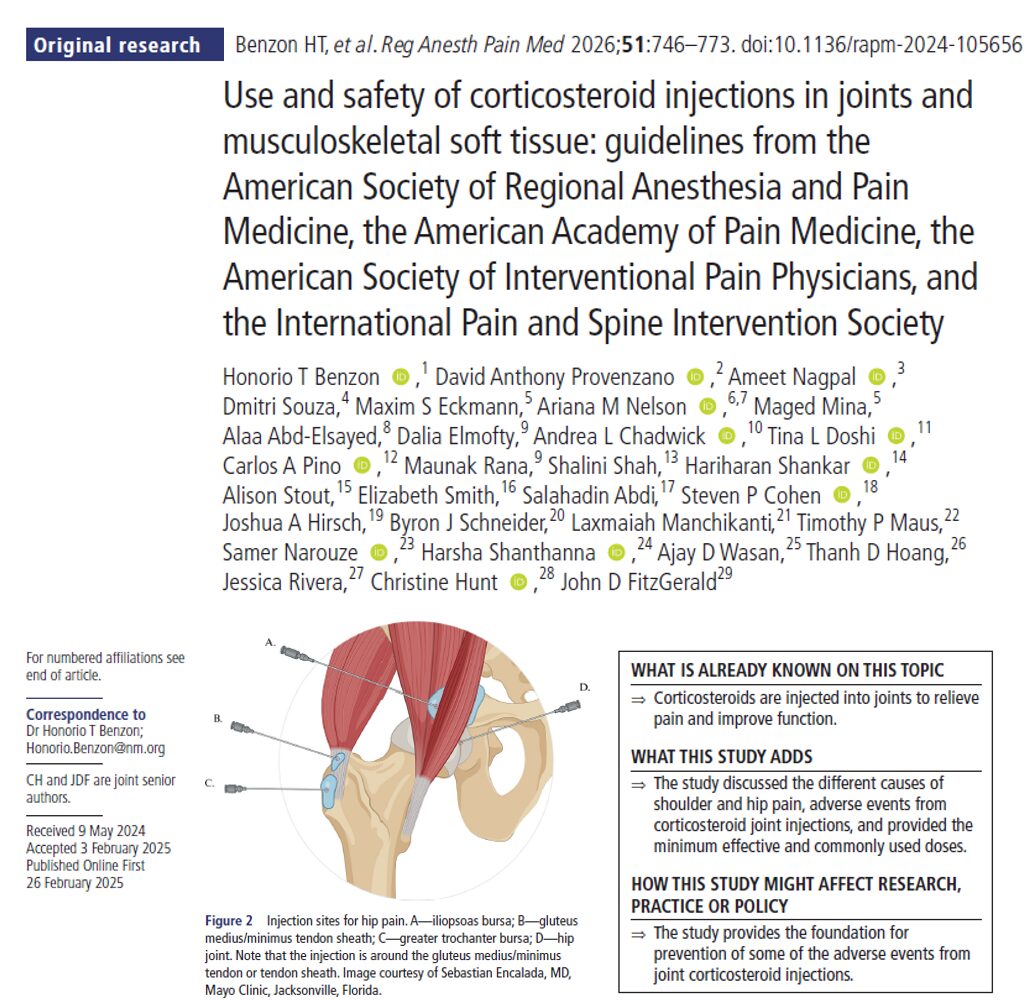
New multidisciplinary guidelines published in Regional Anesthesia & Pain Medicine provide detailed recommendations for the use and safety of corticosteroid injections in adults with chronic joint and musculoskeletal pain. The guideline was developed by experts representing ASRA Pain Medicine, the American Academy of Pain Medicine, the American Society of Interventional Pain Physicians, and the International Pain and Spine Intervention Society.
Covering injections of the shoulder, elbow, hip, knee, wrist, hand, and other small joints, the recommendations reinforce that corticosteroid injections can provide meaningful short-term pain relief, but higher doses and repeated injections do not necessarily produce better outcomes and may increase adverse effects.
A central message is to use the lowest effective corticosteroid dose, individualize repeat injections, and use imaging when it meaningfully improves accuracy or safety. Ultrasound guidance generally increases injection accuracy and can reduce procedural pain, while corticosteroid-related risks include hyperglycemia, adrenal suppression, cartilage damage, reduced bone mineral density, and postoperative joint infection.
Why corticosteroid injection practice is changing
Intra-articular corticosteroid (IACS) injections are widely used after conservative treatment fails to adequately control musculoskeletal pain.
They can reduce inflammation and pain, improve function, facilitate rehabilitation, or provide temporary symptom control while patients await definitive treatment such as surgery.
However, the guideline highlights an important problem: doses routinely administered in clinical practice may exceed the minimum required for therapeutic benefit.
Potential adverse effects include:
- Hyperglycemia
- Hypothalamic-pituitary-adrenal axis suppression
- Cartilage damage
- Reduced bone mineral density
- Postinjection pain and swelling
- Skin depigmentation and lipoatrophy
- Superficial or intra-articular infection
- Tendon injury or rupture in certain peritendinous applications
- Increased risk of postoperative joint infection under certain circumstances
This shifts the clinical question from simply whether corticosteroids work to how they can be used at the lowest effective exposure while maintaining benefit.
How long does pain relief last?
The guideline concludes that corticosteroid joint injections primarily provide short-term symptomatic relief.
Across different joints and conditions, improvement generally lasts from a few weeks to several months. The magnitude and duration depend on the underlying pathology, injection location, corticosteroid preparation, and patient characteristics.
For knee osteoarthritis, much of the evidence shows benefit in the first several weeks after injection, while sustained long-term superiority over other treatments remains unclear.
For hip injections, the guideline characterizes IACS as providing approximately 4–12 weeks of pain relief.
Shoulder corticosteroid injections can provide short-term improvements in pain and disability, particularly for conditions such as adhesive capsulitis, subacromial bursitis, shoulder impingement, and rotator cuff tendinopathy.
Lower doses may be enough
One of the most clinically important recommendations concerns corticosteroid dose.
For shoulder injections, studies found no meaningful advantage from routinely increasing the corticosteroid dose.
The guideline recommends an initial shoulder corticosteroid dose not exceeding the equivalent of 20 mg of triamcinolone or methylprednisolone.
Evidence reviewed by the authors showed:
- 20 mg triamcinolone can be as effective as 40 mg for shoulder IACS
- 20 mg can also be as effective as 40 mg for subacromial-subdeltoid bursa injections
- 40 mg triamcinolone is as effective as 80 mg for knee IACS
- 40 mg triamcinolone or methylprednisolone is commonly used for hip IACS
- 20 mg triamcinolone is favored over 5 or 10 mg for trigger finger injections
The findings challenge the assumption that escalating the steroid dose necessarily produces stronger or longer analgesia.
Ultrasound improves injection accuracy
Another major theme is the expanding role of image guidance.
The guideline concludes with high certainty that ultrasound-guided techniques produce more accurate intra-articular needle placement than landmark-based techniques.
Ultrasound enables clinicians to visualize:
- Joint spaces
- Tendons and tendon sheaths
- Bursae
- Blood vessels
- Surrounding soft tissues
- Needle position
- Injectate distribution
Image guidance may also decrease injection pain, improve patient satisfaction, and improve short-term outcomes in selected procedures.
However, greater accuracy does not automatically translate into superior long-term clinical outcomes.
The guideline therefore recommends selecting image guidance according to the anatomy, procedure, clinician expertise, and patient characteristics. Image guidance may be particularly useful when anatomical landmarks are difficult to identify, including in patients with obesity.
Shoulder injections
Corticosteroid injections remain an important option for selected painful shoulder disorders.
The guideline supports short-term use for:
- Adhesive capsulitis
- Subacromial-subdeltoid bursitis
- Shoulder impingement syndrome
- Rotator cuff tendinitis or tendinopathy
- Selected biceps tendon disorders
- Glenohumeral and acromioclavicular joint pain
For moderate-to-severe symptoms that have not responded adequately to conservative treatment, shoulder CSI can improve pain and disability for approximately 8 weeks.
Importantly, the guideline recommends combining injections with physical therapy or home exercises rather than treating injections as a stand-alone treatment.
Hip injections
Hip IACS can be used for both diagnostic and therapeutic purposes in patients with osteoarthritis.
The guideline recommends considering 40 mg triamcinolone or an equivalent corticosteroid dose for an intra-articular hip injection.
It also recommends a screening hip X-ray before IACS to establish baseline pathology and identify conditions such as osteonecrosis that could influence the decision to inject.
Potential hip-related complications deserve particular attention. The guideline identifies concerns, including:
- Accelerated cartilage loss
- Subchondral insufficiency fracture
- Osteonecrosis
- Rare rapid joint destruction
Consequently, clinicians are advised to be cautious with high corticosteroid doses and multiple injections.
For greater trochanteric pain syndrome, education and exercise remain particularly important. At one-year follow-up, education plus exercise may yield greater global improvement than corticosteroid injection alone, although pain relief may be similar.
Knee injections
Knee osteoarthritis is one of the most common indications for IACS.
The guideline recommends using the lowest effective corticosteroid dose and increasing the interval between repeat injections whenever possible.
For triamcinolone acetonide, the recommended initial maximum knee dose is 40 mg, or an equivalent dose of another particulate corticosteroid.
Increasing the dose to 80 mg has not demonstrated superior pain relief or functional improvement.
Ultrasound guidance also has practical advantages for knee procedures. Studies reviewed by the guideline found that ultrasound-guided aspiration and injection can produce:
- Greater injection accuracy
- Less procedural pain
- Greater synovial fluid aspiration
- More complete joint decompression
- Better short-term clinical outcomes
- Greater patient satisfaction
Repeated injections raise cartilage concerns
One of the guideline’s most important safety discussions involves repeated knee injections.
Basic science and animal research suggests that several commonly used corticosteroids can have dose-dependent detrimental effects on cartilage.
More importantly, a randomized, placebo-controlled trial involving repeated 40 mg triamcinolone injections every 12 weeks for two years demonstrated greater cartilage volume loss than saline injections without a corresponding improvement in pain.
The guideline consequently recommends minimizing corticosteroid exposure rather than scheduling indefinite injections automatically.
Repeat injections should be based on the patient’s response, recurrence of clinically important symptoms, cumulative corticosteroid exposure, and individual risk factors.
How frequently should injections be repeated?
There is no universally established yearly or lifetime maximum number of corticosteroid joint injections.
The guideline discusses a suggested minimum interval of approximately 2–3 weeks up to 3 months, depending on the clinical circumstances, pharmacology, previous response, and adverse-event risk.
In practice, repeat injections should stop when:
- Acceptable or complete pain relief has been achieved.
- Additional injections no longer provide meaningful improvement.
- The duration or magnitude of benefit progressively declines.
- Cumulative corticosteroid exposure becomes concerning.
- Patient-specific risks begin to outweigh expected benefit.
A patient and clinician should therefore make the repeat-injection decision together rather than following an automatic injection schedule.
Small joints, wrist, and hand injections
The recommendations vary considerably according to the underlying disorder.
For rheumatoid arthritis affecting the small joints of the hands and wrists, IACS may be used as adjunctive treatment to decrease pain, improve function, and reduce inflammation.
The evidence is less favorable for osteoarthritis of certain hand joints.
The guideline reports that corticosteroid injection does not provide consistent short- or long-term improvement for carpometacarpal osteoarthritis.
For trigger finger, corticosteroid injection can provide short- to intermediate-term benefit, and 20 mg triamcinolone appears more effective than 5 or 10 mg during earlier follow-up.
For De Quervain’s tenosynovitis, combining corticosteroid injection with a thumb splint can improve outcomes.
Plantar heel pain is an important exception
The guideline makes a distinction between non-inflammatory plantar heel pain and heel pain associated with rheumatic inflammatory disease.
For non-inflammatory plantar heel pain, corticosteroid injections are not recommended because available evidence does not demonstrate superiority over placebo injections.
Potential complications include plantar fascia rupture and fat-pad atrophy.
In contrast, corticosteroid injection may be considered for plantar heel pain associated with inflammatory rheumatic diseases such as spondyloarthritis when conservative measures have failed.
Tendon injections require caution
Corticosteroid injection near tendons requires particular care.
Historical reports have documented tendon rupture following corticosteroid injections, including rupture of the long head of the biceps.
The concern is especially relevant when corticosteroid is injected into the tendon itself rather than around the tendon or tendon sheath.
For long-head biceps procedures, the guideline strongly favors ultrasound guidance over landmark techniques because ultrasound improves accuracy and allows clinicians to visualize the tendon and nearby vascular anatomy.
What about patients taking anticoagulants?
Peripheral joint injections are generally considered low bleeding-risk procedures.
The guideline cites evidence showing very low rates of clinically significant bleeding in patients receiving therapeutic anticoagulation.
For patients taking anticoagulant or antiplatelet therapy who do not have additional major coagulopathic risk factors, ASRA Pain Medicine guidance supports continuing treatment for low-risk procedures such as peripheral joint injections rather than routinely interrupting therapy.
Individual bleeding risk still requires clinical assessment.
Clinical implications
Clinicians considering corticosteroid joint or soft-tissue injections should:
- Identify the specific pain generator and establish an appropriate diagnosis.
- Start with conservative therapies when clinically appropriate.
- Use the lowest corticosteroid dose demonstrated to be effective.
- Select image guidance when it improves accuracy or procedural safety.
- Combine injections with rehabilitation, exercise, or education where evidence supports it.
- Avoid unnecessary or automatically scheduled repeat injections.
- Consider cumulative corticosteroid exposure and systemic adverse effects.
- Evaluate glucose-related risks, particularly in patients with diabetes.
- Consider cartilage, tendon, and bone effects when planning repeated treatment.
- Account for future joint surgery when determining injection timing.
Conclusion
The new multidisciplinary guideline supports corticosteroid injections as a useful but primarily short-term intervention for carefully selected patients with joint and musculoskeletal pain.
Perhaps its most important message is that more corticosteroid is not necessarily better.
Lower effective doses, appropriate injection intervals, accurate identification of the pain generator, selective use of ultrasound guidance, and integration with physical therapy or exercise can help maximize benefit while reducing unnecessary corticosteroid exposure.
The recommendations also highlight clinically important risks, including hyperglycemia, adrenal suppression, cartilage loss, reduced bone mineral density, tendon injury, and postoperative joint infection, that should be considered when deciding whether and when to repeat treatment.
Reference:
Benzon HT, Provenzano DA, Nagpal A, et al. Use and safety of corticosteroid injections in joints and musculoskeletal soft tissue: guidelines from the American Society of Regional Anesthesia and Pain Medicine, the American Academy of Pain Medicine, the American Society of Interventional Pain Physicians, and the International Pain and Spine Intervention Society. Reg Anesth Pain Med. 2026;51(7):746-773.
Explore NYSORA’s Ultrasound Pain App for guidance on intra-articular steroid injections.