 Nerve Blocks App
 Anesthesia Assistant App
 Ultrasound Pain App
 Pain Medicine Assistant App
 POCUS App
 IV Access App
 MSK Knee App
 VetRA App

 Nerve Block Manual 2027
 Nerve Block Manual
 Regional Anesthesia Updates
 Anesthesiology Manual
 Anesthesiology Review
 Anesthesia Updates 2025
 Anesthesia Updates 2026
 Pediatric Anesthesia Updates
 Airway Management Updates
 US Interventional Pain Manual
 Pain Medicine Updates
 Mastering Difficult IV Access
 PACU Nursing Manual
 RA Veterinary Manual
 Books
 About

 Back to News
 9 min read
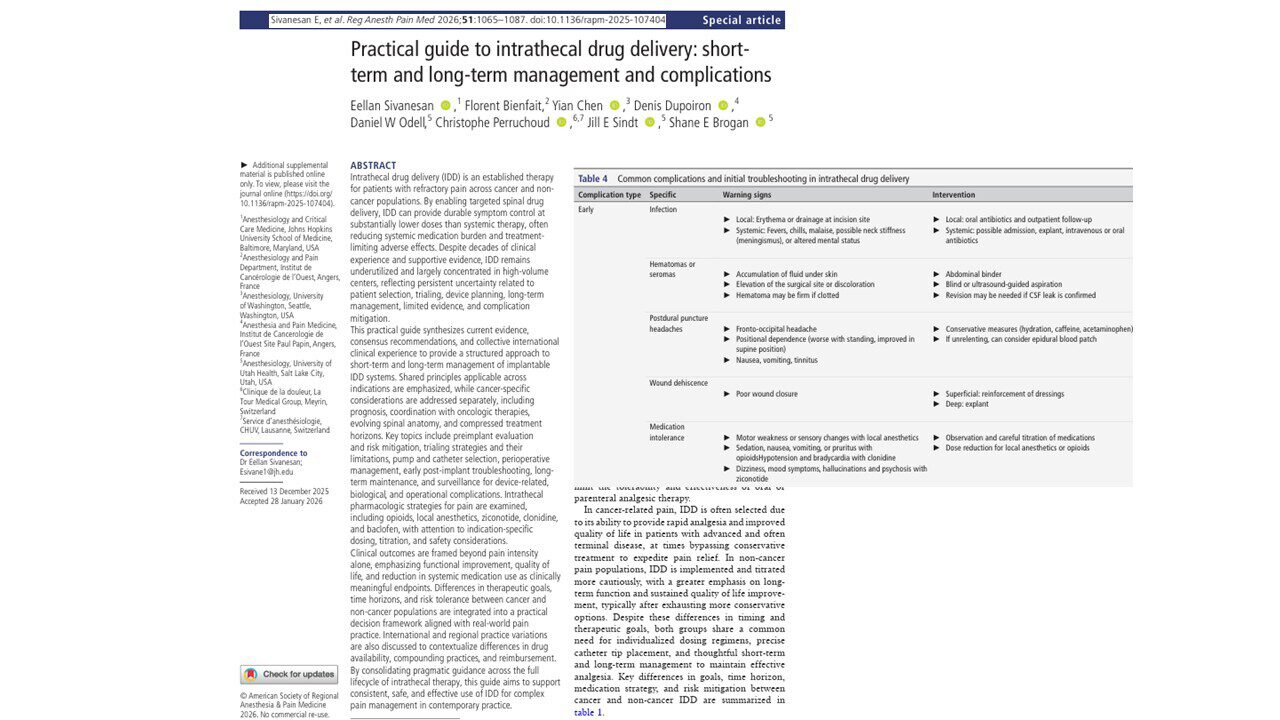
Intrathecal drug delivery (IDD) has been used for more than four decades to manage refractory cancer and non-cancer pain. By delivering medication directly into the cerebrospinal fluid (CSF), close to the spinal cord targets involved in pain transmission, IDD can achieve meaningful analgesia using substantially lower doses than systemic therapy. This can reduce systemic medication burden and treatment-limiting adverse effects. Yet despite decades of experience and supportive evidence, intrathecal therapy remains relatively underused and is often concentrated in specialized, high-volume centers.
Why? The challenge is not simply inserting a pump. Successful IDD requires decisions throughout the entire treatment pathway: selecting the right patient, determining whether and how to perform a trial, choosing a pump and catheter location, selecting and titrating medication, managing refills, monitoring long-term efficacy, and recognizing complications before they become serious.
A 2026 article by Sivanesan and colleagues in Regional Anesthesia and Pain Medicine addresses these challenges with a comprehensive practical guide to short- and long-term intrathecal therapy. Importantly, the authors distinguish between cancer and non-cancer pain, where treatment goals, acceptable risk, speed of titration, and expected duration of therapy may be fundamentally different.
Rather than reporting a new randomized trial, this special article synthesizes current evidence, consensus recommendations, and international clinical experience to provide a practical framework covering the complete lifecycle of implantable IDD therapy.
The guide addresses:
- Patient selection and preimplant evaluation
- Risk mitigation before implantation
- Intrathecal trialing and its limitations
- Pump and catheter selection
- Pharmacologic strategies and dosing
- Perioperative and early postimplant management
- Long-term refills and maintenance
- Device, biological, medication, and operational complications
- Cancer-specific considerations, including prognosis and coordination with oncologic treatment.
This broad approach makes the paper a useful clinical reference, not simply an evaluation of one intervention.
Key findings
- Cancer and non-cancer pain require different treatment strategies
One of the most useful distinctions in the review is between IDD for cancer and non-cancer pain.
For chronic non-cancer pain, patients may live with an implanted system for decades. Treatment therefore emphasizes sustained analgesia, improved physical function and quality of life, low effective drug concentrations, careful titration, and long-term risk reduction. Patients should understand that the realistic goal is sustained pain reduction and improved function—not necessarily complete elimination of pain.
Cancer pain often requires a different approach. Rapid analgesia may take priority, particularly in advanced disease, and clinicians may need to titrate medications more aggressively or introduce adjuncts earlier. Treatment must also be coordinated with chemotherapy, immunotherapy, radiation, and surgery.
However, the distinction is increasingly fluid. Improvements in cancer treatment mean that some patients transition from advanced disease into long-term survivorship, requiring their IDD strategy to shift toward a chronic-pain model.
- Patient selection extends beyond the pain diagnosis
The review describes a broad range of potential indications, including persistent spinal pain syndrome, complex regional pain syndrome, peripheral neuropathic pain, spinal cord injury pain, chronic low-back and radicular pain, pelvic pain, phantom limb pain, and selected headache and facial pain disorders.
But diagnosis alone does not determine suitability.
In non-cancer pain, psychosocial assessment, adherence, realistic expectations, functional goals, and the patient’s ability to participate in long-term pump maintenance are important. In cancer, prognosis, changing anatomy, treatment schedules, hematologic status, and anticipated refill requirements become particularly relevant.
Preimplant opioid exposure is another key consideration. Opioid-tolerant patients may require higher initial intrathecal doses and a gradual transition away from systemic opioids, whereas opioid-naïve patients may respond to much lower doses and require particularly cautious titration.
- Trialing is less straightforward than it may appear
Intrathecal therapy can be trialed using single injections, bolus techniques, or continuous infusions. However, evidence has not established one method as superior for predicting long-term success.
The review notes that the updated 2024 PACC recommendations for non-cancer pain found no evidence that continuous and bolus trials differ in their ability to predict long-term outcomes. The choice should therefore consider the individual patient, comorbidities, available monitoring, provider experience, and resources.
Even more importantly, trialing in cancer pain is controversial. There is no prospective evidence supporting routine trialing in this population, and trials can delay definitive therapy, require longer interruption of anticoagulation, add procedural risk, and increase costs. The authors therefore describe trialing in cancer pain as discretionary rather than universally necessary.
Trial success should also extend beyond a numerical pain score. Functional improvement, activity-related pain, sleep, quality of life, and tolerability can help determine whether an apparently borderline response is actually clinically meaningful.
- Where you deliver the drug matters
Intrathecal therapy is targeted therapy—and catheter positioning should reflect that.
CSF drug distribution is limited, and the pharmacokinetic properties of individual agents affect how far they spread. Hydrophilic opioids such as morphine and hydromorphone have greater CSF residence time and broader rostrocaudal spread, whereas lipophilic drugs such as fentanyl undergo rapid tissue uptake and have more limited longitudinal spread.
For localized pain, catheter placement near the relevant spinal segments may permit effective analgesia at lower doses. More diffuse or multifocal pain may favor a higher thoracic catheter position and agents capable of wider distribution.
In other words, plan drug selection and catheter location together rather than as independent decisions.
- Medication selection requires individualized dosing
The review discusses morphine, hydromorphone, fentanyl, bupivacaine, ziconotide, clonidine, and baclofen, emphasizing that each has different pharmacologic and safety characteristics.
For example, PACC recommendations cited by the authors suggest initial single-agent doses of 0.1–0.5 mg/day for morphine and 0.5–2.4 μg/day for ziconotide. Ziconotide requires particularly careful, slow titration because neuropsychiatric adverse effects can occur. An advantage is that it can be stopped without producing a withdrawal syndrome.
Bupivacaine is frequently used as an adjunct. Although comparative evidence for efficacy remains limited, it may help reduce opioid dose escalation, and PACC recommendations cited in the article suggest 0.5–6 mg/day as part of a first-line multidrug regimen for selected localized nociceptive or neuropathic non-cancer pain.
The broader principle is more important than any single starting dose: start conservatively, titrate deliberately, and match the drug to the patient’s pain phenotype, anatomy, previous opioid exposure, and treatment goals.
Long-term management: the pump is not “set and forget”
Implantation marks the beginning—not the end—of IDD management.
For non-cancer pain, clinicians must balance analgesia and function against medication tolerance, granuloma risk, refill frequency, battery longevity, and future pump replacement. Cancer pain may require much more frequent reassessment because disease progression can rapidly alter pain intensity and distribution.
Catheter complications are particularly important. Manufacturer registry data cited in the review suggest an overall catheter complication incidence of approximately 14%, including occlusion, dislodgement, kinking, fracture, and disconnection. These failures may cause loss of analgesia, withdrawal, CSF leakage, or extrathecal medication delivery.
Pump function must also be actively monitored. Batteries generally last approximately 5–10 years depending on the device and therapy. Critically, the authors emphasize comparing the actual reservoir volume retrieved at every refill with the expected volume. A discrepancy may be an early clue to underdelivery or overdelivery because available devices do not directly measure delivery pressure.
Clinical implications
This review reframes IDD as a longitudinal treatment program rather than simply an implantable device.
Successful treatment begins with defining what success means for the individual patient. For a patient with chronic non-cancer pain, a modest reduction in pain accompanied by substantial improvements in mobility, sleep, and daily function may be more meaningful than a large reduction in a numerical pain score without functional improvement. For advanced cancer, the priority may instead be rapid analgesia, reduced systemic medication burden, and the ability to continue oncologic treatment.
The review also highlights the importance of multidisciplinary care. Pain physicians may need to coordinate with oncology, rehabilitation, infectious disease, addiction medicine, pharmacy, and other specialties depending on the patient’s circumstances.
Clinical pearls
- Think beyond pain scores. Function, quality of life, systemic medication reduction, and treatment sustainability are meaningful outcomes.
- Match catheter position to pain distribution and drug pharmacology. Intrathecal medications do not distribute uniformly throughout the CSF.
- Do not assume a mandatory trial predicts long-term success. No trialing technique has demonstrated clear superiority, and routine trialing may be unnecessary in selected cancer patients.
- Cancer and non-cancer pain should not automatically follow the same titration strategy. The therapeutic time horizon and urgency differ fundamentally.
- At every refill, compare aspirated volume with expected reservoir volume. Unexpected discrepancies may reveal underdelivery or overdelivery.
- Treat sudden loss of analgesia as a possible system failure. Consider catheter kinking, fracture, migration, occlusion, disconnection, or pump malfunction in the differential.
- Never underestimate withdrawal. An unexpectedly empty pump or abrupt interruption of opioid, baclofen, or clonidine therapy can have serious consequences.
- Standardize refill workflows. Double-checking drug concentration and volume and using structured protocols can prevent avoidable programming and medication errors.
Conclusion
Intrathecal drug delivery can provide durable analgesia while reducing systemic medication exposure in carefully selected patients with refractory cancer and non-cancer pain. But the benefits depend on much more than successful pump implantation.
Sivanesan and colleagues emphasize a lifecycle approach: select carefully, define meaningful treatment goals, target drug delivery anatomically, titrate according to the clinical context, and actively monitor the system over time. Cancer and non-cancer pain may require markedly different strategies, and successful treatment should be judged by function and quality of life as well as pain relief.
Perhaps the most practical takeaway is that IDD is not a passive therapy. Pumps, catheters, medications, refill schedules, and patient needs all change over time. Consistent surveillance and standardized workflows are therefore as important to long-term success as choosing the right drug at implantation.
For more information, refer to the full article in RAPM.
Sivanesan E, Bienfait F, Chen Y, Dupoiron D, Odell DW, Perruchoud C, Sindt JE, Brogan SE. Practical guide to intrathecal drug delivery: short-term and long-term management and complications. Reg Anesth Pain Med. 2026 Sep 8;51(9):1065-1087.
Read more about neuraxial anesthesia in our Textbook of Regional Anesthesia on NYSORA360 – an essential learning resource for residents with practical, up-to-date guidance.