 Nerve Blocks App
 Anesthesia Assistant App
 Ultrasound Pain App
 Pain Medicine Assistant App
 POCUS App
 IV Access App
 MSK Knee App
 VetRA App
 Nerve Block Manual
 Regional Anesthesia Updates
 Anesthesiology Manual
 Anesthesiology Review
 Anesthesia Updates 2025
 Anesthesia Updates 2026
 Pediatric Anesthesia Updates
 Airway Management Updates
 US Interventional Pain Manual
 Pain Medicine Updates
 Mastering Difficult IV Access
 PACU Nursing Manual
 RA Veterinary Manual
 Books
Books About
About

Learning objectives
- Describe the mechanisms & symptoms of Wolff-Parkinson-White Syndrome
- Manage patients with Wolff-Parkinson-White Syndrome
Definition & mechanisms
- Wolff-Parkinson-White Syndrome (WPW) is a congenital abnormality that involves the presence of abnormal electrical conductive circuits between the atria and ventricles, resulting in accessory electrical pathways that bypass the AV node
- Can result in life-threatening arrhythmias
Signs & symptoms
| Electrocardiographic signs | Short PR interval |
| Prolonged QRS |
|
| Initial slurring upstroke (“delta” wave) in the presence of sinus rhythm |
|
| Clinical symptoms | Palpitations |
| Episodic lightheadedness |
|
| Presyncope |
|
| Syncope |
|
| Cardiac arrest |
Management
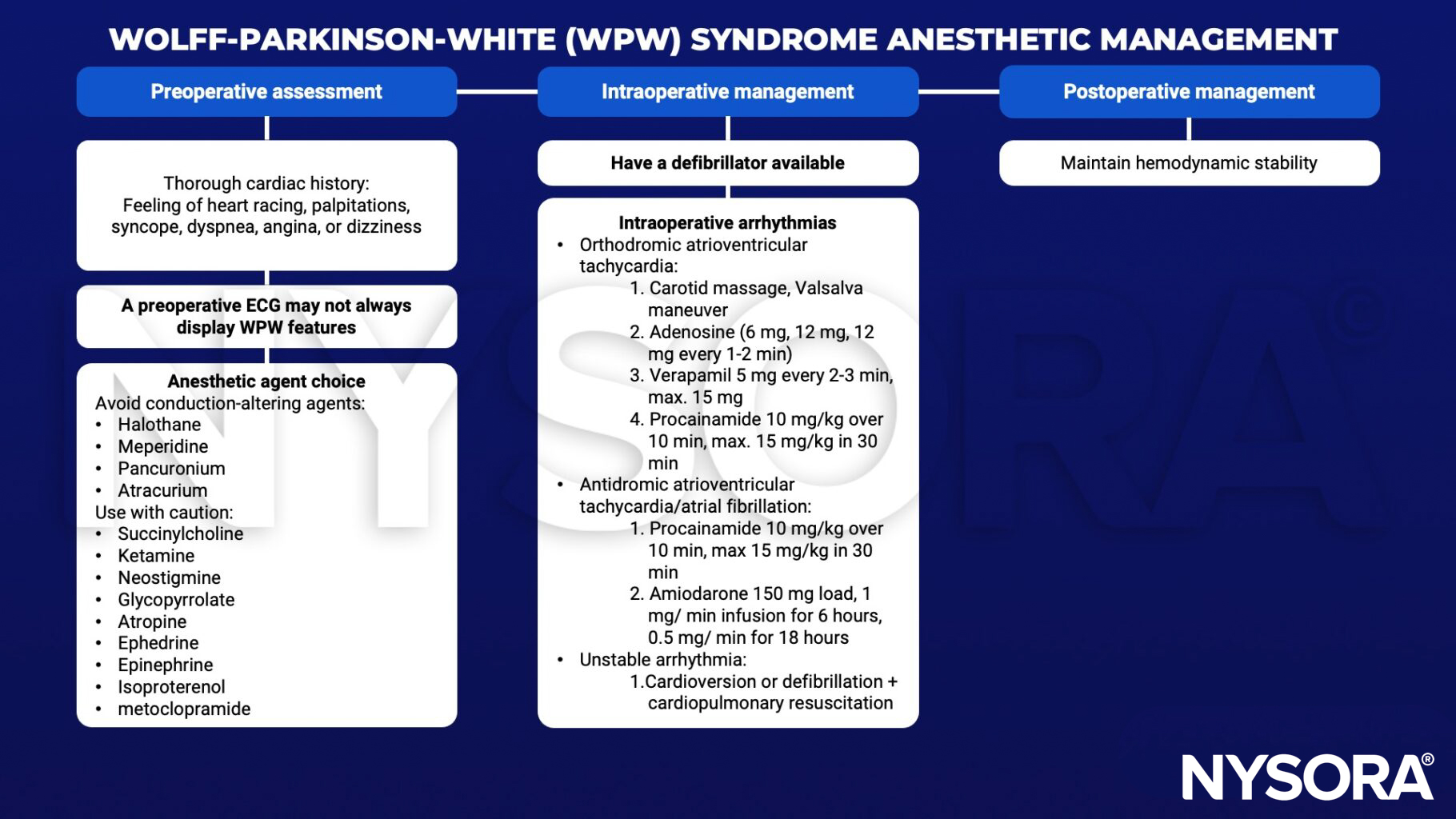
Suggested reading
- Bengali R, Wellens HJ, Jiang Y. Perioperative management of the Wolff-Parkinson-White syndrome. J Cardiothorac Vasc Anesth. 2014;28(5):1375-1386.