 Nerve Blocks App
 Anesthesia Assistant App
 Ultrasound Pain App
 Pain Medicine Assistant App
 POCUS App
 IV Access App
 MSK Knee App
 VetRA App

 Nerve Block Manual
 Regional Anesthesia Updates
 Anesthesiology Manual
 Anesthesiology Review
 Anesthesia Updates 2025
 Anesthesia Updates 2026
 Pediatric Anesthesia Updates
 Airway Management Updates
 US Interventional Pain Manual
 Pain Medicine Updates
 Mastering Difficult IV Access
 PACU Nursing Manual
 RA Veterinary Manual
 Books
 About

 Back to News
 8 min read
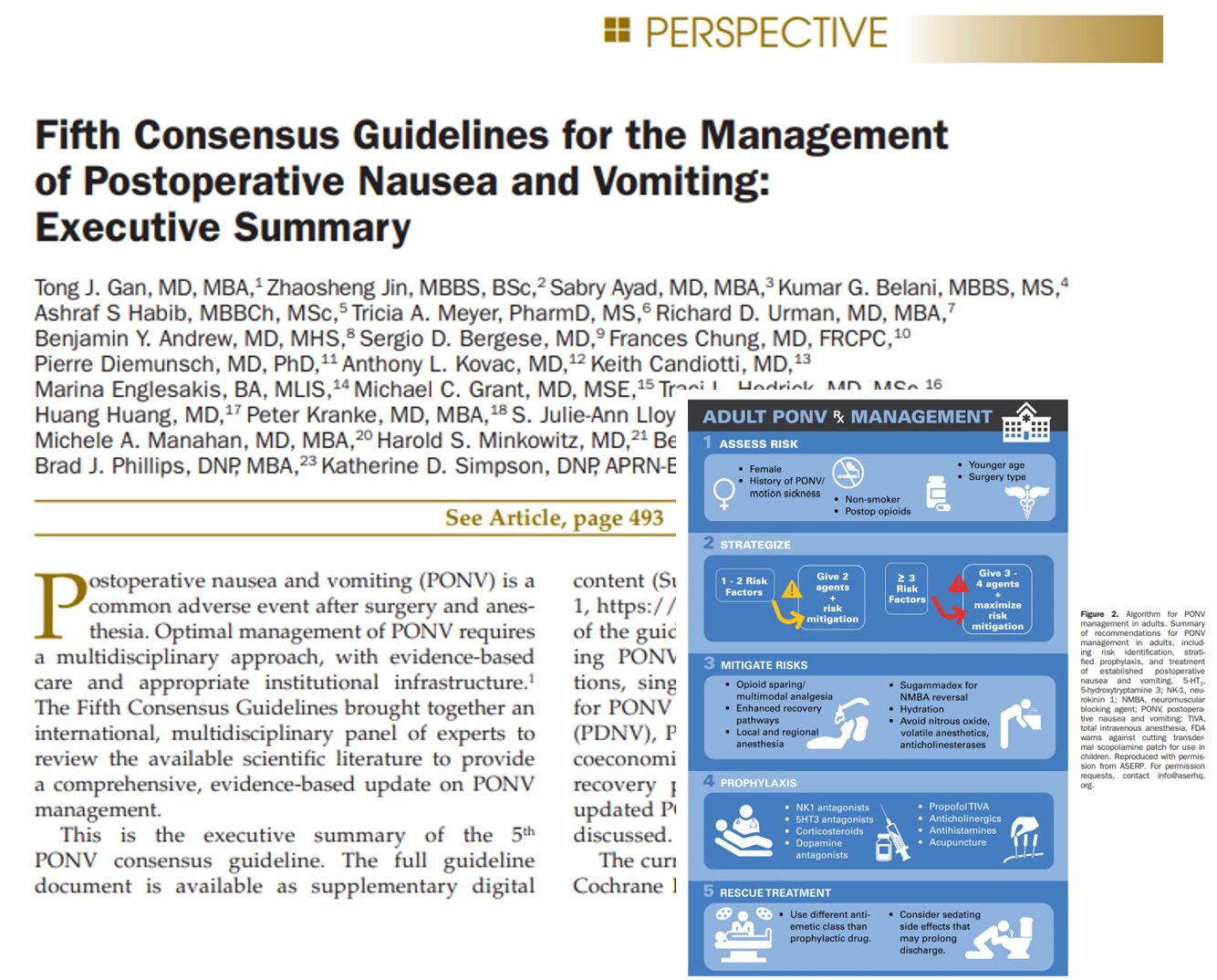
Postoperative nausea and vomiting (PONV) remains one of the most common adverse events following surgery and anesthesia. The newly published Fifth Consensus Guidelines for the Management of Postoperative Nausea and Vomiting provide an extensive update to prevention, risk assessment, rescue therapy and management in both adults and children.
Published in the September 2026 issue of Anesthesia & Analgesia, the executive summary was developed by an international, multidisciplinary expert panel. The recommendations were prepared using the Cochrane Handbook methodology, PRISMA 2020 and PRISMA-S, with evidence graded according to the system used in the American Society of Anesthesiologists’ acute pain management practice guideline.
One of the most important messages is a continued shift toward multimodal prevention rather than waiting for PONV to develop.
What has changed in PONV prevention?
The guidelines recommend two prophylactic interventions for adults at any risk of PONV. Because most surgical patients have at least one risk factor, the panel supports a general multimodal approach rather than restricting combination prophylaxis to only the highest-risk patients.
For adults with three or more risk factors, the guideline’s management algorithm recommends three to four prophylactic agents alongside maximization of baseline risk-reduction strategies. However, the authors emphasize that evidence supporting three or more pharmacological prophylactic interventions remains limited.
Key principles include:
- Assess risk using validated risk factors and prediction tools
- Reduce baseline risk through anesthetic, analgesic and perioperative strategies
- Use multimodal prophylaxis, generally combining interventions with different mechanisms
- Treat breakthrough PONV with a different pharmacological class from the drugs used for prophylaxis
- Consider post-discharge risk, particularly after ambulatory surgery
- Integrate PONV prevention into enhanced recovery pathways
Identifying patients at risk
The guidelines continue to support validated risk assessment. For adults, the simplified Apfel score remains an important tool.
Its four principal risk factors are female sex, a history of PONV or motion sickness, nonsmoking status and postoperative opioid use.
The approximate PONV risk associated with zero, one, two, three and four factors is 10%, 20%, 40%, 60% and 80%, respectively.
The guideline categorizes patients with no Apfel factors as low risk, those with one or two as medium risk, and those with three or more as high risk.
Other factors can modify individual risk. The updated review discusses surgery type, hemodynamic management, physical status and several emerging laboratory or biological associations.
Higher-risk procedures include bariatric surgery, laparoscopic cholecystectomy, urological procedures and knee arthroplasty. Breast, gynecological and obstetric procedures have also been associated with increased PONV risk.
The authors nevertheless caution against simply adding numerous variables to existing prediction models, because doing so is unlikely to substantially improve prediction at the population level.
Reducing baseline PONV risk
Medication is only one component of PONV prevention. Anesthetic and analgesic choices can substantially influence baseline risk.
The guidelines support several approaches.
Propofol-based anesthesia
Propofol total intravenous anesthesia (TIVA) is an important risk-reduction strategy.
Propofol TIVA alone has a PONV risk comparable with volatile anesthesia combined with a 5-HT3 receptor antagonist or droperidol. Propofol TIVA and subhypnotic propofol infusion can also be combined with antiemetic interventions.
Opioid-sparing analgesia
Reducing perioperative opioid exposure is another important component.
Evidence-supported interventions discussed by the guideline include:
- Acetaminophen
- Ketamine
- Nonsteroidal anti-inflammatory drugs and cyclooxygenase-2 inhibitors
- Esmolol infusion
- Selected use of intravenous lidocaine
- Regional anesthesia and analgesia
Opioid-free anesthesia reduces PONV compared with opioid-based anesthesia, although the guideline notes that its relative benefit compared with contemporary multimodal opioid-sparing analgesia remains uncertain.
Regional anesthesia
Epidural analgesia can reduce PONV, although opioid-containing epidural mixtures are associated with greater PONV risk than local anesthetic preparations.
Other potentially useful techniques include transversus abdominis plane blocks, quadratus lumborum blocks and continuous wound infiltration.
Fluids and other interventions
Supplemental crystalloid administration reduces early and late PONV. Colloids may provide greater benefit during major operations lasting more than three hours.
Avoidance of nitrous oxide during maintenance anesthesia can also reduce risk.
Sugammadex is associated with lower incidence and severity of PONV, particularly in the post-anesthesia care unit (PACU).
In contrast, supplemental oxygen has not been demonstrated to reduce PONV risk.
Adults should receive multimodal PONV prophylaxis
A major recommendation in the fifth consensus guideline is a more liberal approach to PONV prevention. Adults with one or two PONV risk factors should receive two prophylactic agents together with appropriate baseline risk-reduction measures. For patients with three or more risk factors, the adult algorithm recommends three to four prophylactic agents and maximization of risk mitigation.
The two agents are not two universally prescribed drugs. Clinicians select an appropriate combination based on the patient, procedure, contraindications and the different mechanisms of available antiemetics.
Evidence-supported combinations include:
- 5-HT3 antagonist + dexamethasone, such as ondansetron plus dexamethasone
- NK-1 antagonist + 5-HT3 antagonist, such as aprepitant plus ondansetron
- NK-1 antagonist + dexamethasone
- 5-HT3 antagonist + droperidol, although the strength of evidence varies according to the specific agent
The guideline reports particularly robust evidence for combinations such as 5-HT3 receptor antagonists with dexamethasone. It also emphasizes baseline risk reduction through measures such as opioid-sparing multimodal analgesia, propofol-based TIVA where appropriate, regional anesthesia, adequate hydration and avoidance of nitrous oxide during maintenance anesthesia.
What should clinicians do when prophylaxis fails?
Breakthrough PONV requires a different approach.
The central rule is straightforward:
Use an antiemetic from a different pharmacological class than the prophylactic drug or drugs already administered.
If more than six hours have elapsed and alternatives are unavailable, another dose of a 5-HT3 receptor antagonist or butyrophenone may be considered.
Long-acting agents such as aprepitant, fosaprepitant and palonosetron should not routinely be redosed in the PACU. Transdermal scopolamine is also unsuitable as an acute rescue medication because of its slow onset.
For antiemetic-naive patients who develop PONV, ondansetron 4–8 mg and droperidol 1–1.25 mg are among the effective rescue options discussed in the guideline. Propofol 20–40 mg can also be effective as PONV treatment, although its clinical use must obviously be considered within an appropriately monitored anesthetic setting.
Post-discharge nausea and vomiting deserves greater attention
Post-discharge nausea and vomiting (PDNV) creates a particular challenge because patients no longer have immediate access to IV antiemetics and direct clinical care.
The simplified adult PDNV score considers five factors:
- Female sex
- Age younger than 50 years
- History of PONV
- Opioid administration in the PACU
- Nausea in the PACU
With zero through five risk factors, PDNV incidence is approximately 10%, 20%, 30%, 50%, 60% and 80%, respectively.
Patients at high risk should receive prophylactic long-acting antiemetic therapy before discharge. Palonosetron reduced PDNV and rescue antiemetic use on postoperative days one and two in the evidence reviewed by the panel. Olanzapine is another long-acting option discussed, although sedation is an important consideration.
Pediatric PONV
The fifth consensus guidelines also provide substantial guidance for children.
In younger patients, postoperative vomiting (POV) is often considered separately from PONV because children may be unable to reliably describe nausea.
Validated pediatric prediction systems include the Vomiting in the Postoperative Period (VPOP) and Postoperative Vomiting in Children (POVOC) scores.
The pediatric management:
- Assess baseline risk using patient and procedural factors.
- Use one prophylactic agent in children without identified risk factors.
- Use two agents in children with one or two risk factors.
- For three or more risk factors, use two agents while maximizing baseline risk mitigation, because evidence does not conclusively support routinely adding a third drug.
- Use a different pharmacological class for rescue therapy if POV/PONV occurs despite prophylaxis.
Ondansetron and dexamethasone remain central pediatric options.
Ondansetron is well established at 0.1 mg/kg up to 4 mg, while dexamethasone (0.15 mg/kg up to 4 mg) is highly effective. The guideline notes that doses of dexamethasone beyond 0.15 mg/kg, up to a 4 mg maximum, do not provide additional clinical benefit.
For children requiring combination prophylaxis, ondansetron plus dexamethasone is the best-studied regimen.
Enhanced recovery pathways should incorporate PONV prevention
The guidelines position PONV prevention as part of the broader perioperative recovery pathway rather than an isolated anesthetic intervention.
Enhanced recovery pathways should incorporate general multimodal PONV prophylaxis while considering measures such as propofol-based TIVA, adequate hydration, opioid-sparing analgesia and regional anesthesia.
The authors also emphasize healthcare economics, patient-reported outcomes, equitable access to antiemetic treatment and standardized institutional protocols.
What research questions remain?
Despite substantial progress, several areas require further investigation.
- Refinement of individual risk assessment
- Genomics and pharmacogenomics
- Inflammatory biomarkers
- Potential effects of GLP-1 receptor agonists on PONV
- Artificial intelligence and digital health technologies
- Optimal antiemetic combinations
- Nonpharmacological interventions
- PONV management in children, older adults and pregnant patients
- Patient-reported outcome measures
- Health economics and global access to treatment
Wearable devices and other digital health technologies could eventually support real-time symptom monitoring after discharge, while artificial intelligence and machine learning may have roles in individualized risk prediction and treatment optimization. These applications are presented as research priorities rather than established standards of care.
A new emphasis on prevention
The fifth consensus guidelines reinforce a fundamental change in perioperative PONV management: prevention should be multimodal, systematic and integrated into the entire perioperative pathway.
Risk scores remain useful, but they now sit within a broader strategy incorporating anesthetic technique, opioid minimization, hydration, regional anesthesia and evidence-based antiemetic combinations.
For patients who still develop PONV, timely rescue treatment using a different drug class is essential. For children, the same algorithmic philosophy applies, although prophylaxis is adjusted according to pediatric risk.
Ultimately, the new consensus moves PONV management further away from treating nausea and vomiting as an unavoidable postoperative inconvenience and toward structured prevention as a core component of perioperative quality and enhanced recovery.
Reference: Gan TJ et al. Fifth Consensus Guidelines for the Management of Postoperative Nausea and Vomiting: Executive Summary. Anesth Analg. 2026;143:497-513.
For practical anesthesia guidance like this, NYSORA’s Anesthesiology Manual is the essential resource for perioperative care!