 Nerve Blocks App
 Anesthesia Assistant App
 Ultrasound Pain App
 Pain Medicine Assistant App
 POCUS App
 IV Access App
 MSK Knee App
 VetRA App
 Nerve Block Manual
 Regional Anesthesia Updates
 Anesthesiology Manual
 Anesthesiology Review
 Anesthesia Updates 2025
 Anesthesia Updates 2026
 Pediatric Anesthesia Updates
 Airway Management Updates
 US Interventional Pain Manual
 Pain Medicine Updates
 Mastering Difficult IV Access
 PACU Nursing Manual
 RA Veterinary Manual
 Books
Books About
About
 Back to News
 7 min read

Phantom limb pain remains one of the most challenging chronic pain conditions following amputation. Despite advances in pain management, many patients continue to experience persistent pain sensations that seem to originate from the missing limb, often years after surgery.
Cryoneurolysis, also known as cryoanalgesia, has generated interest as a potential treatment because it temporarily interrupts nerve signaling by freezing peripheral nerves. Previous studies suggested that cryoneurolysis may help some patients with below-knee amputations, but evidence has been less encouraging in individuals with above-knee amputations.
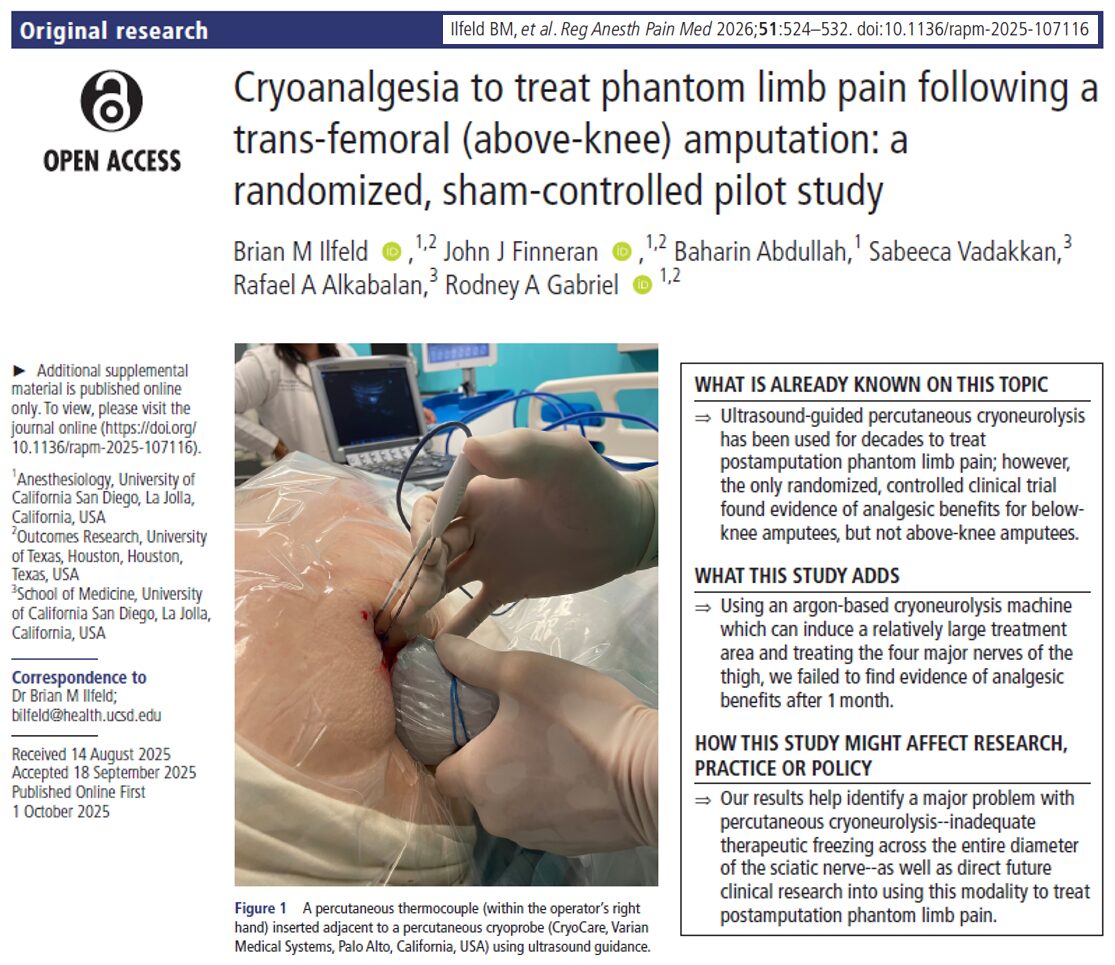
A newly published randomized, sham-controlled pilot study by Ilfeld et al. in Regional Anesthesia & Pain Medicine investigated whether a more aggressive cryoneurolysis approach targeting all major nerves of the thigh could improve outcomes for patients with chronic phantom limb pain after above-knee amputation. The findings suggest that current cryoneurolysis techniques may not achieve sufficient therapeutic nerve freezing to provide lasting pain relief.
What is cryoneurolysis?
Cryoneurolysis is a minimally invasive procedure that uses extremely cold temperatures to temporarily interrupt nerve conduction.
The treatment works by:
- Freezing peripheral nerves
- Producing Wallerian degeneration
- Interrupting transmission of pain signals
- Allowing eventual nerve regeneration
Unlike local anesthetic nerve blocks that typically last hours to days, cryoneurolysis may provide nerve blockade lasting weeks or months.
Why this study matters
A previous randomized trial found that cryoneurolysis appeared more effective in patients with below-knee amputations than in those with above-knee amputations.
Researchers proposed two possible explanations:
- The sciatic nerve is substantially larger in the upper thigh and may be more difficult to freeze adequately
- Above-knee amputations involve additional nerves that had not been treated in prior studies
This study was designed to address both issues by treating all major sensory nerves of the thigh and using an argon-based cryoneurolysis system capable of producing larger and colder ice balls.
Study design
Researchers conducted a:
- Randomized trial
- Sham-controlled study
- Participant-masked design
- Assessor-masked design
- Single-center pilot investigation
The study enrolled adults with:
- Existing trans-femoral (above-knee) amputation
- Phantom limb pain for at least two months
- Daily pain intensity of 4 or greater on a 0–10 numeric rating scale
Participants were randomized to receive active cryoneurolysis or sham treatment.
Treatment protocol
Investigators targeted four major nerves of the thigh:
- Sciatic nerve
- Femoral nerve
- Obturator nerve
- Lateral femoral cutaneous nerve
Ultrasound guidance was used for all procedures.
For larger nerves, researchers utilized an argon-based cryoneurolysis machine capable of producing temperatures approaching −100°C and generating a larger treatment zone than traditional nitrous oxide systems.
Participant characteristics
A total of 12 participants were enrolled.
- Initial randomization included:
- Active cryoneurolysis
- 7 participants
- Sham treatment
- 5 participants
Four participants who initially received sham treatment later crossed over and received active cryoneurolysis.
For analysis:
- Active treatment group: 11 participants
- Sham group: 5 participants
Baseline characteristics included:
- Mean age approximately 60 years
- Predominantly male participants
- Average duration since amputation is ranging from 8 to 14 years
- Long-standing phantom limb pain symptoms
Main findings
No meaningful long-term pain improvement
The primary outcome was average phantom limb pain intensity one month after treatment.
At one month:
- Cryoneurolysis group: Median pain score 5.0
- Sham group: Median pain score 5.0
Researchers found no evidence of clinically meaningful improvement with active treatment compared with placebo.
Temporary improvement only
Patients receiving cryoneurolysis experienced a brief reduction in phantom limb pain during the first day after treatment.
However:
- Improvement disappeared by day 7
- Benefits were not sustained
- Outcomes were similar to placebo by one month
Investigators believe this short-lived improvement was likely due to local anesthetic nerve blocks administered during the procedure rather than cryoneurolysis itself.
Functional outcomes
Researchers evaluated functional interference using the Brief Pain Inventory.
The active treatment group demonstrated:
- Short-term improvement during the first week
- No durable benefit at later follow-up points
Patient Global Impression of Change scores showed a similar pattern, with perceived improvement limited primarily to the first day following treatment.
No improvement at 12 months
Long-term follow-up at 12 months demonstrated minimal differences between groups.
- Average phantom limb pain
- Cryoneurolysis: 4.5
- Sham: 4.5
- Maximum phantom limb pain
- Cryoneurolysis: 8.0
- Sham: 8.0
These findings suggest no sustained analgesic advantage from cryoneurolysis.
A surprising finding: the temperature problem
One of the study’s most important contributions involved direct tissue temperature measurements.
Researchers inserted thermocouples near the cryoprobes during treatment to determine whether therapeutic temperatures were actually being achieved.
Findings revealed:
- Tissue 3 mm from the probe required approximately 2.5 minutes to reach −20°C
- Tissue never reached −40°C during the freeze cycle
- Tissue on the opposite side of the sciatic nerve barely reached 0°C
- Therapeutic temperatures may not have penetrated the full thickness of the sciatic nerve
Why this matters
Successful cryoneurolysis requires temperatures low enough to induce Wallerian degeneration.
Researchers note that therapeutic nerve injury likely requires temperatures somewhere between −20°C and −60°C
The sciatic nerve in the upper thigh often exceeds 10 mm in diameter.
The study suggests that current cryoneurolysis systems may cool tissue adequately near the probe but fail to freeze the entire nerve cross-section.
Residual limb pain increased
Interestingly, residual limb (“stump”) pain increased during the first week after active treatment.
Researchers speculate that incomplete freezing may have produced a painful neuropraxia rather than a therapeutic nerve injury.
This raises important questions about the optimal temperature range needed for effective cryoneurolysis.
Safety outcomes
No adverse events were recorded during the study.
No participants experienced:
- Serious complications
- Permanent neurological injury
- Procedure-related hospitalization
- Major treatment-related adverse events
Clinical implications
The findings challenge assumptions regarding cryoneurolysis for phantom limb pain after above-knee amputation.
- Potential implications include:
- Current cryoneurolysis techniques may be insufficient for large nerves
- Machine-reported temperatures may overestimate therapeutic effects
- Larger nerves may require different probe designs
- Additional technological development may be necessary
- Future studies should directly evaluate tissue temperatures
The authors emphasize that the study does not prove that cryoneurolysis cannot work for phantom limb pain. Rather, it highlights the technical limitations of current approaches.
Limitations of the study
The authors acknowledged several limitations:
- Pilot study design
- Very small sample size
- No formal statistical analysis
- Single-center experience
- Optional crossover design
- Results specific to the equipment and protocol used
Larger trials will be required to definitively determine the role of cryoneurolysis in the management of phantom limb pain.
Key takeaways
- Cryoneurolysis did not demonstrate a meaningful long-term benefit for phantom limb pain after above-knee amputation
- Pain improvements were limited to the first few days after treatment
- Outcomes at one month and beyond were similar to placebo
- Direct temperature measurements suggested inadequate freezing across the sciatic nerve
- Current cryoneurolysis technology may struggle to effectively treat large peripheral nerves
- No serious adverse events were observed
Future directions
- Future research may explore:
- New cryoprobe designs
- Larger treatment zones
- Alternative freezing parameters
- Improved methods for monitoring tissue temperature
- Combination approaches with neuromodulation
- Larger multicenter randomized trials
- Cryoneurolysis strategies tailored to nerve size
Conclusion
This randomized sham-controlled pilot study found no evidence that ultrasound-guided cryoneurolysis of the four major nerves of the thigh provides lasting relief of phantom limb pain after above-knee amputation.
Perhaps more importantly, the investigation revealed a potential technical explanation for these disappointing results: inadequate therapeutic freezing throughout the full thickness of the sciatic nerve. These findings may help guide future technological development and clinical research aimed at improving cryoneurolysis for chronic post-amputation pain.
For more information, refer to the full article in Regional Anesthesia & Pain Medicine.
Ilfeld BM, Finneran JJ, Abdullah B, Vadakkan S, Alkabalan RA, Gabriel RA. Cryoanalgesia to treat phantom limb pain following a trans-femoral (above-knee) amputation: a randomized, sham-controlled pilot study. Reg Anesth Pain Med. 2026;51(5):524-532.
Explore the Ultrasound-Guided Interventional Pain Procedures Manual and the Deluxe Edition for expert instructions on denervation, peripheral nerve interventions, joint injections, and more evidence-based pain management strategies.