 Nerve Blocks App
 Anesthesia Assistant App
 Ultrasound Pain App
 Pain Medicine Assistant App
 POCUS App
 IV Access App
 MSK Knee App
 VetRA App
 Nerve Block Manual 2027
 Nerve Block Manual
 Regional Anesthesia Updates
 Anesthesiology Manual
 Anesthesiology Review
 Anesthesia Updates 2025
 Anesthesia Updates 2026
 Pediatric Anesthesia Updates
 Airway Management Updates
 US Interventional Pain Manual
 Pain Medicine Updates
 Mastering Difficult IV Access
 PACU Nursing Manual
 RA Veterinary Manual
 Books
Books About
About
 Back to News
 8 min read
Avascular necrosis (AVN) of the femoral head is a progressive and potentially disabling condition caused by impaired blood supply to the bone. The resulting ischemia can lead to deterioration of the cartilage and subchondral bone, eventually progressing to femoral head collapse. AVN often affects relatively young adults, typically between 20 and 50 years of age, and may arise from local factors such as trauma or from systemic conditions including chronic corticosteroid exposure, sickle cell disease, and systemic lupus erythematosus.
Chronic hip pain is the most common presenting symptom and can become severe and difficult to manage. Conventional treatment includes nonsteroidal anti-inflammatory drugs (NSAIDs), opioids, and physical therapy, but these measures may provide inadequate or temporary relief. When conservative management fails, joint reconstruction or total hip arthroplasty may ultimately be required. For younger patients in particular, however, early arthroplasty carries the possibility of future revision procedures over their lifetime.
This creates an important therapeutic gap: patients may have substantial chronic pain despite conservative treatment but may not yet be ideal candidates for—or may wish to delay—joint replacement. Alomari and colleagues explored an intriguing minimally invasive option: ultrasound-guided chemical neurolysis of the articular branches supplying the anterior hip capsule, essentially extending the pericapsular nerve group (PENG) block concept from temporary regional analgesia to longer-lasting sensory denervation.
Study objective and methods
The study aimed to assess the analgesic effectiveness and safety of percutaneous chemical denervation of the articular branches of the anterior hip capsule using 100% ethanol in patients with refractory chronic hip pain secondary to AVN.
The investigators performed a retrospective chart review of patients who had undergone a diagnostic PENG block after conservative treatment for AVN-related hip pain had failed. Between August 2021 and May 2022, 10 diagnostic PENG blocks were identified. Nine patients experienced a positive diagnostic response and subsequently underwent chemical neurolysis. A positive diagnostic block was defined as ≥50% pain relief lasting at least 8 hours following injection of 2 mL of 0.5% bupivacaine.
Key procedural and study characteristics included:
- Nine patients underwent therapeutic chemical neurolysis.
- Mean age was 33.6 ± 9.2 years, highlighting the relatively young population affected.
- Mean duration of pain was 22.6 ± 15.4 months.
- AVN etiologies included sickle cell disease in three patients, systemic lupus erythematosus in four, and chemotherapy-related corticosteroid exposure in two.
- All patients had moderate-to-severe AVN, classified as Ficat and Arlet grade 2–4.
- Pain was evaluated using an 11-point Numerical Rating Scale (NRS) at baseline and at 1, 3, and 6 months following neurolysis.
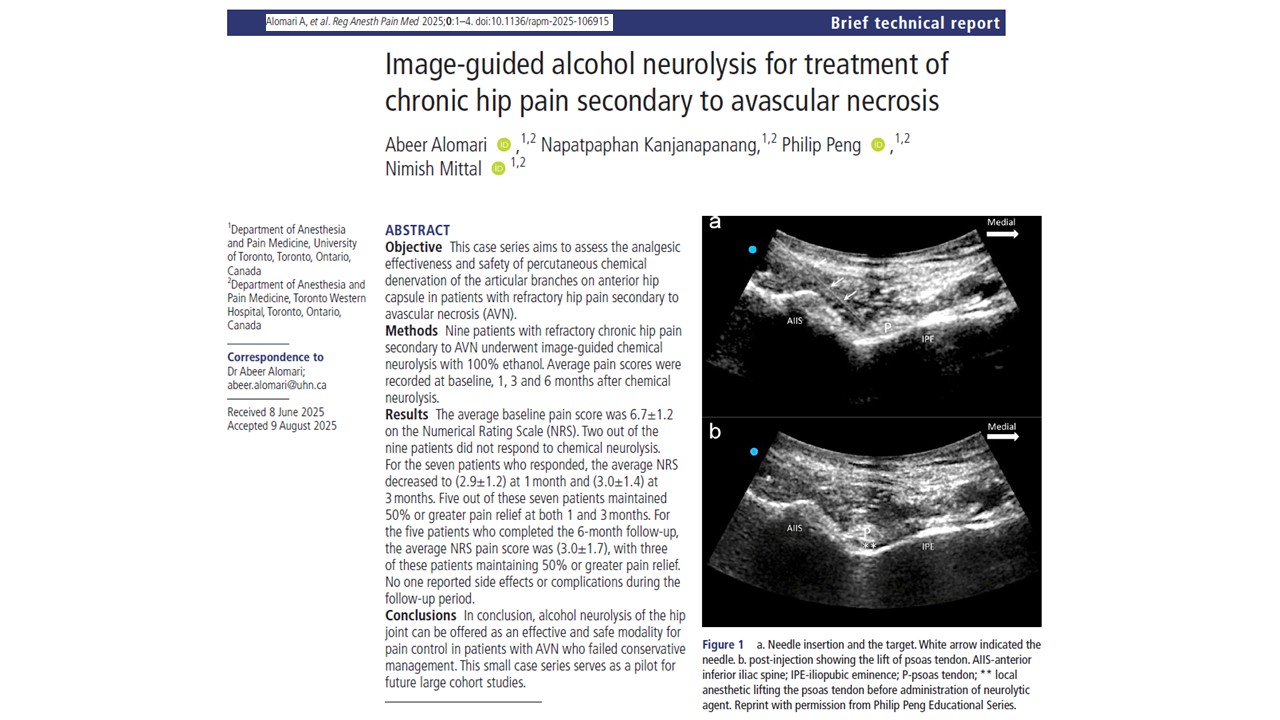
The neurolysis targeted the high articular branches of the femoral nerve and accessory obturator nerve in the fascial plane deep to the iliopsoas between the anterior inferior iliac spine (AIIS) and iliopubic eminence (IPE).
Under ultrasound guidance, a 22-gauge, 80-mm needle was advanced in-plane from lateral to medial toward the ilium between the AIIS and IPE, lateral to the iliopsoas tendon. After hydrolocation demonstrated lifting of the psoas, 2–3 mL of 0.5% bupivacaine with epinephrine was administered. After waiting 2–3 minutes, the investigators slowly injected 2–3 mL of 100% ethanol under continuous real-time ultrasound visualization. Particular attention was paid to preventing spread toward the femoral neurovascular bundle. The needle was flushed with a small amount of bupivacaine during withdrawal to reduce deposition of ethanol in the surrounding soft tissues.
Key findings
The results provide an encouraging early signal of efficacy, although responses were not universal.
Baseline pain was substantial, with a mean NRS score of 6.7 ± 1.2. Two of the nine patients did not respond to chemical neurolysis. Both had steroid-induced AVN involving not only the femoral head but also the femoral neck, and both subsequently underwent total hip arthroplasty.
Among the seven responders, mean pain scores decreased to:
- 2.9 ± 1.2 at 1 month
- 3.0 ± 1.4 at 3 months
- 3.0 ± 1.7 at 6 months among the five patients who completed 6-month follow-up
Five of the seven responders maintained ≥50% pain relief at both 1 and 3 months. Of the five patients with 6-month follow-up, three continued to experience at least 50% pain relief.
There were also potentially important opioid and functional findings. Among the seven responders, one was not taking opioids at baseline. Three reported unchanged opioid use but improved walking distance, while another three achieved a >50% reduction in opioid consumption at both 1 and 3 months. Functional improvements were observed clinically, but the study did not use validated functional outcome instruments, making these observations difficult to quantify objectively.
Importantly, no intraprocedural or postprocedural complications or side effects were reported during follow-up.
Disease severity may be particularly relevant to patient selection. Patients maintaining >50% pain relief at 3 and 6 months had less severe, grade 2–3 disease. In contrast, patients with advanced femoral collapse did not experience meaningful pain relief, suggesting that neurolysis may be more useful before AVN reaches its most advanced structural stages.
Clinical implications
This study introduces an interesting extension of the PENG block concept. Rather than using local anesthetic to provide temporary analgesia, chemical neurolysis attempts to produce longer-lasting interruption of nociceptive input from sensory articular branches of the hip.
The anatomical rationale is important. In this cohort, imaging demonstrated predominantly anterosuperior involvement of the femoral head and acetabulum. Therefore, treatment primarily targeted articular branches of the femoral and accessory obturator nerves. One patient with substantial inferomedial disease received an additional obturator nerve block. The authors suggest that broader articular branch targeting—including obturator and posterior capsular contributions—could be considered when disease involvement is more extensive or when anterior neurolysis alone is insufficient.
Chemical neurolysis may also have a technical advantage over radiofrequency approaches in this particular anatomical region. The femoral and accessory obturator articular branches occupy a relatively broad area between the AIIS and IPE, and conventional radiofrequency may require multiple needle placements to create an adequate strip lesion. Chemical neurolysis allows the neurolytic solution to spread across a wider region and potentially reach lower articular branches. However, that broader spread also makes meticulous needle placement and injectate monitoring essential.
These results should not be interpreted as evidence that alcohol neurolysis is established treatment for AVN. The study included only nine treated patients, had no control group, was retrospective, and had incomplete follow-up. Rather, it provides proof-of-concept evidence supporting further investigation of image-guided sensory denervation as an option for carefully selected patients with otherwise refractory AVN-related hip pain.
Clinical pearls
- Use a prognostic block first. In this series, chemical neurolysis was performed only after a diagnostic PENG block produced ≥50% pain relief for at least 8 hours.
- Match the target to the disease distribution. Predominantly anterosuperior AVN was approached by targeting femoral and accessory obturator articular branches; more extensive disease may require additional targets.
- Disease stage may matter. Sustained responders tended to have grade 2–3 disease, whereas advanced femoral collapse was associated with treatment failure in this very small cohort.
- Control ethanol spread carefully. Continuous real-time ultrasound visualization was used to ensure that the neurolytic agent did not track toward the femoral neurovascular bundle.
- Pain scores are only part of the outcome. Future evaluation should include validated functional measures and distinguish pain at rest from pain during activity.
Future research
The findings raise several questions that larger prospective studies will need to answer. The most important is whether the apparent analgesic benefit can be reproduced in larger and more diverse patient populations. Comparative studies are also needed to establish how alcohol neurolysis performs relative to radiofrequency ablation, phenol neurolysis, repeated local anesthetic blocks, and other interventions.
Patient selection deserves particular attention. The lack of response among patients with advanced femoral collapse suggests that radiological disease severity may influence efficacy, but nine patients are far too few to define a reliable threshold. Future trials should therefore stratify outcomes according to AVN stage, anatomical distribution, etiology, and pain characteristics.
Validated functional outcomes such as WOMAC should also be incorporated alongside pain scores, opioid consumption, walking ability, quality of life, and ultimately the timing or need for hip arthroplasty. Longer follow-up will be essential to establish the duration of analgesia and better characterize uncommon or delayed adverse events.
Conclusion
Ultrasound-guided alcohol neurolysis targeting sensory articular branches of the anterior hip capsule represents a promising minimally invasive strategy for refractory AVN-related hip pain. In this small case series, seven of nine treated patients responded, with substantial reductions in mean pain scores lasting several months in some patients and no reported complications during follow-up. Some responders also experienced reduced opioid use or improved walking tolerance.
The results are particularly interesting for younger patients who have exhausted conservative options but may not yet be ideal candidates for total hip arthroplasty. However, the evidence remains preliminary. The small sample, retrospective design, absence of a comparator, incomplete 6-month follow-up, and lack of validated functional outcomes mean that efficacy and safety cannot yet be established definitively. The study should therefore be viewed as a pilot that provides a rationale for larger prospective investigations.
For more information, refer to the full article in RAPM.
Alomari A, Kanjanapanang N, Peng P, Mittal N. Image-guided alcohol neurolysis for treatment of chronic hip pain secondary to avascular necrosis. Reg Anesth Pain Med. 2026 Jul 6;51(7):823-826.
Read more about cryoneurolysis in our Regional Anesthesiology Module on NYSORA 360 on NYSORA360 – an essential learning resource for residents with practical, up-to-date guidance.