 Nerve Blocks App
 Anesthesia Assistant App
 Ultrasound Pain App
 Pain Medicine Assistant App
 POCUS App
 IV Access App
 MSK Knee App
 VetRA App
 Nerve Block Manual 2027
 Nerve Block Manual
 Regional Anesthesia Updates
 Anesthesiology Manual
 Anesthesiology Review
 Anesthesia Updates 2025
 Anesthesia Updates 2026
 Pediatric Anesthesia Updates
 Airway Management Updates
 US Interventional Pain Manual
 Pain Medicine Updates
 Mastering Difficult IV Access
 PACU Nursing Manual
 RA Veterinary Manual
 Books
Books About
About
 Back to News
 9 min read


New European clinical practice guidelines provide the first dedicated framework for the use, monitoring and reversal of neuromuscular block in anesthetised children.
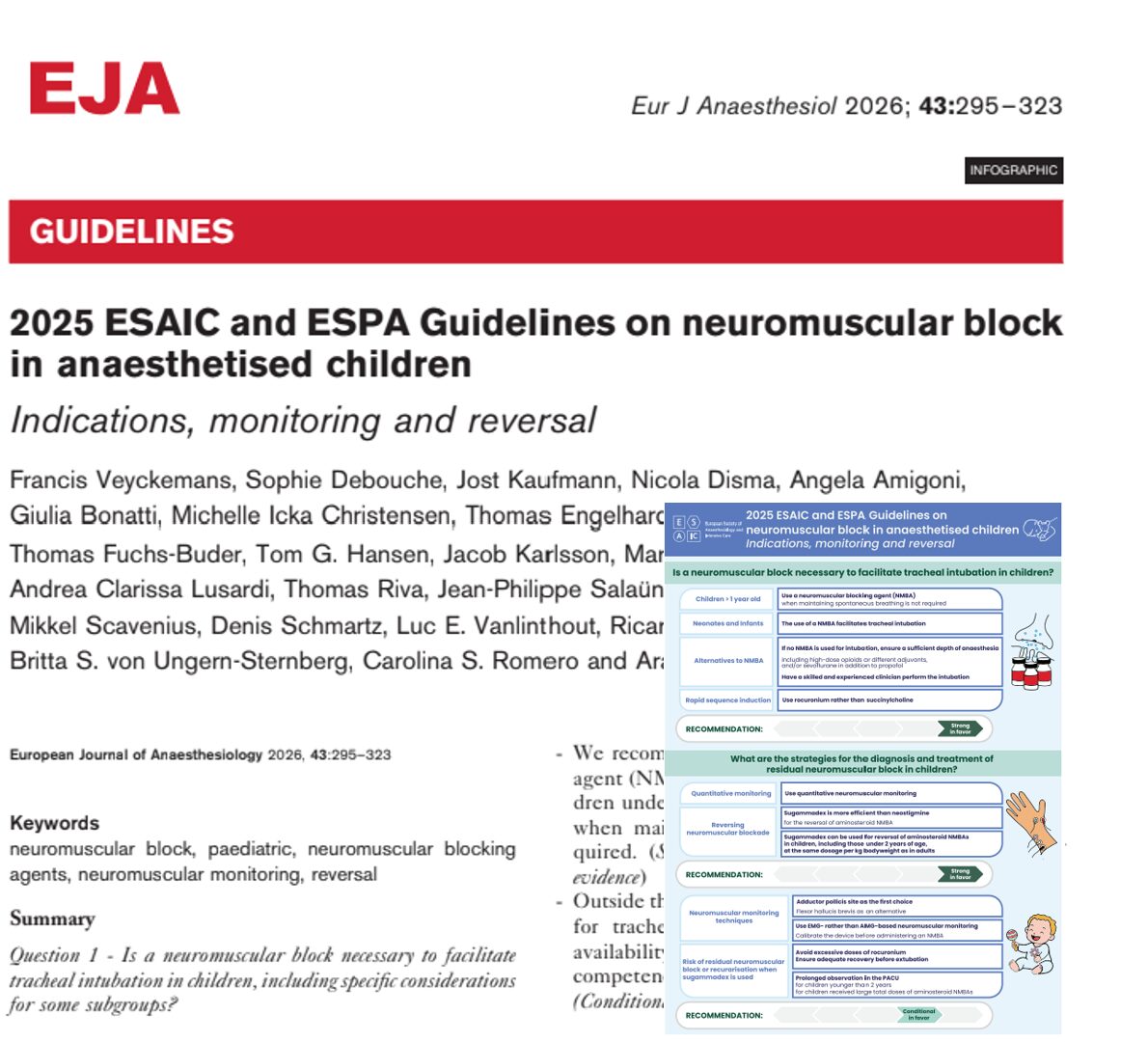
Published in the European Journal of Anaesthesiology in 2026, the 2025 ESAIC and ESPA Guidelines on neuromuscular block in anesthetised children address tracheal intubation, surgical conditions, quantitative neuromuscular monitoring, reversal of neuromuscular blockade and management of children with specific comorbidities.
Developed by an international task force from the European Society of Anaesthesiology and Intensive Care (ESAIC) and European Society for Paediatric Anaesthesiology (ESPA), the guideline highlights three particularly important themes: neuromuscular blocking agents (NMBAs) generally improve intubation conditions, quantitative monitoring should accompany NMBA use, and sugammadex is preferred over neostigmine for reversal of aminosteroid neuromuscular blockade.
Neuromuscular blocking agents recommended for pediatric intubation
One of the guideline’s strongest messages concerns tracheal intubation.
The expert panel recommends using an NMBA to facilitate tracheal intubation in children undergoing general anesthesia in the operating room when maintenance of spontaneous breathing is not required. This is a strong recommendation supported by a moderate level of evidence.
The recommendation specifically extends to neonates and infants in the operating room.
The evidence reviewed by the task force suggests that avoiding an NMBA can make pediatric tracheal intubation substantially more difficult. A systematic review prepared for the guideline included 30 randomised controlled trials and 2,276 children. Avoidance of an NMBA was associated with:
- A 3.47-fold relative risk of difficult intubation
- A 5.12-fold relative risk of failed intubation
- Less favourable intubating conditions
- A greater likelihood of failed first attempts
Another systematic review found that failed first intubation attempts were significantly less frequent when an NMBA was administered.
The advantages may be especially relevant in younger children. Neonates and infants have anatomical and physiological characteristics that can make airway management particularly challenging, and neuromuscular blockade may improve glottic visualisation, suppress airway reflexes and reduce the number of intubation attempts.
Rocuronium preferred for rapid sequence induction
The guideline also addresses the longstanding choice between rocuronium and succinylcholine for rapid sequence induction and intubation (RSII).
For children requiring RSII, the panel recommends rocuronium rather than succinylcholine, with a strong recommendation based on moderate-certainty evidence.
Rocuronium is increasingly used in this setting partly because sugammadex provides the option of rapid pharmacological reversal.
Studies reviewed by the task force found that appropriate doses of rocuronium can provide intubating conditions comparable with succinylcholine.
The guideline nevertheless stresses that drug selection and dosing must remain part of an individualised anesthetic strategy.
What if an NMBA cannot be used?
There are situations in which avoiding neuromuscular blockade may be desirable or necessary, including maintenance of spontaneous ventilation, intra-operative nerve monitoring, allergy or lack of drug availability.
In these circumstances, the guideline recommends ensuring adequate depth of anesthesia and using appropriate adjuncts.
High-dose opioids, sevoflurane and propofol-based combinations can provide satisfactory conditions in selected patients.
Importantly, the guideline emphasises that intubation without an NMBA should be undertaken by a skilled and experienced clinician.
Deep neuromuscular block is not necessary for every operation
The guideline does not advocate maximal neuromuscular blockade throughout every pediatric operation.
Instead, it recommends a selective approach during abdominal surgery.
Deep neuromuscular blockade may improve operating conditions during major procedures such as hepatobiliary surgery, where reducing intra-abdominal and airway pressures can improve surgical exposure.
For minor procedures such as inguinal hernia repair, however, deep blockade may provide little additional benefit.
The practical message is therefore to tailor the depth of neuromuscular blockade to the procedure rather than automatically maintaining deep blockade in every child.
The guideline also suggests that neuromuscular blockade can improve surgical and ventilatory conditions when a second-generation supraglottic airway is used for abdominal surgery.
Quantitative neuromuscular monitoring becomes central to safe care
Perhaps the most practice-changing recommendation concerns monitoring.
Whenever an NMBA is administered, the guideline gives a strong recommendation for quantitative neuromuscular monitoring.
Monitoring should be used both to adjust the degree of blockade during anesthesia and to exclude residual neuromuscular block before tracheal extubation.
The guideline defines complete recovery as a train-of-four ratio (TOFr) of at least 0.9.
Clinical assessment alone cannot reliably exclude residual paralysis.
This is particularly important because residual neuromuscular blockade can contribute to impaired respiratory function following anesthesia.
Where should neuromuscular function be monitored?
The adductor pollicis muscle, following ulnar nerve stimulation, is suggested as the preferred monitoring site.
When this site is inaccessible, the flexor hallucis brevis can be considered as an alternative.
The guideline also suggests:
- Using electromyography-based quantitative monitoring in preference to acceleromyography-based monitoring
- Calibrating the monitoring device before administering an NMBA
- Interpreting monitoring results alongside the child’s age, comorbidities and pharmacology of the NMBA
- Confirming adequate recovery before proceeding with extubation
Newer electromyography (EMG) devices designed for small children may make objective monitoring more practical in neonates and infants.
Sugammadex preferred over neostigmine
Another major recommendation concerns pharmacological reversal.
For aminosteroid NMBAs such as rocuronium and vecuronium, the guideline strongly recommends sugammadex over neostigmine.
The recommendation is supported by moderate-certainty evidence.
A meta-analysis incorporating 18 studies and 1,065 children found that sugammadex produced faster recovery to a TOFr above 0.9 and shortened the interval to extubation compared with control strategies, which predominantly involved acetylcholinesterase inhibitors.
The advantages identified include:
- Faster recovery from neuromuscular blockade
- Shorter time to tracheal extubation
- More effective reversal of moderate and deep blockade
- Less need for additional reversal medication
- Avoidance of the anticholinergic medication required alongside neostigmine
The guideline further states that children younger than two years can receive sugammadex at the same weight-based dose range used in older children and adults.
At the time the guideline was written, however, the authors noted that sugammadex remained off-label in children younger than two years.
Residual block and recurarisation remain important concerns
Sugammadex does not remove the need for quantitative monitoring.
The guideline warns about residual neuromuscular blockade and recurarisation, particularly in children younger than two years and after large cumulative doses of rocuronium or vecuronium.
In one retrospective study involving 2,923 children younger than two years who received rocuronium, 4.2% received a second dose of sugammadex because residual neuromuscular blockade was suspected.
The authors therefore suggest avoiding excessive rocuronium doses and systematically using quantitative monitoring to confirm adequate recovery before extubation.
Extended observation in the post-anesthesia care unit should also be considered for children younger than two years or following large cumulative doses of rocuronium or vecuronium when sugammadex has been used.
Special precautions for neuromuscular disease
The guideline devotes considerable attention to children with neuromuscular disorders.
Succinylcholine should be avoided in children with Duchenne or Becker muscular dystrophy because of the risk of severe rhabdomyolysis, hyperkalemia and potentially fatal cardiac arrest.
For children with muscular dystrophy, nondepolarising NMBAs should instead be carefully titrated. These patients can have delayed onset and substantially prolonged recovery.
Quantitative monitoring is therefore particularly important.
For myasthenic disorders, the guideline advises against succinylcholine and suggests rocuronium or vecuronium when neuromuscular blockade is necessary because these agents can be reversed with sugammadex.
Neostigmine should not be used in children with myasthenic disorders because it may contribute to postoperative cholinergic or myasthenic crises and is contraindicated in some congenital myasthenic syndromes.
Cerebral palsy and anticonvulsants require individualised dosing
Children with cerebral palsy may respond differently to NMBAs.
Studies reviewed for the guideline suggest that some children with cerebral palsy demonstrate resistance to nondepolarising agents such as rocuronium and vecuronium.
Chronic anticonvulsant treatment may further modify the response.
The guideline therefore recommends quantitative monitoring and individualised NMBA administration rather than relying solely on conventional weight-based dosing.
Children receiving chronic anticonvulsant therapy may require higher or more frequent aminosteroid NMBA doses to maintain an appropriate degree of blockade.
A step-by-step approach to implementation
The authors recognise that implementing quantitative monitoring and changing established anesthetic practice will require training, equipment and institutional support.
Their proposed progression can be summarised as:
- Educate clinicians about pediatric NMBA and reversal-agent pharmacology.
- Increase appropriate NMBA use for pediatric tracheal intubation.
- Introduce routine neuromuscular monitoring.
- Use neostigmine only at an appropriate level of spontaneous neuromuscular recovery.
- Progress to routine quantitative monitoring and confirm a TOFr of at least 0.9 before extubation.
- Introduce sugammadex for reversal of deep blockade produced by steroidal NMBAs.
- Adopt EMG-based quantitative neuromuscular monitoring where feasible.
The guideline stresses that these recommendations are intended to guide rather than dictate clinical practice. Decisions still need to account for the individual child, procedure, airway strategy, available resources and clinician expertise.
What remains uncertain?
Important evidence gaps remain.
The task force did not issue specific recommendations for NMBA use during intubation or ventilation in the pediatric intensive care unit (PICU) or neonatal intensive care unit (NICU).
The evidence was considered insufficient, and the authors concluded that future recommendations should involve multidisciplinary panels including PICU and NICU specialists.
Further research is also needed to determine optimal monitoring in neonates, pediatric sugammadex dose-response relationships across different age groups, interactions with newer anticonvulsants and optimal management of children with rare neuromuscular diseases.
What the new guidance means for pediatric anesthesia
The 2025 ESAIC/ESPA guideline moves pediatric neuromuscular blockade toward a more measurable and individualised approach.
Rather than focusing simply on whether a muscle relaxant has been administered, the guideline links appropriate NMBA selection, quantitative monitoring, procedure-specific depth of blockade and objective confirmation of recovery.
For clinicians, the practical message is clear: use neuromuscular blockade when it provides a meaningful airway or surgical advantage, measure its effect rather than estimating it clinically, reverse it appropriately, and confirm recovery before extubation.
For vulnerable groups, including neonates, infants and children with neuromuscular disorders, the need for individualised dosing and objective monitoring becomes even more important.
The guideline therefore represents an important step towards standardising evidence-based neuromuscular block management in pediatric anesthesia while also identifying the substantial areas in which better pediatric evidence is still required.
Reference: Veyckemans F et al. 2025 ESAIC and ESPA Guidelines on neuromuscular block in anaesthetised children: Indications, monitoring and reversal. Eur J Anaesthesiol. 2026;43:295-323.
Read more about recent evidence like this in NYSORA’s Anesthesia Assistant app. Simulate case, check dosages and search through NYSORA knowledge database!