 Nerve Blocks App
 Anesthesia Assistant App
 Ultrasound Pain App
 Pain Medicine Assistant App
 POCUS App
 IV Access App
 MSK Knee App
 VetRA App
 Nerve Block Manual
 Regional Anesthesia Updates
 Anesthesiology Manual
 Anesthesiology Review
 Anesthesia Updates 2025
 Anesthesia Updates 2026
 Pediatric Anesthesia Updates
 Airway Management Updates
 US Interventional Pain Manual
 Pain Medicine Updates
 Mastering Difficult IV Access
 PACU Nursing Manual
 RA Veterinary Manual
 Books
Books About
About
 Back to News
 9 min read
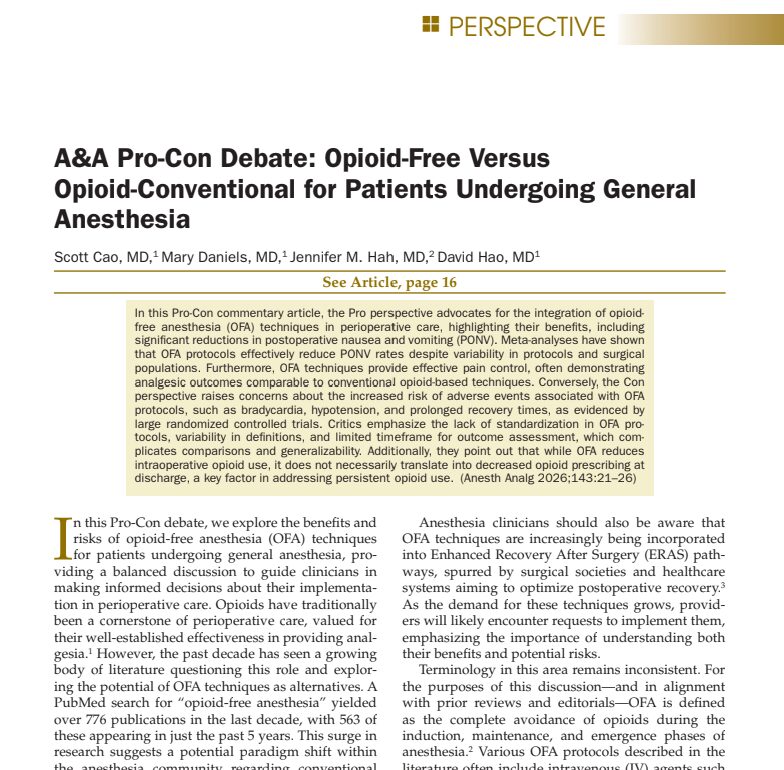
The role of opioids during general anesthesia is being reconsidered as anesthesiologists increasingly adopt multimodal approaches designed to limit opioid exposure while maintaining adequate analgesia.
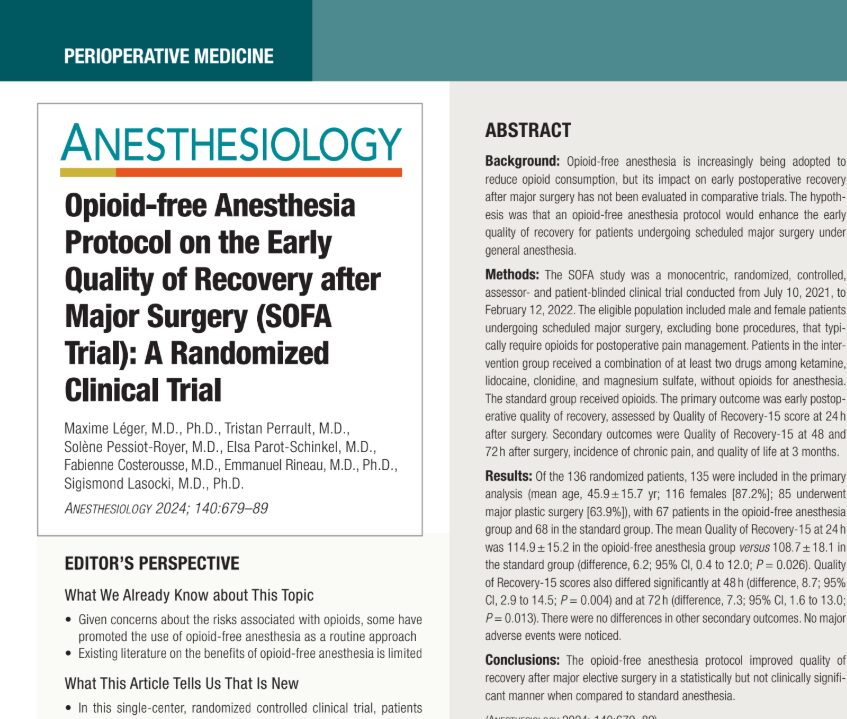
A Pro-Con debate published in the July 2026 issue of Anesthesia & Analgesia examines one of the more contentious questions arising from this shift: Should opioid-free anesthesia replace conventional opioid-based techniques for patients undergoing general anesthesia?
The authors find meaningful arguments on both sides. Opioid-free anesthesia (OFA) appears capable of reducing postoperative nausea and vomiting (PONV) while providing postoperative pain control comparable with conventional approaches in several studies. However, concerns remain about adverse effects of the drugs used as opioid substitutes, inconsistent definitions and protocols, and the absence of convincing evidence that avoiding intraoperative opioids prevents persistent postoperative opioid use.
The result is not a simple choice between opioids and no opioids. Instead, the evidence points toward individualized perioperative analgesia based on patient characteristics, surgical context and the risks associated with each pharmacologic strategy.
What is opioid-free anesthesia?
The terminology surrounding OFA is not completely standardized.
For the purposes of the Anesthesia & Analgesia debate, OFA means complete avoidance of opioids during induction, maintenance and emergence from general anesthesia.
OFA protocols may instead use combinations of intravenous agents such as:
- Ketamine
- Dexmedetomidine
- Lidocaine
- Esmolol
Conventional opioid-based anesthesia may incorporate agents including fentanyl, remifentanil, sufentanil, morphine and hydromorphone.
Importantly, opioid-free anesthesia is not synonymous with opioid-free postoperative analgesia. A patient who receives no opioids during general anesthesia may still require an opioid after surgery for adequate pain control.
That distinction is important when considering the potential clinical benefits of OFA.
The case for opioid-free anesthesia
A substantial reduction in postoperative nausea and vomiting
Perhaps the strongest argument supporting OFA is its association with lower rates of PONV.
A systematic review and meta-analysis cited by the authors included 1,934 patients across 26 randomized controlled trials. Compared with conventional opioid-based anesthesia, OFA was associated with significantly less:
- Nausea: odds ratio 0.27
- Vomiting: odds ratio 0.22
A separate meta-analysis reported a 59% relative risk reduction in PONV with OFA protocols.
This matters clinically because PONV is more than an unpleasant postoperative symptom. It can impair quality of recovery, prolong stays in the postanesthesia care unit (PACU) and disrupt ambulatory surgical workflow.
There are several potential explanations for the observed benefit.
Opioids can stimulate the chemoreceptor trigger zone in the area postrema and delay gastric emptying, both of which can contribute to nausea and vomiting. Eliminating intraoperative opioids removes these effects.
Some drugs incorporated into OFA protocols, including dexmedetomidine, ketamine and lidocaine, may also have independent effects that contribute to lower PONV rates.
However, the authors emphasize an important limitation: the meta-analyses did not consistently report antiemetic protocols or standardized PONV risk stratification, such as the Apfel score. Surgical populations were also heterogeneous.
Consequently, the magnitude of the PONV benefit cannot necessarily be attributed to opioid avoidance alone.
Can patients receive adequate analgesia without intraoperative opioids?
A major concern surrounding OFA is straightforward: if opioids are removed from general anesthesia, will patients experience more pain?
Available evidence suggests that effective analgesia is possible.
A meta-analysis involving 14 randomized controlled trials and 1,354 patients found significantly lower pain scores at 24 hours with OFA compared with opioid-based anesthesia. The mean difference was −0.72 on the visual analog scale.
The authors note, however, that this difference was probably not clinically significant. The more relevant interpretation may therefore be that OFA can achieve broadly comparable pain control rather than that it necessarily provides superior analgesia.
Individual randomized trials have produced similarly encouraging findings.
In patients undergoing thoracoscopic lung resection, an OFA strategy was associated with lower pain scores without an increase in rescue analgesic requirements.
A multicenter trial in endoscopic sinus surgery also reported significantly lower pain scores at several postoperative time points with OFA.
But there are caveats. The sinus surgery trial involved a relatively low-pain outpatient procedure, while the conventional group received high intraoperative opioid doses without basic nonopioid analgesics such as acetaminophen or nonsteroidal anti-inflammatory drugs. These design choices may have favored the OFA group.
How nonopioid drugs provide analgesia
The effectiveness of OFA depends on multimodal pharmacology rather than simply withholding an analgesic.
Dexmedetomidine, an α2-adrenergic agonist, has sedative and analgesic effects without causing the respiratory depression characteristic of opioids.
Ketamine antagonizes N-methyl-D-aspartate (NMDA) receptors and modifies central nociceptive pathways. It may also attenuate central sensitization and opioid-induced hyperalgesia.
Lidocaine, through sodium-channel blockade and other effects, can decrease neuronal excitability and nociceptive transmission.
Using agents with different mechanisms may therefore allow clinicians to target several components of perioperative nociception simultaneously.
Yet this pharmacologic complexity also forms the basis of the argument against routine OFA.
The case against opioid-free anesthesia
Avoiding opioids does not mean avoiding adverse effects
One of the most important warnings highlighted in the debate comes from a large multicenter randomized trial comparing a dexmedetomidine-based opioid-free technique with remifentanil-based anesthesia.
Composite adverse outcomes occurred in 78% of patients receiving dexmedetomidine versus 67% receiving remifentanil, corresponding to a relative risk of 1.16.
Problems included:
- Bradycardia
- Hypotension requiring intervention
- Longer extubation times
- Longer PACU stays
The dexmedetomidine protocol initially permitted infusion rates of up to 1.4 μg/kg/h. After safety concerns emerged, including severe bradycardia, the maximum dose was reduced. The trial was ultimately discontinued after multiple cases of asystole in the dexmedetomidine group.
The authors also acknowledge criticism of that study’s protocol, meaning its results should not automatically be extrapolated to every carefully titrated use of dexmedetomidine.
Nevertheless, the trial illustrates a fundamental principle: substituting several nonopioid drugs for opioids does not automatically make an anesthetic safer.
Ketamine, intravenous lidocaine and gabapentinoids have their own adverse-effect profiles. Gabapentin, for example, has been associated with sedation and dizziness, particularly in older adults.
Combining multiple agents can also produce cumulative or interacting adverse effects.
A major problem: OFA is not one standardized technique
Another challenge is the striking heterogeneity of OFA research.
Different studies have used different combinations and doses of dexmedetomidine, ketamine, lidocaine, propofol and other medications. Some incorporate regional anesthesia. Even the definition of “opioid-free” has not been applied consistently.
The article points to studies classified within the OFA literature in which patients actually received fentanyl or remifentanil.
This makes comparison between studies difficult and limits the ability to translate pooled results into a single clinical protocol.
Short-term improvements do not necessarily mean long-term benefit
Most OFA trials concentrate on outcomes during approximately the first 24 postoperative hours.
These commonly include pain scores, PONV and opioid consumption.
Much less is known about outcomes that may matter weeks or months later, including:
- Persistent postsurgical pain
- Persistent opioid use
- Functional recovery
- Readmissions
- Patient satisfaction
- Healthcare resource utilization
This is particularly important because reducing opioid exposure in the operating room is sometimes assumed to reduce the subsequent risk of chronic opioid use.
According to the authors, current evidence does not establish that connection.
Does opioid-free anesthesia prevent persistent opioid use?
At present, there is no conclusive evidence that avoiding opioids intraoperatively reduces opioid prescribing at hospital discharge or prevents persistent postsurgical opioid use.
One study of enhanced recovery protocols in colorectal surgery found no significant difference in the proportion of patients discharged with opioid prescriptions when opioid-free and opioid-sparing intraoperative approaches were compared.
Discharge prescribing is influenced by factors extending well beyond the anesthetic itself, including institutional protocols, clinician prescribing practices, patient expectations and subsequent painful conditions.
This distinction has important implications for efforts to reduce opioid-related harm.
Changing the intraoperative anesthetic may be only one component of a much broader strategy. Appropriate discharge prescribing, patient counseling and coordinated postoperative pain management remain essential.
Clinical implications for anesthesiologists
The debate does not establish OFA as universally superior to conventional opioid anesthesia, or vice versa.
Instead, several practical conclusions emerge:
- Assess the individual patient. A patient with substantial PONV risk may potentially benefit from minimizing opioid exposure, whereas cardiovascular susceptibility to bradycardia or hypotension may alter the risk-benefit calculation for particular nonopioid agents.
- Consider the surgical procedure. Evidence obtained from relatively low-pain outpatient operations cannot automatically be generalized to major operations with substantially different nociceptive burdens.
- Separate opioid-free anesthesia from postoperative opioid avoidance. Avoiding opioids intraoperatively does not guarantee that postoperative opioids will be unnecessary.
- Evaluate the complete multimodal regimen. The safety question is not simply whether opioids are present. Clinicians must consider the dose, pharmacology and interactions of every alternative agent.
- Avoid assuming short-term benefits translate into long-term outcomes. Lower PONV or opioid consumption during the first postoperative day has not yet been shown to prevent persistent opioid use.
Where does the debate leave clinical practice?
The evidence summarized in Anesthesia & Analgesia supports a more nuanced approach than declaring either strategy the winner.
OFA has demonstrated a meaningful ability to reduce PONV and can provide postoperative analgesia comparable with conventional opioid-based techniques in studied populations. These are potentially important benefits, particularly when opioid-associated adverse effects are a major concern.
But OFA has its own risks. Dexmedetomidine-based regimens have raised cardiovascular safety concerns, protocols remain highly heterogeneous, and much of the literature measures only short-term outcomes.
Most importantly, reducing or eliminating opioids in the operating room has not been demonstrated to solve the broader problem of persistent postoperative opioid use.
The authors therefore conclude that decisions about opioid-free versus conventional anesthesia should be individualized according to patient history, surgical context, anticipated risks and institutional capabilities. Larger, standardized trials are still needed to establish comparative safety, analgesic efficacy and long-term effects on opioid use.
As multimodal analgesia becomes increasingly embedded in perioperative practice, the future may ultimately be less about choosing between “opioid-free” and “opioid-conventional” anesthesia and more about determining which combination of therapies provides the best balance of analgesia, recovery and safety for each patient.
Reference: Cao S et al. A&A Pro-Con Debate: Opioid-Free Versus Opioid-Conventional for Patients Undergoing General Anesthesia. Anesth Analg. 2026;143:21-26.
Read more about recent evidence like this in NYSORA’s Anesthesia Assistant app. Simulate case, check dosages and search through NYSORA knowledge database!