 Nerve Blocks App
 Anesthesia Assistant App
 Ultrasound Pain App
 Pain Medicine Assistant App
 POCUS App
 IV Access App
 MSK Knee App
 VetRA App
 Nerve Block Manual
 Regional Anesthesia Updates
 Anesthesiology Manual
 Anesthesiology Review
 Anesthesia Updates 2025
 Anesthesia Updates 2026
 Pediatric Anesthesia Updates
 Airway Management Updates
 US Interventional Pain Manual
 Pain Medicine Updates
 Mastering Difficult IV Access
 PACU Nursing Manual
 RA Veterinary Manual
 Books
Books About
About
 Back to News
 7 min read
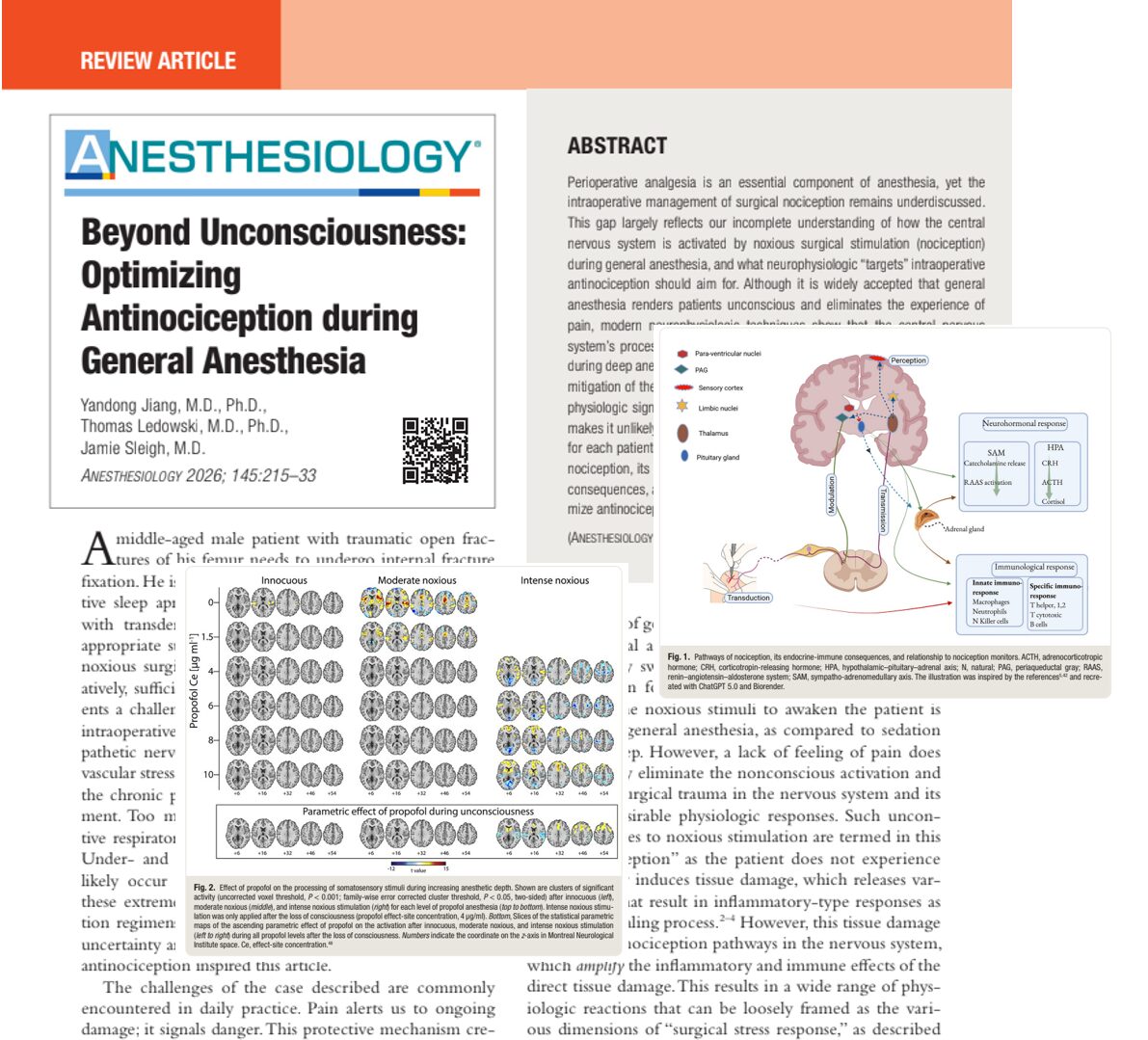
A major 2026 review in Anesthesiology challenges a deceptively simple assumption about general anesthesia: making a patient unconscious does not necessarily switch off the nervous system’s response to surgical injury.
The review, by Jiang et al. (2026), argues that intraoperative nociception deserves greater attention as a distinct component of anesthetic management. Even during apparently adequate general anesthesia, noxious surgical stimulation can continue to activate neural, autonomic, endocrine and immune pathways.
The clinical challenge is therefore more complicated than preventing awareness or movement. Anesthesiologists must potentially find an individualized balance between too little and too much antinociception.
Pain and nociception are not the same thing
One of the most important distinctions in the review is between pain and nociception.
Pain is a conscious, subjective experience. Nociception refers to the neural processing of potentially tissue-damaging stimuli.
During adequate general anesthesia, a patient is unconscious and therefore does not consciously experience surgical pain. Yet afferent nociceptive signals generated by tissue injury can still enter and be processed within the nervous system.
Modern neurophysiologic investigations suggest that this processing is only partially suppressed by general anesthesia, even at substantial anesthetic depth.
That distinction changes the clinical question.
Instead of asking only, “Is the patient unconscious?”, clinicians may also need to ask, “How strongly is the patient’s nervous system responding to surgical injury?”
What happens when surgery activates nociceptive pathways?
Surgical incision, tissue manipulation and inflammation activate peripheral nociceptors. These signals travel through afferent pathways into the spinal cord and higher neural structures.
The resulting responses can involve multiple systems.
Important manifestations described in the review include:
- Central nervous system responses, including electroencephalographic arousal
- Autonomic responses, including changes in heart rate, arterial blood pressure, vascular tone, sweating and pupillary diameter
- Somatic responses, including movement when neuromuscular blockade is absent
- Endocrine responses, including activation of stress-hormone pathways
- Inflammatory and immune responses associated with surgical tissue injury and neural signaling
Excessive nociception may therefore contribute to the broader surgical stress response rather than simply producing changes in pulse or blood pressure.
Why deeper anesthesia is not necessarily the answer
A crucial implication is that hypnosis and antinociception are related but different dimensions of anesthesia.
Increasing hypnotic anesthetic concentration may suppress some responses to stimulation, but simply making a patient more deeply unconscious is not equivalent to selectively controlling nociceptive signaling.
Modern general anesthesia can instead be considered a combination of interacting components such as:
- Unconsciousness
- Amnesia
- Immobility
- Antinociception
- Autonomic stability
The optimal dose of one component cannot necessarily be inferred from another.
This helps explain why heart rate and blood pressure alone provide an imperfect picture of intraoperative nociception.
The search for a nociception monitor
Anesthesiologists have traditionally interpreted tachycardia, hypertension, movement, sweating and other physiologic changes as evidence that surgical stimulation is inadequately controlled.
But these signs are nonspecific.
Heart rate, for example, can be altered by beta-blockers, arrhythmias, hypovolemia, temperature, anesthetic drugs and vasoactive medications. Blood pressure is similarly affected by numerous factors unrelated to nociception.
This has driven the development of dedicated nociception-monitoring technologies.
Current approaches include assessment of:
- Heart-rate variability and parasympathetic tone
- Photoplethysmographic pulse-wave characteristics
- Skin conductance
- Pupillary responses
- Nociceptive reflexes
- Electroencephalographic signals
- Composite multiparameter indices
Among commercial technologies discussed in the review are the Analgesia Nociception Index, Nociception Level Index, pupillometry, qNOX and nociceptive flexion threshold measurements.
However, there is an important caveat.
No single intraoperative nociception monitor has yet demonstrated reproducible, clinically important superiority over conventional hemodynamic assessment across surgical populations, according to the authors.
That means these devices should not currently be interpreted as direct “pain meters.”
Could artificial intelligence improve monitoring?
Artificial intelligence may ultimately help solve part of the problem.
Nociception is unlikely to be represented adequately by one physiologic variable. A future system could instead integrate EEG, cardiovascular activity, photoplethysmography, autonomic signals and other measurements simultaneously.
Machine-learning algorithms are particularly suited to identifying complex relationships among large numbers of variables.
The review notes encouraging early work involving machine-learning nociception models using multisensory inputs, while emphasizing that considerable validation remains necessary.
In other words, AI-assisted monitoring is promising, but it is not yet a clinically established solution.
The other side of the equation: can nociception be suppressed too much?
The goal is not necessarily to abolish every detectable nociceptive response.
This is one of the review’s more provocative messages.
Nociception is fundamentally a protective biological system. Sensory neurons also interact with immune cells and participate in processes involved in inflammation and tissue healing.
The authors therefore conceptualize intraoperative management as a “sweet spot” between under-treatment and over-treatment.
Insufficient antinociception could allow excessive sympathetic, endocrine, inflammatory and neural responses to surgery.
Excessive treatment, however, can expose patients to complications from the interventions used to suppress those responses.
Why simply giving more opioids has limitations
Opioids remain powerful intraoperative antinociceptive drugs, but increasing opioid administration indefinitely is not a satisfactory solution.
Potential concerns include:
- Postoperative respiratory depression
- Sedation
- Nausea and vomiting
- Delayed recovery
- Opioid tolerance
- Opioid-induced hyperalgesia
- Potential immune effects
These limitations have increased interest in opioid-sparing and opioid-free anesthesia, using multimodal strategies such as regional anesthesia, ketamine, dexmedetomidine, lidocaine, magnesium, and other nonopioid interventions.
The balance becomes particularly important in patients susceptible to opioid-related adverse events, such as those with obstructive sleep apnea.
The review therefore supports the broader concept of individualized, multimodal antinociception rather than a uniform opioid-based strategy.
Regional anesthesia can block nociceptive input
Regional anesthesia occupies a particularly interesting position because it can interrupt nociceptive transmission before the signal reaches the central nervous system.
A successful peripheral nerve block or neuraxial technique can therefore provide something fundamentally different from merely suppressing the central response to incoming nociceptive signals.
The review considers antinociceptive interventions at several levels.
- Block the input. Regional and neuraxial anesthesia can interrupt afferent nociceptive transmission.
- Modify central processing. Opioids, ketamine, dexmedetomidine and other agents can modulate nociceptive processing within the central nervous system.
- Modify the output. Other pharmacologic strategies can attenuate components of the physiologic stress response.
No single approach is necessarily optimal for every operation or patient.
What about opioid-sparing anesthesia?
Enhanced Recovery After Surgery programs have encouraged multimodal, opioid-sparing perioperative analgesia.
That approach can include combinations of regional anesthesia and nonopioid medications rather than relying exclusively on high-dose opioids.
The review by Jiang et al. discusses several agents and strategies relevant to this concept, including:
- Regional anesthesia
- Ketamine
- Dexmedetomidine
- Lidocaine
- Magnesium
- Beta-adrenergic modulation
- Cyclooxygenase pathway inhibition
Importantly, “opioid sparing” should not automatically be equated with “better nociception control.” The clinical objective is adequate and individualized antinociception while minimizing treatment-related harm.
What should anesthesiologists do now?
The available evidence does not support a universal numerical target for intraoperative nociception.
A practical strategy remains multidimensional.
- Assess the patient before surgery. Consider comorbidities, chronic pain, existing opioid therapy, obstructive sleep apnea, frailty and anticipated surgical stimulus.
- Anticipate nociceptive intensity. Incision, intubation and major tissue manipulation can produce markedly different physiologic responses.
- Use multimodal information. Interpret hemodynamics alongside anesthetic depth, medications, surgical events and, when appropriate, dedicated nociception monitoring.
- Consider regional techniques. When clinically appropriate, nerve blocks and neuraxial anesthesia can reduce afferent nociceptive transmission.
- Individualize pharmacologic treatment. Avoid assuming that every tachycardic or hypertensive response requires additional opioids.
- Avoid both extremes. The objective is not simply maximum suppression but an appropriate balance between surgical stress and adverse effects from treatment.
- Connect intraoperative and postoperative care. Antinociceptive decisions during surgery may influence postoperative analgesic requirements and recovery.
A shift toward personalized antinociception
The central message of the 2026 review is not that clinicians have been anesthetizing patients incorrectly. It is that unconsciousness alone cannot describe everything happening in the nervous system during surgery.
The next challenge is determining how much intraoperative nociceptive activity matters, how accurately it can be measured, and how aggressively it should be treated.
Future research will need to move beyond asking whether a monitor changes opioid consumption. More important questions concern whether individualized antinociception improves meaningful outcomes such as postoperative pain, recovery, cognitive function and longer-term physical and psychological health.
For now, the precise physiologic “sweet spot” remains unknown and is likely to differ between patients.
That uncertainty makes personalized management, not maximal suppression, the key concept.
Reference: Jiang Y et al. Beyond Unconsciousness: Optimizing Antinociception during General Anesthesia. Anesthesiology. 2026;145:215-233.
Read more about recent evidence like this in NYSORA’s Anesthesia Assistant app. Simulate case, check dosages and search through NYSORA knowledge database!