 Nerve Blocks App
 Anesthesia Assistant App
 Ultrasound Pain App
 Pain Medicine Assistant App
 POCUS App
 IV Access App
 MSK Knee App
 VetRA App

 Nerve Block Manual 2027
 Nerve Block Manual
 Regional Anesthesia Updates
 Anesthesiology Manual
 Anesthesiology Review
 Anesthesia Updates 2025
 Anesthesia Updates 2026
 Pediatric Anesthesia Updates
 Airway Management Updates
 US Interventional Pain Manual
 Pain Medicine Updates
 Mastering Difficult IV Access
 PACU Nursing Manual
 RA Veterinary Manual
 Books
 About

 Back to News
 11 min read
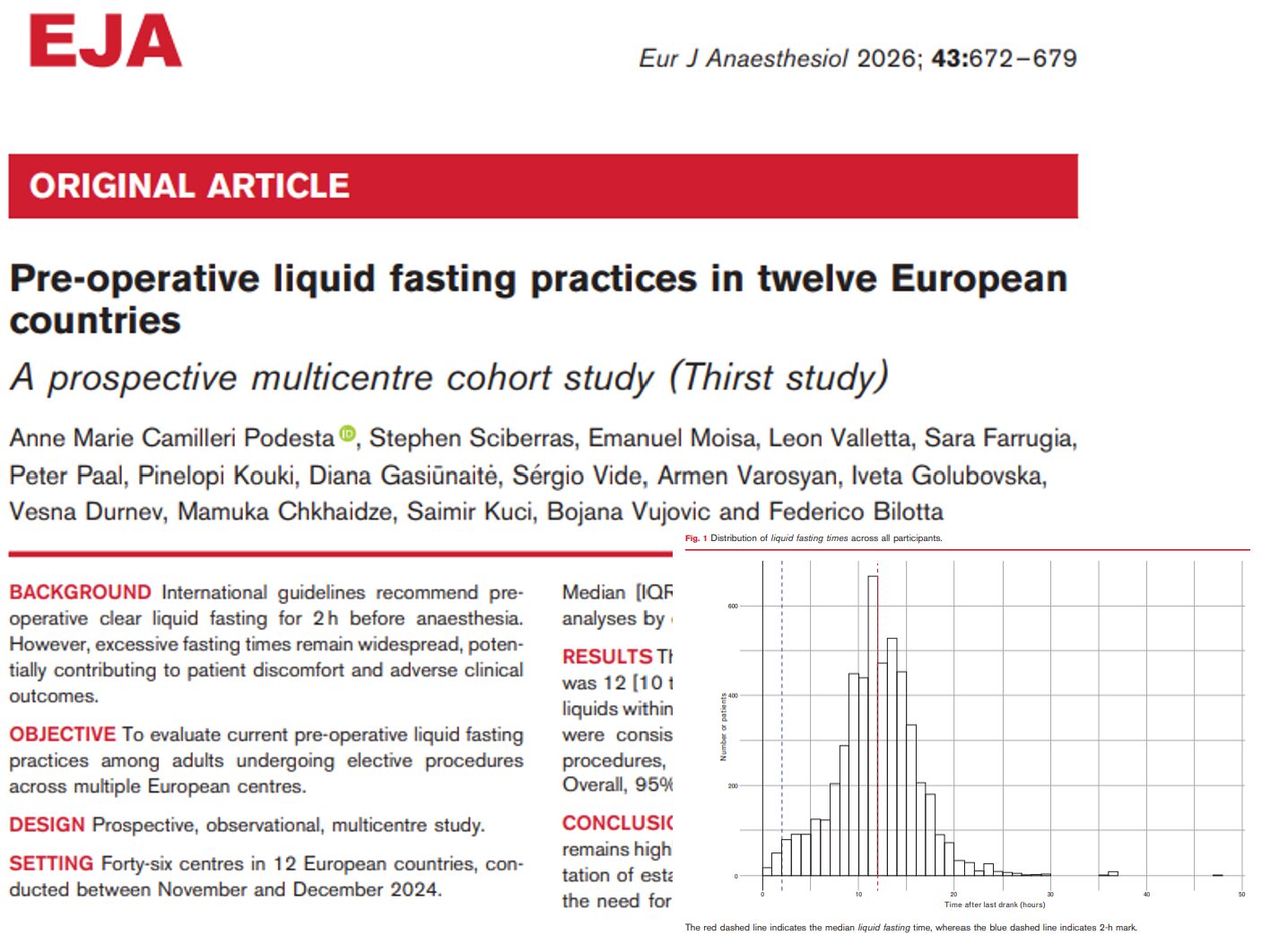

Intravenous (IV) iron therapy is an effective and generally safe treatment for iron deficiency and iron-deficiency anemia (IDA). Yet concerns about adverse reactions continue to limit its use, potentially leaving patients with inadequately treated anemia.
A new international consensus paper published in the British Journal of Anaesthesia (BJA) in July 2026 aims to address these concerns by translating current evidence into practical recommendations for clinicians.
Developed by experts from the Network for the Advancement of Patient Blood Management, Haemostasis and Thrombosis (NATA), the publication provides guidance on selecting IV iron formulations, recognising adverse events, preventing complications and managing reactions safely.
The central message is reassuring: serious hypersensitivity reactions are rare, most infusion-related events are manageable, and appropriate monitoring and formulation selection can substantially improve treatment safety.
However, the recommendations also highlight an important and sometimes overlooked complication: formulation-dependent hypophosphatemia, particularly following ferric carboxymaltose administration.
Key findings at a glance
- Serious hypersensitivity reactions are uncommon: Severe reactions occur in only a small proportion of patients receiving modern IV iron formulations.
- Not every infusion reaction is anaphylaxis: Mild, transient reactions can often be managed by temporarily interrupting the infusion.
- Hypophosphatemia varies substantially between formulations: A meta-analysis reported an incidence of 47% with ferric carboxymaltose versus 4% with ferric derisomaltose.
- Extravasation can cause permanent skin staining: Careful cannula placement, saline flushing and regular inspection are essential.
- Infection risk remains uncertain: Most large randomised trials have not demonstrated a clinically important increase in infection risk, although treatment is generally deferred during active, uncontrolled infections.
- Routine prolonged observation is not always necessary: NATA suggests that mandatory 30-minute postinfusion observation is generally unnecessary, while emphasising close monitoring during administration.
- Treatment should be individualised: Patient characteristics, cumulative iron exposure, infusion convenience and formulation-specific adverse effects should guide clinical decisions.
Why intravenous iron safety matters
Iron deficiency and IDA are common among patients undergoing major surgery and those living with chronic kidney disease, heart failure, inflammatory bowel disease and cancer.
IV iron is particularly valuable when oral iron is ineffective, poorly tolerated or contraindicated, or when rapid iron replenishment is clinically necessary.
Compared with oral supplementation, IV administration can replenish iron stores more rapidly and support hemoglobin recovery.
In perioperative patient blood management, IV iron is increasingly used to optimize hemoglobin concentrations and support recovery from postoperative anemia.
However, the new consensus emphasises that improvements in iron parameters do not automatically translate into fewer blood transfusions or better major clinical outcomes in every surgical population. Evidence remains inconsistent, particularly when IV iron is administered shortly before cardiac surgery.
Despite these limitations, appropriate IV iron treatment remains an important component of modern anemia management.
1. Hypersensitivity reactions: distinguishing mild reactions from anaphylaxis
Hypersensitivity reactions are among the most feared complications of IV iron administration.
The consensus highlights a critical distinction between transient infusion reactions and true anaphylaxis.
Most infusion reactions are not IgE-mediated
Many acute reactions associated with modern IV iron formulations are thought to involve complement activation-related pseudoallergy (CARPA).
In this process, iron–carbohydrate nanoparticles activate the complement system, potentially generating the anaphylatoxins C3a and C5a and triggering inflammatory mediator release.
Symptoms may include:
- Transient flushing or warmth
- Chest or back tightness
- Nausea or anxiety
- Mild hypotension
- Transient discomfort during infusion
These reactions often resolve after temporarily stopping the infusion.
A characteristic presentation is the Fishbane reaction, a self-limiting, non-allergic infusion reaction involving chest or back discomfort, myalgia and flushing without significant respiratory or cardiovascular compromise.
The consensus estimates that Fishbane-like reactions occur in approximately 1% of administrations.
Recognising anaphylaxis
Anaphylaxis is considerably rarer but potentially life-threatening.
Warning signs include:
- Persistent or worsening hypotension
- Bronchospasm, wheezing or stridor
- Angioedema involving the lips, tongue or airway
- Generalised urticaria
- Respiratory compromise
- Syncope or cardiovascular collapse
The consensus describes severe or potentially dangerous reactions as occurring in fewer than 0.1% of administrations in its comparative clinical table. Rates vary across studies and definitions.
Importantly, anaphylaxis requires immediate emergency treatment and must not be confused with a benign infusion reaction.
Clinical recommendations
NATA recommends temporarily interrupting IV iron administration when mild reactions occur and providing supportive care.
Once symptoms have completely resolved and a serious hypersensitivity reaction has been excluded, cautious rechallenge at a slower infusion rate may be considered under close clinical supervision.
In contrast, rechallenge is not recommended following suspected IgE-mediated hypersensitivity or anaphylaxis.
Formal desensitisation may be considered in selected patients when IV iron remains essential, with specialist supervision.
2. Managing an acute infusion reaction: a practical approach
The consensus provides a clinical algorithm for recognising and managing infusion-related adverse events.
Step-by-step management
- Stop the infusion immediately. Interrupt IV iron administration when an acute reaction is suspected.
- Assess the patient. Evaluate airway, breathing, circulation, vital signs and the severity of symptoms.
- Maintain intravenous access. Switch to normal saline as appropriate and continue clinical monitoring.
- Differentiate mild reactions from anaphylaxis. Look for respiratory compromise, progressive hypotension, angioedema or multisystem involvement.
- Provide appropriate treatment. Mild reactions may resolve with observation and supportive care. Suspected anaphylaxis requires immediate epinephrine and emergency resuscitation according to local protocols.
- Consider further administration only when safe. Rechallenge may be appropriate after a clearly mild, resolved reaction, but not following suspected anaphylaxis.
- Document the event. Record symptoms, timing, formulation, dose, infusion rate, treatment and outcome.
Important clinical distinction: Epinephrine is the first-line treatment for anaphylaxis. Current standard emergency practice generally favours intramuscular epinephrine initially; intravenous epinephrine is reserved for appropriately monitored specialist resuscitation settings. Antihistamines and corticosteroids must not delay epinephrine administration.
3. Hypophosphatemia: an important formulation-dependent complication
One of the most clinically significant findings concerns hypophosphatemia, or abnormally low serum phosphate concentrations.
Although many cases are mild and asymptomatic, severe or prolonged phosphate depletion can produce substantial morbidity.
Ferric carboxymaltose carries a higher risk
The consensus highlights major differences between available IV iron preparations.
A meta-analysis of 42 clinical trials reported the following pooled incidence of hypophosphatemia:
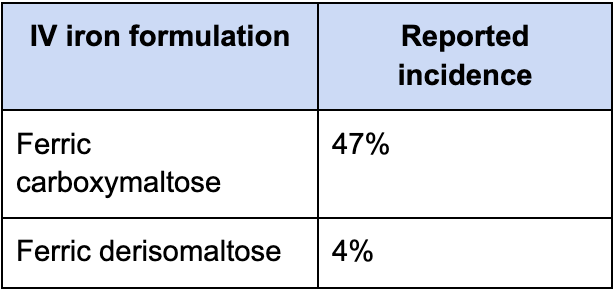
These figures represent pooled study estimates rather than the expected risk for every individual patient.
In the PHOSPHARE-IBD trial, hypophosphatemia occurred in up to 51% of patients treated with ferric carboxymaltose during follow-up through day 35.
The consensus also notes that ferric carboxymaltose-associated hypophosphatemia can persist for several months in some patients.
Clinical consequences
Hypophosphatemia generally develops within the first two weeks after treatment.
Potential symptoms include:
- Persistent or worsening fatigue
- Muscle weakness
- Myalgia
- Bone pain
- Reduced physical performance
Severe or prolonged phosphate depletion may lead to hypophosphatemic osteomalacia and fractures, particularly after repeated exposure.
These symptoms can overlap with those of iron deficiency, making diagnosis challenging.
Which patients require closer monitoring?
Risk factors identified in the consensus include repeated iron infusions, high cumulative iron exposure, malnutrition, low baseline phosphate concentrations and concomitant antiresorptive therapy.
Routine phosphate testing is not considered necessary for every patient receiving IV iron.
However, NATA supports targeted monitoring in individuals at increased risk or those developing symptoms suggestive of phosphate depletion.
For patients requiring recurrent treatment, clinicians should consider whether a formulation associated with a lower incidence of hypophosphatemia would be more appropriate.
Clinical takeaway: The choice of IV iron formulation should consider not only dose and infusion time but also the patient’s likelihood of requiring repeated treatment and their susceptibility to phosphate depletion.
4. Extravasation: preventing tissue injury and permanent skin staining
Extravasation occurs when IV iron leaks from the blood vessel into surrounding tissue.
Although uncommon, it can cause persistent skin discoloration and, in more severe cases, tissue injury, ulceration, necrosis or scarring.
Unlike many transient infusion reactions, iron-related skin staining can be permanent.
Recognising extravasation early
Clinicians should monitor for:
- Pain or burning at the cannula site
- Swelling around the infusion site
- Erythema or blanching
- Local discomfort during administration
- Changes in skin colour
Prevention recommendations
NATA recommends flushing the IV line with 10 mL of 0.9% normal saline before and after IV iron administration.
Additional precautions include selecting an appropriate vein, securing the cannula, confirming patency and regularly checking the infusion site.
The practical checklist advises reassessing the cannula site every 5–10 minutes during administration.
What to do if extravasation occurs
- Stop the infusion immediately.
- Assess the cannula and affected tissue.
- Attempt gentle aspiration through the cannula before removal.
- Elevate the affected limb and provide appropriate local care.
- Document the event, including the extent of tissue changes.
- Arrange clinical follow-up and consider specialist referral when indicated.
The paper discusses additional management options, including cold compresses, saline washout and selected adjunctive treatments, although these should be guided by local extravasation protocols and specialist assessment.
Patients may require monitoring for up to eight weeks to identify delayed tissue injury or persistent discoloration.
The consensus also recommends appropriate counselling and photographic documentation when necessary.
5. Infection risk: what does the evidence show?
Whether IV iron increases infection risk has been debated for years.
Iron is essential for microbial growth, raising theoretical concerns that iron administration could facilitate pathogen proliferation.
However, iron is also necessary for normal immune function.
The 2026 consensus reviews evidence from major randomised trials involving patients with chronic kidney disease, heart failure and other conditions.
Several large studies, including PIVOTAL and trials involving ferric carboxymaltose, did not demonstrate a significant increase in infection rates.
Nevertheless, the evidence is not entirely conclusive.
Patients with active infections were often excluded from clinical trials, limiting the certainty of conclusions for this population.
Practical recommendations
The NATA panel recommends using IV iron when clinically indicated but deferring treatment in the presence of active, uncontrolled infection and during antibiotic treatment as specified in its consensus statement.
Clinical decisions should consider infection severity, the urgency of correcting iron deficiency and the patient’s overall condition.
The findings do not support routinely withholding IV iron from all patients solely because of a theoretical infection risk.
6. Choosing the appropriate IV iron formulation
Modern IV iron products differ in maximum permitted doses, infusion durations, cost and adverse-event profiles.
The consensus includes the following examples of administration characteristics:
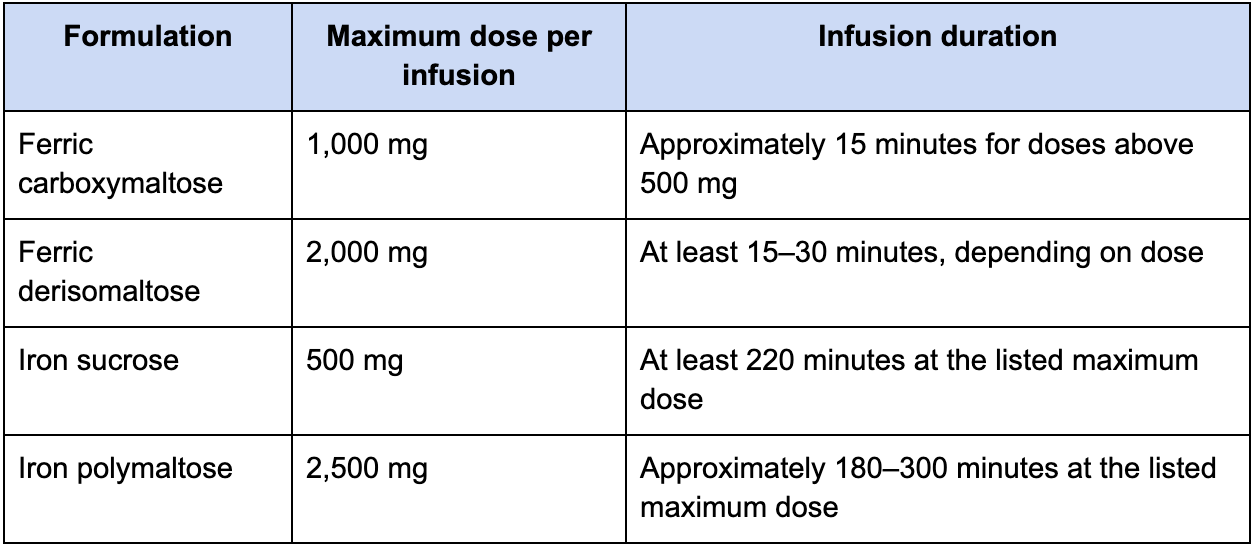
These figures reproduce the product examples in the consensus paper. Approved doses and infusion protocols may differ according to country, formulation and current product information.
Ferric carboxymaltose and ferric derisomaltose offer convenient high-dose administration, potentially reducing the number of visits required.
However, convenience must be balanced against formulation-specific risks, especially hypophosphatemia.
The authors also emphasise cost and availability, noting that more expensive preparations have not demonstrated clear clinical superiority across all settings.
7. Practical checklist for safe intravenous iron administration
The publication provides a detailed checklist intended to standardise safe clinical practice.
Before the infusion
- Confirm the indication for IV iron.
- Review hemoglobin and iron status and determine the appropriate dose.
- Identify previous IV iron reactions and relevant allergy risk factors.
- Assess for active infection and other relevant clinical concerns.
- Consider hypophosphatemia risk when selecting the formulation.
- Explain potential adverse events, including skin staining.
- Confirm secure venous access and flush with normal saline.
- Ensure emergency medications and resuscitation equipment are available.
During the infusion
- Start at the appropriate recommended infusion rate.
- Observe the patient closely, especially during the first 10–15 minutes.
- Maintain communication with the patient.
- Monitor for hypersensitivity symptoms.
- Inspect the cannula site every 5–10 minutes.
- Monitor vital signs as clinically indicated.
- Stop the infusion immediately if an adverse reaction or extravasation is suspected.
After the infusion
- Flush the cannula according to protocol.
- Reassess the infusion site.
- Inform the patient about possible delayed symptoms.
- Document the formulation, dose, batch number and infusion duration.
- Record any adverse events and their management.
- Arrange follow-up or phosphate monitoring when clinically indicated.
NATA suggests that routine prolonged postinfusion observation is generally unnecessary, but monitoring must still comply with local policies and applicable product information.
8. Intravenous iron during pregnancy
The consensus also addresses IV iron administration during pregnancy.
IV iron should generally be avoided during the first trimester whenever possible.
During the second and third trimesters, IV iron can be considered when oral iron is ineffective or poorly tolerated, particularly when rapid correction of anemia is required.
NATA recommends vigilant maternal monitoring during infusion but does not recommend routine continuous fetal monitoring in otherwise uncomplicated pregnancies.
A brief fetal heart rate assessment before and after administration may be considered.
Conclusion: safer intravenous iron begins with better recognition and prevention
The 2026 NATA consensus reinforces an important principle: fear of rare adverse reactions should not unnecessarily prevent patients from receiving effective iron replacement therapy.
At the same time, safe administration requires more than selecting an iron formulation and calculating a dose.
Clinicians must distinguish benign infusion reactions from anaphylaxis, recognise formulation-dependent hypophosphatemia, prevent extravasation and assess infection risk.
The recommendations provide a practical framework for integrating these considerations into routine clinical care.
By combining appropriate patient selection, informed consent, careful infusion monitoring and prompt adverse-event management, healthcare teams can optimise the benefits of IV iron while minimising avoidable harm.
For anesthesiologists, hematologists, surgeons, nurses and other professionals involved in patient blood management, these recommendations offer an opportunity to improve both the safety and consistency of intravenous iron treatment.
Reference: Saal-Bauernschubert L et al. Intravenous iron administration and management of adverse events: a systematic review and Network for the Advancement of Patient Blood Management, Haemostasis and Thrombosis consensus recommendations. Br J Anaesth. 2026;137:708–720.
Go beyond the paper: Listen to the NYSORA Podcast about this article HERE.
For more expert guidance on perioperative anemia management, patient blood management, and anesthesia safety, turn to NYSORA’s Anesthesiology Manual for practical, evidence-based insights to support everyday clinical practice!