 Nerve Blocks App
 Anesthesia Assistant App
 Ultrasound Pain App
 Pain Medicine Assistant App
 POCUS App
 IV Access App
 MSK Knee App
 VetRA App
 Nerve Block Manual 2027
 Nerve Block Manual
 Regional Anesthesia Updates
 Anesthesiology Manual
 Anesthesiology Review
 Anesthesia Updates 2025
 Anesthesia Updates 2026
 Pediatric Anesthesia Updates
 Airway Management Updates
 US Interventional Pain Manual
 Pain Medicine Updates
 Mastering Difficult IV Access
 PACU Nursing Manual
 RA Veterinary Manual
 Books
Books About
About
 Back to News
 9 min read


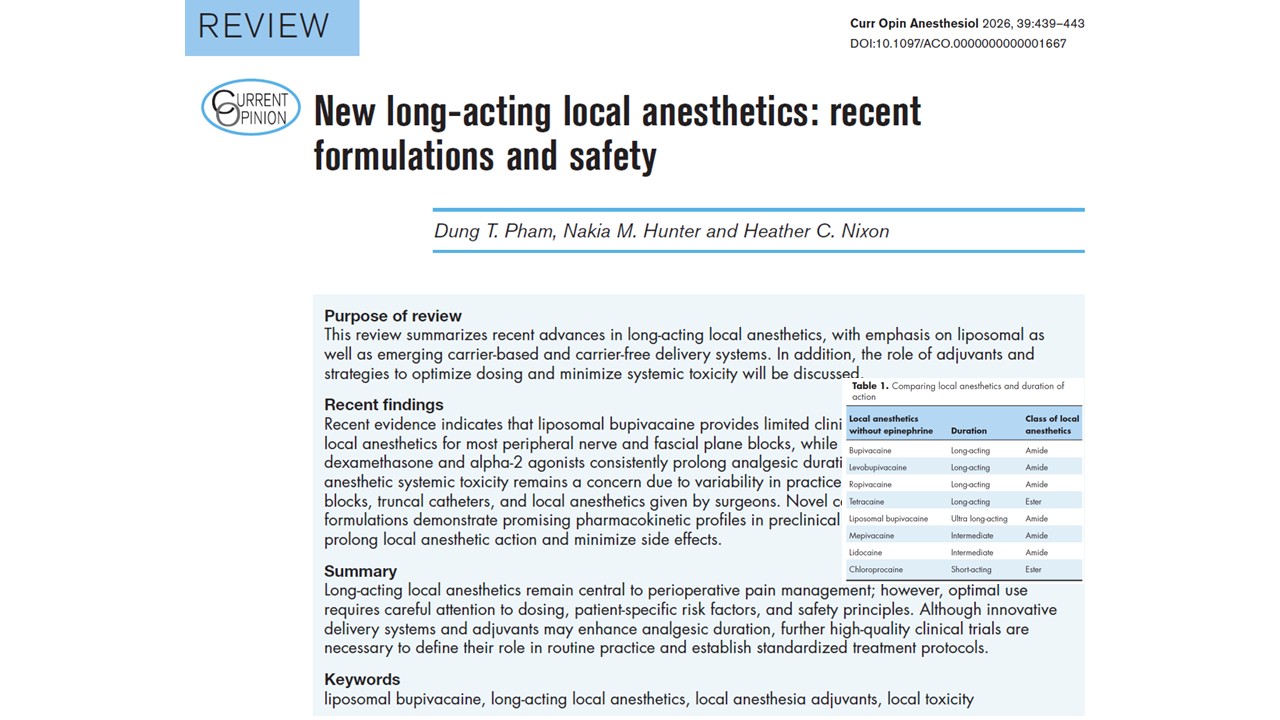
Long-acting local anesthetics have become a cornerstone of modern perioperative pain management, enabling clinicians to provide prolonged analgesia while reducing opioid requirements and improving postoperative recovery. Over the past decade, advances in drug delivery technologies have generated considerable excitement, particularly with the introduction of liposomal formulations and the development of innovative carrier-based and carrier-free anesthetic systems.
However, despite growing commercial adoption and ongoing technological innovation, a new review published in Current Opinion in Anaesthesiology suggests that enthusiasm should be balanced by evidence. While several novel formulations show promise in extending analgesia and improving drug pharmacokinetics, the clinical advantages of currently available products—particularly liposomal bupivacaine—appear more modest than initially anticipated. At the same time, concerns regarding local anesthetic systemic toxicity (LAST), dosing variability, and cost-effectiveness continue to influence clinical decision-making.
Long-acting local anesthetics remain central to multimodal analgesia
Regional anesthesia has transformed perioperative pain management by allowing targeted pain control while minimizing systemic opioid exposure.
Traditional long-acting local anesthetics—including bupivacaine, levobupivacaine, ropivacaine, and tetracaine—have been widely used for decades in peripheral nerve blocks, neuraxial anesthesia, wound infiltration, and fascial plane blocks.
More recently, these agents have become integral components of enhanced recovery after surgery (ERAS) protocols, where prolonged analgesia facilitates earlier mobilization, shorter hospital stays, and improved patient satisfaction.
The review notes that current research is focused less on discovering entirely new anesthetic molecules and more on developing innovative delivery systems capable of prolonging drug action while minimizing systemic toxicity and adverse effects.
Drug delivery technology is driving the next generation of local anesthetics
Instead of relying solely on the pharmacological properties of existing drugs, researchers are engineering sophisticated delivery platforms that release local anesthetics gradually.
Two major approaches are currently under investigation:
- Carrier-based formulations
- Carrier-free formulations
Both strategies aim to maintain effective tissue concentrations for longer periods without increasing peak plasma levels that could contribute to toxicity.
According to the review, several technologies are being explored, including:
- Liposomal delivery systems
- Microspheres
- Nanoparticles
- Bioadhesive films
- Lipid–protein–sugar particles
- Hydrogels
- Self-assembling molecular systems
These technologies seek to provide prolonged analgesia while reducing the need for repeated injections or continuous catheter techniques.
Liposomal bupivacaine remains the most established innovation
Among commercially available long-acting formulations, liposomal bupivacaine has attracted the greatest attention.
First approved by the U.S. Food and Drug Administration in 2011 for surgical site infiltration, liposomal bupivacaine uses multivesicular lipid carriers to slowly release bupivacaine over several days.
The theoretical advantages are attractive:
- Longer postoperative pain control
- Reduced opioid consumption
- Improved patient comfort
- Fewer rescue analgesics
- Earlier hospital discharge
These expectations led to the rapid expansion of liposomal bupivacaine into peripheral nerve blocks and fascial plane blocks across multiple surgical specialties.
However, the latest evidence paints a more nuanced picture.
Clinical benefits appear smaller than expected
The review highlights multiple recent studies comparing liposomal bupivacaine with conventional local anesthetics.
Perhaps the strongest evidence comes from a systematic review and meta-analysis involving 16 randomized clinical trials and more than 1,200 adult patients undergoing abdominal fascial plane blocks.
Investigators evaluated:
- Postoperative pain scores
- Opioid consumption
- Duration of analgesia
- Opioid-related adverse effects
The analysis found no meaningful differences between liposomal bupivacaine and conventional local anesthetics across either primary or secondary outcomes.
Similarly, a randomized trial evaluating transversus abdominis plane (TAP) blocks following major abdominal surgery compared liposomal bupivacaine, plain bupivacaine, and placebo.
Again, investigators observed similar:
- Pain scores
- Opioid consumption
- Sensory recovery
- Opioid-related complications
These findings suggest that prolonged drug release does not necessarily translate into clinically superior analgesia for many regional anesthesia techniques.
Utilization trends reflect changing clinical confidence
Real-world clinical practice appears to mirror these findings.
A population-based study involving more than 100,000 orthopedic procedures demonstrated that use of liposomal bupivacaine increased rapidly between 2012 and 2015, then gradually declined in subsequent years.
Although usage remained relatively common in academic centers and certain geographic regions, overall adoption slowed as evidence questioning its clinical superiority accumulated.
Cost has also emerged as an important consideration.
The review notes that liposomal bupivacaine may cost up to 100 times more per milligram than conventional bupivacaine, raising important questions regarding value when clinical benefits remain inconsistent.
Novel carrier-free formulations may overcome current limitations
While liposomal technology has dominated clinical discussion, researchers are increasingly exploring carrier-free delivery systems.
Unlike liposomal preparations, these formulations modify the anesthetic molecule itself or alter its physical properties to achieve slower release without requiring lipid encapsulation.
Several experimental approaches highlighted in the review include:
- Modified drug crystals
- pH-adjusted formulations
- Molecular modifications
- Self-assembling nanoparticles
- Injectable hydrogels
One particularly innovative system combines two anesthetics with different solubility profiles—QX314-OH and levobupivacaine—within a hyaluronic acid hydrogel.
Animal studies demonstrated controlled drug release and prolonged analgesia through differences in drug solubility.
Although still experimental, this approach illustrates how engineering drug behavior may ultimately prove more effective than simply encapsulating existing anesthetics.
Combination therapies may provide synergistic analgesia
Another promising direction involves combining local anesthetics with anti-inflammatory medications.
The review describes a dual-drug delivery system containing levobupivacaine and meloxicam encapsulated within vesicular phospholipid gels.
In preclinical studies, both drugs were released gradually over approximately five days.
Researchers believe this combination offers complementary mechanisms:
- Levobupivacaine blocks nerve conduction.
- Meloxicam suppresses postoperative inflammation.
Together, they may provide more durable postoperative pain control than either agent alone.
Another investigational product, HTX-011, combines low-dose meloxicam with bupivacaine in a bioerodible polymer matrix.
Clinical studies cited in the review reported that more than 90% of patients required no opioid rescue medication during the first 72 postoperative hours following wound infiltration.
Although encouraging, further large-scale studies are needed before widespread adoption.
Self-assembling formulations represent another frontier
Researchers are also exploring self-assembling molecular systems that form slow-release microcrystals upon administration.
One experimental formulation combines ropivacaine with methylprednisolone sodium succinate.
Following injection, the compounds spontaneously assemble into ropivacaine microcrystals that gradually release an anesthetic.
Beyond prolonging analgesia, investigators observed reduced local tissue toxicity, potentially owing to the anti-inflammatory properties of methylprednisolone.
Animal studies suggest that similar technology could eventually be adapted for multiple local anesthetics and adjuvants.
Adjuvants continue to play an important role
While researchers pursue new drug formulations, existing adjuvants remain among the most effective methods for extending regional anesthesia.
The review identifies several agents with the strongest supporting evidence:
- Dexamethasone
- Clonidine
- Dexmedetomidine
These medications enhance analgesia through multiple mechanisms and often prolong sensory blockade beyond what local anesthetics alone can achieve.
A recent systematic review found that:
- Four milligrams of perineural dexamethasone
- Eight milligrams of intravenous dexamethasone
Both significantly prolonged peripheral nerve block duration compared with no adjuvant.
Similarly, dexmedetomidine appears capable of accelerating block onset while improving analgesic duration and reducing postoperative nausea, vomiting, and delirium.
Nevertheless, the authors caution that optimal dosing strategies remain uncertain because available studies demonstrate considerable heterogeneity.
Local anesthetic systemic toxicity remains a major concern
Despite advances in technology, local anesthetic systemic toxicity continues to represent one of the most serious complications of regional anesthesia.
LAST may present with:
- Perioral numbness
- Tinnitus
- Seizures
- Cardiac arrhythmias
- Cardiovascular collapse
Bupivacaine remains particularly concerning because of its high affinity for cardiac sodium channels.
Fortunately, clinical practice has evolved considerably.
The review credits several developments with improving safety:
- Routine ultrasound guidance
- Incremental injection techniques
- Lower effective concentrations
- Greater awareness of toxicity
- Early lipid emulsion therapy
A recent pharmacovigilance analysis demonstrated a substantial decline in mortality associated with long-acting local anesthetics after 2010, likely reflecting wider adoption of ultrasound-guided regional anesthesia and standardized lipid rescue protocols.
High-volume fascial plane blocks require particular attention
One important message emerging from the review concerns dosing practices.
Modern fascial plane blocks frequently require large volumes of local anesthetic.
Recommended strategies include:
- Using lower concentrations when larger volumes are required
- Performing incremental injections
- Aspirating before injection
- Employing ultrasound guidance
- Adjusting doses according to patient-specific risk factors
- Considering epinephrine to reduce intravascular absorption
Certain procedures—including erector spinae plane blocks, TAP blocks, and pectoral nerve blocks—may warrant additional caution because of their relatively large injection volumes and anatomical characteristics.
Current practice often exceeds recommended dose limits
Perhaps one of the most concerning observations in the review concerns cumulative dosing.
A narrative review evaluating more than 100 studies involving truncal catheters found that typical 24-hour doses frequently exceeded recommended maximum limits.
Investigators reported:
- Approximately 28% exceeded recommended ropivacaine doses.
- Approximately 51% exceeded recommended bupivacaine doses.
Thirty cases of LAST were identified.
Risk factors included:
- High cumulative doses
- Bilateral catheter techniques
- Drug interactions affecting metabolism
- Cardiac surgery
- Hypoalbuminemia
These findings highlight the need for more standardized, evidence-based dosing protocols across regional anesthesia practice.
Innovation must be balanced with evidence
The review emphasizes that newer technology alone should not drive clinical adoption.
Although many novel formulations demonstrate impressive pharmacokinetic properties in laboratory and early clinical studies, meaningful improvements in patient outcomes remain the ultimate goal.
Future investigations must determine whether these technologies consistently improve:
- Analgesic duration
- Functional recovery
- Opioid reduction
- Patient satisfaction
- Safety
- Cost-effectiveness
Only through high-quality randomized clinical trials can clinicians determine which innovations deserve widespread implementation.
The future of regional anesthesia
Long-acting local anesthetics continue to evolve rapidly.
Rather than relying solely on new anesthetic molecules, the field is increasingly focused on smarter drug delivery systems capable of maximizing efficacy while minimizing toxicity.
Liposomal formulations have demonstrated prolonged drug release, but their clinical advantages remain inconsistent across many peripheral nerve blocks. At the same time, carrier-free formulations, dual-drug systems, hydrogels, nanoparticles, and self-assembling microcrystals represent an exciting generation of technologies that may eventually provide more predictable, longer-lasting analgesia.
Equally important is the growing recognition that optimizing regional anesthesia extends beyond the anesthetic itself. Appropriate adjuvants, individualized dosing, ultrasound guidance, and vigilant monitoring remain essential components of safe and effective perioperative pain management.
Conclusion
Long-acting local anesthetics continue to evolve through innovative delivery systems and the use of adjuvants that aim to extend postoperative analgesia while reducing opioid requirements. However, the latest evidence indicates that although technologies such as liposomal, carrier-based, and carrier-free formulations show considerable promise, their clinical benefits are not yet consistently superior to those of conventional local anesthetics across many regional anesthesia techniques. At the same time, careful dosing, ultrasound guidance, and vigilance for local anesthetic systemic toxicity remain essential to ensuring patient safety. As research advances, well-designed clinical trials will be critical to determine whether these emerging formulations can deliver meaningful improvements in efficacy, safety, and cost-effectiveness before they become part of routine anesthetic practice.
For more information, refer to the full article in Current Opinion in Anesthesiology.
Pham DT, Hunter NM, Nixon HC. New long-acting local anesthetics: recent formulations and safety. Curr Opin Anaesthesiol. 2026 Aug 1;39(4):439-443.
Read more about local anesthetics in our Regional Anesthesiology Module on NYSORA 360 on NYSORA360 – an essential learning resource for residents with practical, up-to-date guidance.