 Nerve Blocks App
 Anesthesia Assistant App
 Ultrasound Pain App
 Pain Medicine Assistant App
 POCUS App
 IV Access App
 MSK Knee App
 VetRA App
 Nerve Block Manual
 Regional Anesthesia Updates
 Anesthesiology Manual
 Anesthesiology Review
 Anesthesia Updates 2025
 Anesthesia Updates 2026
 Pediatric Anesthesia Updates
 Airway Management Updates
 US Interventional Pain Manual
 Pain Medicine Updates
 Mastering Difficult IV Access
 PACU Nursing Manual
 RA Veterinary Manual
 Books
Books About
About
 Back to News
 7 min read
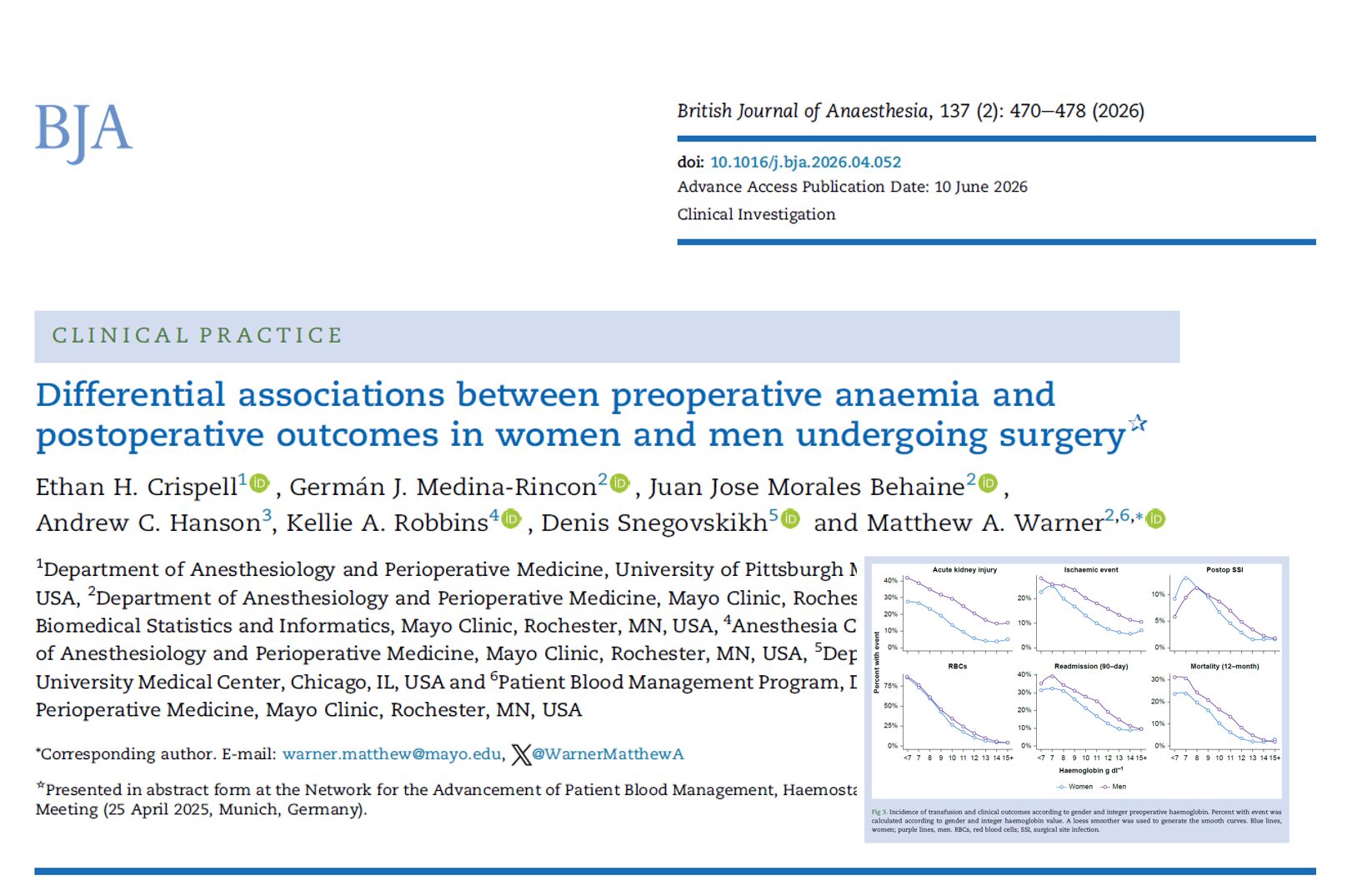
A large observational study published in the British Journal of Anaesthesia suggests that the relationship between preoperative anemia and several important postoperative complications differs between women and men.
Analysing more than 228,000 surgical procedures, Crispell and colleagues found that worsening preoperative anemia was associated with poorer postoperative outcomes in both groups. However, the associations with acute kidney injury (AKI), ischemic events and surgical site infection (SSI) were substantially stronger in women.
The findings add to the growing evidence supporting systematic detection and management of anemia before major surgery. They also raise an important question for perioperative clinicians: should women and men really be assessed using different hemoglobin thresholds when preparing for surgery?
More than 228,000 surgical procedures analysed
The retrospective observational cohort study included adults undergoing surgery at a large US academic medical centre between August 2012 and July 2022.
Patients were eligible if their procedure required postoperative hospital admission and a hemoglobin measurement was available within 90 days before surgery.
In total, the analysis included 228,341 procedures, of which 112,850 (49.4%) were in women and 115,491 (50.6%) in men.
Preoperative anemia was common:
- 31.1% of the overall cohort had preoperative anemia
- 30.8% of women were anemic
- 31.4% of men were anemic
- 13.2% of patients developed postoperative AKI
The investigators initially defined anemia according to sex-specific hemoglobin thresholds: < 12 g dl⁻¹ for women and < 13 g dl⁻¹ for men.
Anemia severity was categorised as:
- No anemia: ≥ 12 g dl⁻¹ in women or ≥ 13 g dl⁻¹ in men
- Mild anemia: ≥ 11 g dl⁻¹ but below the respective sex-specific threshold
- Moderate anemia: 8–10.9 g dl⁻¹
- Severe anemia: <8 g dl⁻¹
The primary outcome was postoperative AKI. Other outcomes included ischemic events, SSI, perioperative red blood cell (RBC) transfusion, postoperative length of stay, 90-day hospital readmission and 12-month mortality.
Anemia was associated with worse outcomes in both women and men
The overall message was clear: as preoperative anemia became more severe, postoperative outcomes generally worsened.
However, the magnitude of some associations differed significantly between women and men.
The most striking difference involved postoperative AKI.
Compared with patients without anemia, the adjusted odds ratio (OR) for AKI among patients with severe preoperative anemia was:
- 2.91 in women
- 1.43 in men
Importantly, this difference was not restricted to severe anemia.
For mild anemia, the adjusted OR for AKI was 1.75 in women compared with 1.23 in men. For moderate anemia, the corresponding values were 2.30 and 1.32.
This suggests a progressively stronger association between declining hemoglobin and renal complications among women.
Ischemic events also showed a stronger association in women
A similar pattern emerged for postoperative ischemic events.
For patients with severe anemia compared with those without anemia, the adjusted OR was:
- 2.48 in women
- 1.62 in men
The interaction between gender and anemia was statistically significant.
Although an observational analysis cannot establish that anemia directly causes these events, the findings suggest that a comparable degree of preoperative anemia may not carry an identical postoperative risk profile in women and men.
Surgical site infection showed another marked difference
The strongest relative association reported for severe anemia involved SSI.
Compared with patients without anemia, severe preoperative anemia was associated with an adjusted OR for SSI of:
- 4.78 in women
- 2.62 in men
Interaction testing confirmed significantly stronger anemia–outcome associations in women for AKI, ischemic events and SSI, with P < 0.001 for all three interactions.
These observations are biologically plausible, although the mechanisms remain uncertain.
The authors note that women generally have lower circulating blood volumes, hemoglobin concentrations and iron stores than men while potentially experiencing similar or proportionally greater perioperative blood loss.
Reduced hemoglobin and iron availability could affect tissue oxygen delivery and cellular function. Adequate oxygenation and iron availability are also important for immune responses and wound healing.
These mechanisms remain hypotheses rather than explanations established by this study.
Every 1 g dl⁻¹ decrease in hemoglobin mattered
One particularly informative part of the study treated hemoglobin as a continuous variable rather than simply categorising patients as anemic or non-anemic.
For every 1 g dl⁻¹ decrease in preoperative hemoglobin below 14 g dl⁻¹, the adjusted odds of several complications increased.
For AKI, the OR associated with each 1 g dl⁻¹ decrease was:
- 1.25 in women
- 1.08 in men
For ischemic events:
- 1.18 in women
- 1.11 in men
For SSI:
- 1.43 in women
- 1.32 in men
All three interactions were statistically significant at P < 0.001.
This continuous analysis is clinically important because it reduces the emphasis on a single diagnostic cut-off. Instead, it suggests that perioperative risk progressively increases as hemoglobin falls.
Not every outcome showed a stronger association in women
The results should not be interpreted as showing that anemia was more strongly associated with every adverse outcome among women.
For RBC transfusion, the relationship with decreasing hemoglobin was actually somewhat stronger in men.
For every 1 g dl⁻¹ decrease below 14 g dl⁻¹, the adjusted OR for RBC transfusion was 1.89 in men and 1.81 in women.
The effect estimate for postoperative length of stay was also modestly higher in men.
Meanwhile, the investigators found no significant gender interaction for 90-day hospital readmission or 12-month mortality in the continuous hemoglobin analyses.
This specificity strengthens an important interpretation of the findings: the observed gender differences appear to concern particular postoperative complications rather than representing a universal increase in anemia-associated risk among women.
Should perioperative anemia use a hemoglobin threshold of 13 g dl⁻¹ for everyone?
One of the study’s most clinically relevant implications concerns how anemia is defined before surgery.
Traditional WHO definitions use different thresholds for nonpregnant women and men: < 12 g dl⁻¹ and < 13 g dl⁻¹, respectively.
In perioperative medicine, however, there has been growing support for considering hemoglobin < 13 g dl⁻¹ as preoperative anemia irrespective of sex.
Crispell and colleagues performed a sensitivity analysis using this gender-neutral threshold. The principal findings remained consistent.
The authors argue that using < 12 g dl⁻¹ for women could fail to identify some women who are already experiencing increased anemia-associated perioperative risk.
The findings therefore support existing calls to consider a common 13 g dl⁻¹ preoperative threshold when screening surgical patients.
Importantly, this study does not demonstrate that raising hemoglobin above a particular value will necessarily prevent the observed complications. It identifies associations and should not be interpreted as a randomised evaluation of anemia treatment.
What should perioperative teams consider?
For anesthesiologists, surgeons and patient blood management teams, the findings reinforce the importance of treating preoperative anemia as a potentially modifiable perioperative risk marker rather than simply an abnormal laboratory result.
A practical pathway may include:
- Screen patients early: Obtain a full blood count sufficiently in advance of major surgery to allow investigation and treatment where appropriate.
- Identify the cause: Anemia is a clinical finding rather than a diagnosis. Evaluation should consider iron deficiency, chronic inflammation, renal disease, vitamin B12 or folate deficiency, ongoing blood loss and other relevant causes.
- Consider a 13 g dl⁻¹ threshold: Perioperative programmes may wish to consider whether a gender-neutral hemoglobin threshold better identifies patients requiring further assessment.
- Investigate iron status: Where clinically appropriate, ferritin, transferrin saturation and markers of inflammation can help determine whether iron deficiency is present.
- Treat the underlying cause: Management should be individualised according to anemia etiology, surgical urgency, expected blood loss, comorbidity and the time available before surgery.
- Plan perioperative blood management: Anemia assessment should form part of a broader patient blood management strategy incorporating blood conservation and appropriate transfusion practice.
A stronger case for early anemia detection
The study adds an important dimension to perioperative anemia management.
Preoperative anemia was common, affecting almost one-third of the cohort, and greater severity was consistently associated with poorer postoperative outcomes.
More importantly, the relationship was not identical between women and men. Women demonstrated substantially stronger associations between anemia and AKI, ischemic events and SSI.
For perioperative clinicians, these findings reinforce the value of early hemoglobin assessment, investigation of anemia and appropriate preoperative optimisation.
They also strengthen the rationale for reconsidering whether women should continue to have a lower hemoglobin threshold for defining anemia in the perioperative setting.
Further prospective studies will be required to determine whether targeted anemia treatment, and potentially the use of a universal 13 g dl⁻¹ screening threshold, can translate these observational findings into fewer postoperative complications.
Reference: Crispell EH et al. Differential associations between preoperative anaemia and postoperative outcomes in women and men undergoing surgery. Br J Anaesth. 2026;137:470-478.
Want to read more about anemia and its perioperative implications? Explore the NYSORA Anesthesiology Manual. Designed as a quick-reference resource, the manual puts essential information at your fingertips when you need it.
And for a digital learning experience, check out the Anesthesiology Module on NYSORA360!