 Nerve Blocks App
 Anesthesia Assistant App
 Ultrasound Pain App
 Pain Medicine Assistant App
 POCUS App
 IV Access App
 MSK Knee App
 VetRA App
 Nerve Block Manual
 Regional Anesthesia Updates
 Anesthesiology Manual
 Anesthesiology Review
 Anesthesia Updates 2025
 Anesthesia Updates 2026
 Pediatric Anesthesia Updates
 Airway Management Updates
 US Interventional Pain Manual
 Pain Medicine Updates
 Mastering Difficult IV Access
 PACU Nursing Manual
 RA Veterinary Manual
 Books
Books About
About
 Back to News
 8 min read

A large retrospective cohort study published in Regional Anesthesia and Pain Medicine suggests that regional anesthesia alone may provide substantially greater hemodynamic stability than combined general and regional anesthesia for elective shoulder arthroscopy performed in the beach-chair position.
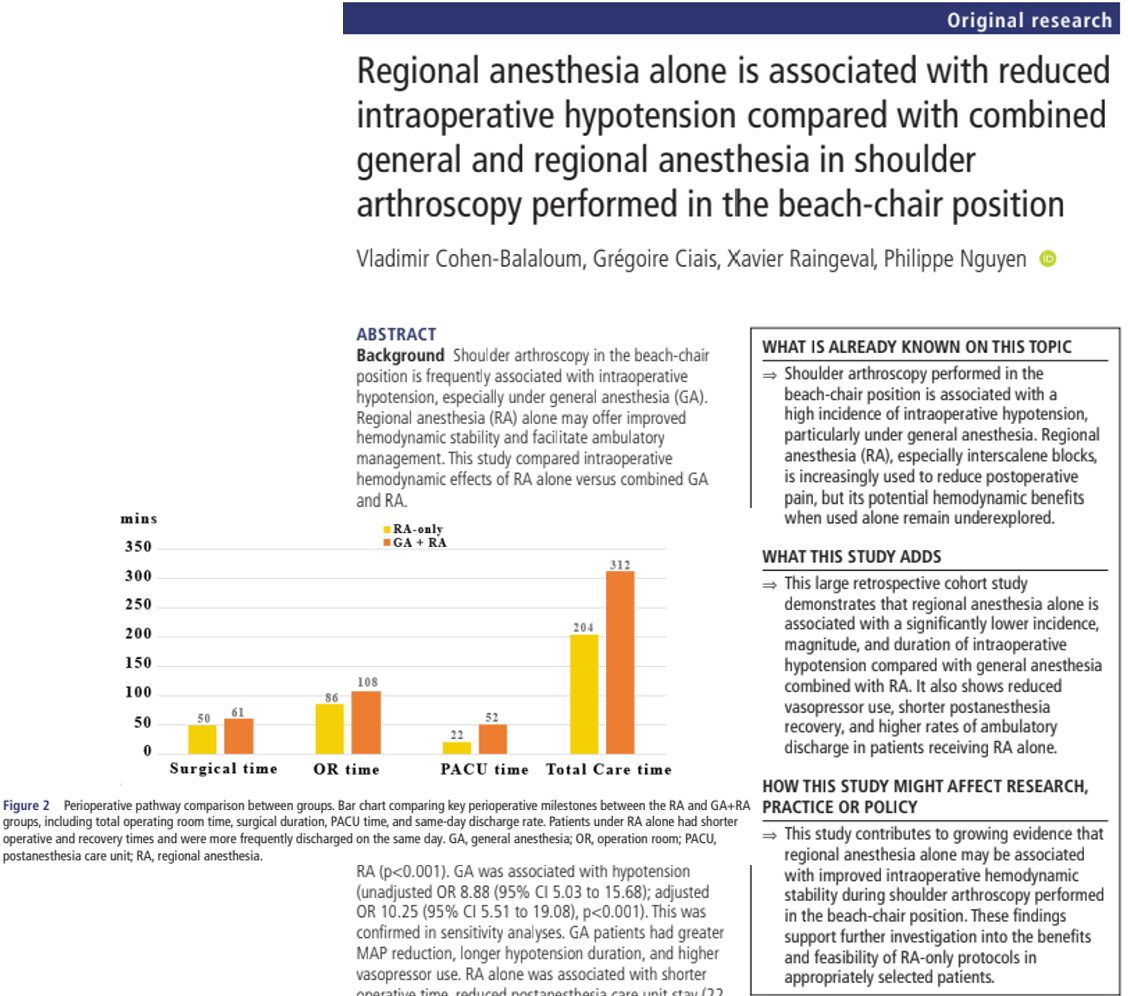
The study by Cohen-Balaloum and colleagues included 482 adults undergoing elective shoulder arthroscopy at a high-volume orthopedic surgery center in Paris, France. Intraoperative hypotension occurred in 13% of patients receiving regional anesthesia alone compared with 57% receiving general anesthesia plus regional anesthesia.
The findings also point to differences beyond blood pressure. Patients managed with regional anesthesia alone required fewer vasopressors, spent less time in the postanesthesia care unit (PACU), and were more frequently discharged on the day of surgery.
However, the investigators emphasize that this was a retrospective, single-center study. The results demonstrate associations rather than proving that regional anesthesia itself caused the improved outcomes.
Why blood pressure matters in the beach-chair position
Shoulder arthroscopy is frequently performed in the beach-chair position, in which the patient is positioned semi-upright to improve surgical exposure.
This positioning presents specific hemodynamic challenges. Gravitational redistribution of blood can reduce venous return and arterial pressure. Maintaining adequate mean arterial pressure (MAP) is particularly important because substantial hypotension may compromise cerebral, coronary, and renal perfusion.
General anesthetic agents can further influence cardiovascular physiology through vasodilation and myocardial depression, while positive-pressure ventilation may affect venous return.
Regional anesthesia potentially avoids some of these effects because patients can maintain spontaneous ventilation and do not necessarily require the anesthetic drugs used for general anesthesia.
The investigators therefore examined whether regional anesthesia used as the primary anesthetic—not simply as an analgesic supplement to general anesthesia—was associated with better intraoperative hemodynamics.
How the study was conducted
The retrospective cohort study included adults undergoing elective shoulder arthroscopy between October 1, 2023, and October 1, 2024, at Clinique Jouvenet in Paris.
After exclusions, 482 patients with complete intraoperative hemodynamic data were analyzed:
- 417 patients (87%) received regional anesthesia alone
- 65 patients (13%) received general anesthesia combined with regional anesthesia
- 77% of procedures were performed for rotator cuff tears
- Baseline demographic, cardiovascular and blood pressure characteristics were statistically similar between groups
Regional anesthesia consisted of an ultrasound-guided interscalene brachial plexus block combined with a superficial cervical plexus block.
The interscalene block was performed with 15–20 mL of ropivacaine 0.5%, while 5 mL was used for the superficial cervical plexus block. All interscalene blocks were single-shot procedures.
Light sedation with midazolam, propofol or clonidine could be administered when required.
Patients receiving general anesthesia underwent induction with propofol, sufentanil and a neuromuscular blocking agent, followed by maintenance with sevoflurane and mechanical ventilation.
Hypotension was much less frequent with regional anesthesia alone
The study’s primary outcome was intraoperative hypotension, defined as MAP below 65 mm Hg at any point during surgery.
The difference between groups was substantial:
- 13% of patients receiving regional anesthesia alone developed hypotension
- 57% of patients receiving general plus regional anesthesia developed hypotension
- The difference was statistically significant at p<0.001
The median minimum MAP was also markedly different: 86 mm Hg with regional anesthesia alone versus 63 mm Hg with combined general and regional anesthesia.
Patients receiving general anesthesia also experienced a greater relative decrease in MAP from baseline and longer periods of hypotension.
Adjusted analysis showed a strong association
Because factors other than anesthesia technique can influence blood pressure, the researchers performed several logistic regression analyses.
In the unadjusted analysis, combined general and regional anesthesia was associated with an odds ratio of 8.88 for intraoperative hypotension compared with regional anesthesia alone.
After adjustment for age, sex, body mass index, hypertension, cardiac disease, treated diabetes and chronic kidney disease, the association remained substantial:
Adjusted OR 10.25; 95% CI 5.51–19.08; p<0.001.
Sensitivity analyses using different definitions of hypotension, MAP below 70 mm Hg and a greater than 30% reduction from baseline MAP, produced similar findings.
Vasopressor requirements were also substantially different
The blood pressure differences translated into considerably different requirements for pharmacological support.
Ephedrine or phenylephrine was administered to:
- 8% of patients receiving regional anesthesia alone
- 55% of patients receiving combined general and regional anesthesia
Norepinephrine was required in 11% of the combined-anesthesia group, compared with no patients in the regional-anesthesia-only group.
Intravenous fluid administration was also greater in the combined group.
These findings suggest that the observed difference was not simply a matter of patients briefly crossing the study’s predefined MAP threshold. General anesthesia was associated with deeper and more prolonged blood pressure reductions and substantially greater requirements for active hemodynamic management.
Recovery was faster after regional anesthesia alone
Differences continued into the postoperative period.
Median PACU stay was:
22 minutes with regional anesthesia alone versus 52 minutes with combined general and regional anesthesia.
Same-day discharge occurred in:
96% versus 75%, respectively.
Total operating-room time was also shorter, at a median of 86 minutes with regional anesthesia alone versus 108 minutes with combined anesthesia.
Median total perioperative care duration was 3.4 hours versus 5.2 hours.
What about sedation during regional anesthesia?
Regional anesthesia alone did not necessarily mean patients remained completely unsedated.
Approximately 62% of patients in the regional anesthesia group received light sedation, most commonly midazolam or low-dose propofol.
Importantly, the investigators reported no sedation-related conversions to general anesthesia, respiratory compromise or prolonged recovery.
Six patients initially managed with regional anesthesia required conversion to general anesthesia because of block failure. These patients represented approximately 1% of the regional anesthesia cohort and were analyzed in the combined group under the study’s as-treated approach.
A sensitivity analysis excluding these patients did not materially change the findings.
Why might regional anesthesia improve hemodynamic stability?
The authors propose several physiological explanations.
General anesthesia may promote hypotension through systemic vasodilation, myocardial depression and the cardiovascular effects of positive-pressure ventilation.
In contrast, regional anesthesia alone allows spontaneous ventilation to continue and may better preserve sympathetic tone and normal cardiovascular compensatory mechanisms.
These differences could become particularly relevant when patients are placed upright in the beach-chair position, where venous return is already reduced.
The study cannot establish that these mechanisms caused the observed results, however. Physiological explanations should therefore be distinguished from the statistical association demonstrated by the cohort.
Important limitations
The magnitude of the differences is striking, but several limitations affect how the results should be interpreted.
Most importantly, this was not a randomized controlled trial.
At the study center, regional anesthesia was routinely proposed as the first-line technique. General anesthesia was generally used when patients specifically requested to be asleep. Consequently, unmeasured differences between patients, including anxiety or tolerance of awake surgery, could have influenced the results.
Other limitations include:
- The study was retrospective and conducted at a single specialized center
- Only 65 patients received combined general and regional anesthesia
- Propensity-score matching was not performed
- Sedation was not standardized in the regional-anesthesia group
- Same-day discharge depended partly on postoperative clinical assessment and institutional organization
- Postoperative neurological outcomes were not specifically studied
- The results may depend on substantial institutional expertise with regional anesthesia
The authors therefore call for prospective multicenter studies to confirm the findings.
What could the findings mean for shoulder surgery?
The results add to evidence supporting regional anesthesia as more than a postoperative analgesic technique for shoulder surgery.
In appropriately selected patients and experienced centers, an interscalene block combined with a superficial cervical plexus block may potentially serve as the primary anesthetic for arthroscopic procedures.
According to this cohort, potential advantages associated with that strategy included:
- Lower incidence and duration of intraoperative hypotension
- Smaller reductions in mean arterial pressure
- Reduced vasopressor requirements
- Shorter operating-room and recovery times
- Higher rates of same-day discharge
These findings should not be interpreted as showing that general anesthesia is inappropriate for shoulder arthroscopy. Individual anesthetic planning depends on the procedure, patient characteristics and preferences, contraindications to regional techniques, anticipated airway and respiratory considerations, and the experience of the anesthetic team.
What happens next?
The authors report that a randomized controlled trial, NCT06451380, is underway at their institution to investigate this question prospectively.
Future research could also determine whether the improved blood pressure profile translates into differences in clinically important outcomes, such as postoperative organ injury or neurological complications.
Research into patient satisfaction, optimal sedation protocols, long-term outcomes and cost-effectiveness could further clarify the role of regional-anesthesia-only pathways.
The bottom line
In this 482-patient cohort, regional anesthesia alone was associated with substantially less intraoperative hypotension than general anesthesia combined with regional anesthesia during elective shoulder arthroscopy in the beach-chair position.
The difference extended beyond the incidence of hypotension. Regional anesthesia alone was associated with less profound blood pressure reductions, lower vasopressor requirements, shorter PACU stays and more frequent same-day discharge.
The study provides a strong rationale for prospective investigation of regional-anesthesia-only pathways. But because the research was retrospective, single-center and non-randomized, randomized trials are needed before the observed associations can be interpreted as causal effects or broadly generalized to other surgical settings.
Reference: Cohen-Balaloum V et al. Regional anesthesia alone is associated with reduced intraoperative hypotension compared with combined general and regional anesthesia in shoulder arthroscopy performed in the beach-chair position. Reg Anesth Pain Med. 2026;51:947-953.
Read more about recent evidence like this in NYSORA’s Anesthesia Assistant app. Simulate case, check dosages and search through NYSORA knowledge database!