 Nerve Blocks App
 Anesthesia Assistant App
 Ultrasound Pain App
 Pain Medicine Assistant App
 POCUS App
 IV Access App
 MSK Knee App
 VetRA App
 Nerve Block Manual 2027
 Nerve Block Manual
 Regional Anesthesia Updates
 Anesthesiology Manual
 Anesthesiology Review
 Anesthesia Updates 2025
 Anesthesia Updates 2026
 Pediatric Anesthesia Updates
 Airway Management Updates
 US Interventional Pain Manual
 Pain Medicine Updates
 Mastering Difficult IV Access
 PACU Nursing Manual
 RA Veterinary Manual
 Books
Books About
About
 Back to News
 10 min read

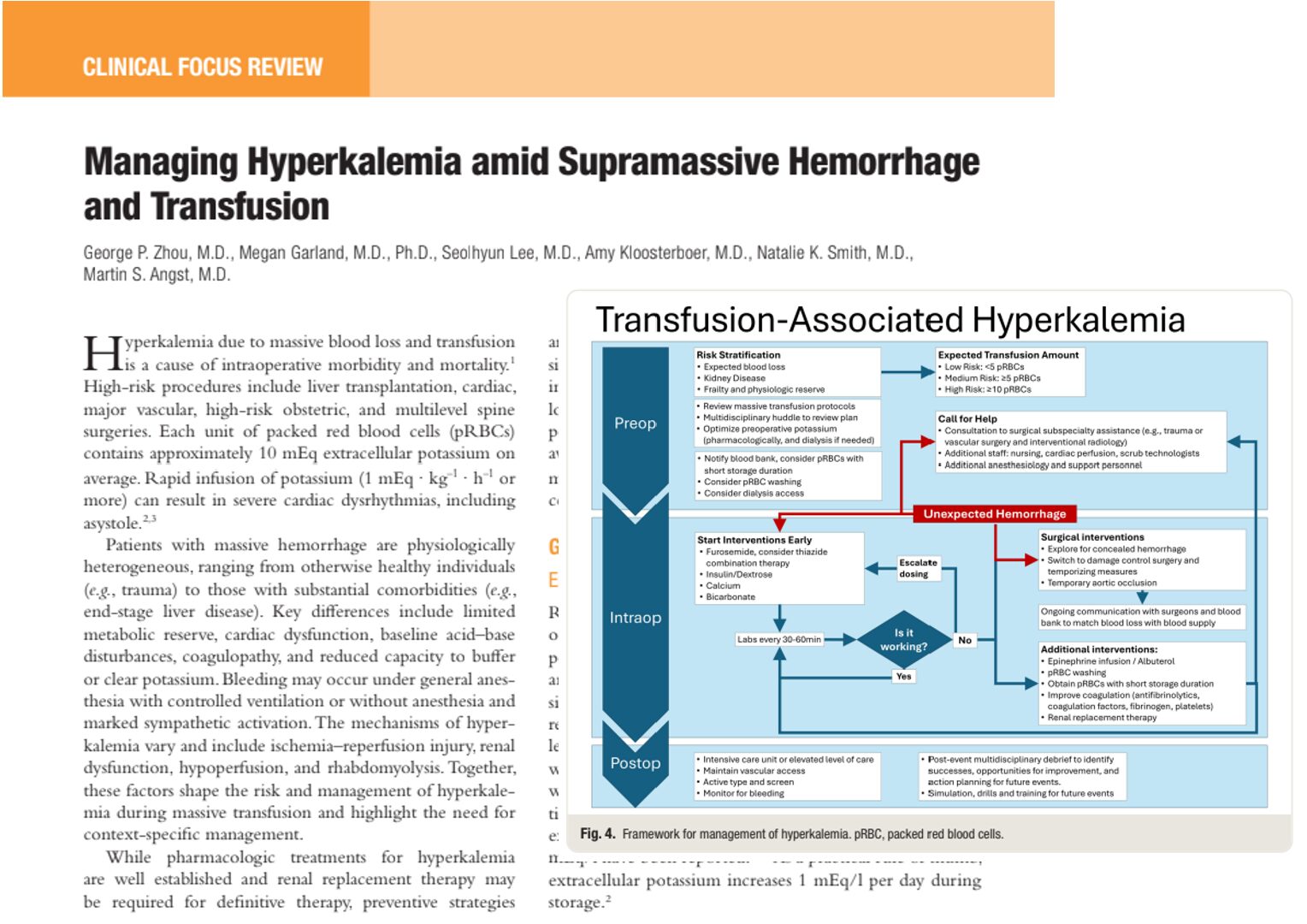
A 2026 Clinical Focus Review published in Anesthesiology provides a detailed framework for preventing and treating transfusion-associated hyperkalemia during massive hemorrhage, a potentially lethal complication that can culminate in severe cardiac dysrhythmia or asystole.
The review, by George P. Zhou, MD, and colleagues, focuses particularly on situations in which blood loss and transfusion reach extreme levels and conventional pharmacologic treatment may not be enough. High-risk settings include liver transplantation, cardiac surgery, major vascular procedures, high-risk obstetric surgery and multilevel spine surgery.
The central message is that clinicians should think beyond simply treating an elevated serum potassium concentration. Management can involve reducing the potassium being delivered, shifting potassium intracellularly, increasing renal elimination and, when necessary, removing potassium through renal replacement therapy.
Why massive transfusion can cause dangerous hyperkalemia
Potassium is predominantly intracellular. Red blood cells contain approximately 100 mEq/L of intracellular potassium, while only around 2% of total body potassium is normally extracellular.
During storage, however, potassium progressively leaks from erythrocytes into the extracellular component of packed red blood cell (pRBC) units.
According to the review:
- Extracellular potassium can exceed normal serum concentrations within 48 hours of storage
- Concentrations exceed approximately 10 mEq/L after the first week
- Concentrations may exceed 40 mEq/L as pRBCs approach expiration
- Levels above 70 mEq/L have been reported
- A practical approximation is an increase in extracellular potassium of about 1 mEq/L for each day of storage
This potassium burden becomes particularly important when large quantities of blood are delivered rapidly. The authors note that an average pRBC unit contains approximately 10 mEq of extracellular potassium.
Rapid potassium administration at approximately 1 mEq/kg/hour or greater can cause severe dysrhythmias, including asystole.
Irradiated blood may carry an additional potassium burden
Irradiated pRBCs deserve particular attention.
Irradiation is used to inactivate donor leukocytes, but it also accelerates erythrocyte hemolysis and the movement of intracellular potassium into the extracellular compartment.
The review reports extracellular potassium concentrations of approximately 15 to 20 mEq/L within 24 hours of irradiation, rising to 64 to 97 mEq/L by 14 days after irradiation.
Consequently, older irradiated units may present a substantial potassium load when transfused rapidly and in large volumes.
Transfusion speed can be as important as the potassium concentration
The problem is not simply how much potassium a unit contains. How quickly that potassium reaches the heart also matters.
Large-bore vascular access and modern rapid transfusion systems can deliver blood at extraordinary rates. The review describes flow rates of approximately 0.5 to 2 L/min through appropriate large-bore catheters and rapid transfusion equipment.
At such rates, potassium-rich blood entering the central circulation may transiently expose the myocardium to a much higher potassium concentration than a peripheral laboratory sample suggests.
Example: rapidly administering longer-stored pRBCs at 1 L/min in a patient with limited venous return could transiently produce an intracardiac potassium concentration of approximately 10 mEq/L.
This is clinically striking because commonly used cardioplegia solutions contain approximately 10 to 24 mEq/L potassium.
The implication is important: a patient’s measured systemic potassium concentration may not completely reflect the transient potassium concentration reaching the heart during extremely rapid transfusion.
Central versus peripheral transfusion may also matter
The location of the transfusion catheter could influence acute cardiovascular effects.
Blood delivered through an internal jugular or subclavian central venous catheter reaches the right heart rapidly. This may expose the myocardium abruptly to:
- Potassium
- Citrate
- Large-volume preload changes
- Associated reductions in ionized calcium
Femoral or peripheral administration could theoretically provide more opportunity for dilution and buffering before blood reaches the heart.
However, the authors emphasize that comparative evidence regarding catheter location remains limited.
Washing pRBCs directly reduces potassium exposure
One of the review’s most important preventive strategies is washing stored pRBCs before transfusion.
This differs fundamentally from medications such as insulin. Insulin temporarily shifts potassium from the extracellular to intracellular space; washing pRBCs removes much of the extracellular potassium before it enters the patient.
Blood-bank washing is already established in pediatric cardiac surgery, particularly for neonates whose cardiopulmonary bypass prime can represent a large proportion of their circulating blood volume.
For adult massive transfusion, however, conventional blood-bank washing is difficult to scale because individual units require processing, disposables and verification.
The authors therefore examine another approach: washing banked pRBCs intraoperatively using a cell salvage device.
How intraoperative pRBC washing works
Cell salvage systems normally collect blood from the operative field, separate erythrocytes using centrifugation, wash them and return the processed cells to the patient.
The same technology can be adapted so that banked pRBCs are loaded into the collection reservoir and processed before transfusion.
When stored pRBCs are washed with 0.9% saline, extracellular potassium can fall to approximately 2 mEq/L immediately after processing.
The review reports that prediluting pRBCs with saline at approximately 1:2 to 1:4 can:
- Achieve greater than 90% potassium clearance
- Minimize erythrocyte loss
- Produce RBC yields of approximately 95%
There is nevertheless an important logistical limitation: processing takes time.
The authors report approximately 6 to 10 minutes per pRBC unit in standard mode and 3 to 4 minutes in emergency mode.
Emergency processing sacrifices some purification efficiency for speed. For that reason, emergency mode should not be selected when maximal potassium removal is the overriding objective.
Balanced solutions may offer advantages for washing
Normal saline is commonly used for RBC washing, but the review discusses potential disadvantages when large quantities are involved, including changes in electrolyte composition and lower pH.
Balanced crystalloid solutions may reduce hemolysis and improve erythrocyte membrane integrity.
The authors also identify continuous renal replacement therapy (CRRT) dialysate as an interesting wash solution because it can provide:
- Potassium-free composition
- Favorable pH characteristics
- Large-volume bags
Its higher cost is a disadvantage.
When renal replacement therapy becomes important
For patients with severely impaired renal potassium elimination, renal replacement therapy may become essential.
Intermittent hemodialysis provides substantially greater potassium clearance than conventional CRRT. Using zero-potassium dialysate, the review reports removal of approximately 30 to 35 mEq of potassium during the first hour, with approximately 90 to 120 mEq removed during a conventional four-hour outpatient dialysis treatment.
However, intraoperative hemodialysis presents practical challenges involving water supply, waste disposal and hemodynamic stability.
CRRT is more portable and generally better suited to unstable intraoperative patients.
High-intensity CRRT may be needed
Routine CRRT prescriptions may not provide enough potassium clearance during ongoing massive transfusion.
The review’s theoretical examples demonstrate that potassium clearance can be increased by:
- Using potassium-free dialysate
- Increasing dialysate and replacement-fluid flow
- Increasing ultrafiltration when clinically appropriate
- Replacing ultrafiltration volume with low-potassium fluids
Importantly, actual clearance can be substantially lower than theoretical calculations because of treatment interruptions, filter clotting, changing serum potassium concentrations and machine-specific limitations.
The authors therefore advocate advance multidisciplinary planning for high-risk cases, potentially including an “emergency CRRT package” containing predefined prescriptions, equipment, supplies and nursing instructions.
Pharmacologic treatment remains essential
Device-based approaches do not replace conventional hyperkalemia treatment.
The review discusses several pharmacologic strategies.
Insulin and dextrose
A commonly used regimen consists of 5 to 10 units of intravenous regular insulin with 12.5 to 25 g of intravenous dextrose.
The review reports a typical serum potassium reduction of approximately 0.6 to 1.0 mEq/L within 15 to 60 minutes, with effects persisting for several hours.
Response can be attenuated in critically ill patients and those with insulin resistance or hepatic dysfunction.
The authors also emphasize that insulin-mediated potassium uptake and glucose uptake do not occur identically. Potassium influx can peak within approximately five minutes, whereas glucose uptake begins later.
Patients with advanced liver disease, sarcopenia or insulin resistance may therefore respond differently from healthier patients.
β2 agonists
Albuterol promotes intracellular potassium movement within minutes.
The review reports an approximate 0.5 mEq/L reduction within one hour, although adequate delivery can be challenging in intubated patients.
Epinephrine can also reduce potassium, although its overall physiologic effects require consideration in the clinical context.
Sodium bicarbonate
The effect of sodium bicarbonate is more modest and particularly relevant when metabolic acidosis is present.
A 50-mEq dose typically lowers potassium by approximately 0.1 to 0.3 mEq/L, according to the review, and the effect may be transient.
Loop diuretics
When renal function is preserved, increasing urinary potassium excretion can be highly effective.
The authors report that 20 to 40 mg of intravenous furosemide, given as a bolus or infusion in healthy volunteers, can produce approximately 40 mEq of potassium loss during the first hour.
The response can be much smaller in patients with renal dysfunction, heart failure, chronic diuretic exposure or diuretic resistance.
Calcium remains critical for myocardial protection
Massive transfusion introduces another major electrolyte problem: citrate-associated hypocalcemia.
Hypocalcemia can magnify the arrhythmogenic consequences of hyperkalemia. Appropriate calcium replacement is therefore an important component of massive-transfusion management.
However, the review notes that evidence defining an optimal plasma calcium target specifically when hyperkalemia and massive transfusion occur simultaneously remains limited.
A practical framework for high-risk surgery
- Identify risk before major bleeding occurs. Consider anticipated blood loss, renal disease, hepatic dysfunction and the patient’s physiologic reserve.
- Prepare blood and equipment early. Communicate with the blood bank, consider pRBC storage duration and determine whether RBC washing or dialysis could be required.
- Begin potassium-control measures early. Options include furosemide, insulin/dextrose, β2 agonists, calcium and bicarbonate according to the clinical situation.
- Monitor frequently during active hemorrhage. The review’s framework calls for laboratory reassessment every 30 to 60 minutes during dynamic management.
- Escalate if treatment is insufficient. Consider washed pRBCs, CRRT and other strategies while simultaneously controlling the source of hemorrhage.
- Continue surveillance after surgery. Patients may require intensive care, continued vascular access and monitoring for recurrent or rebound electrolyte abnormalities.
Prevention may be more effective than repeatedly treating potassium after transfusion
A particularly important concept from the review is the distinction between managing potassium after it enters the circulation and preventing that potassium load in the first place.
Pharmacologic interventions redistribute or enhance elimination of potassium. Dialysis removes circulating potassium. Washing pRBCs, by contrast, reduces extracellular potassium before transfusion.
The authors highlight a previous liver-transplantation study in which routine intraoperative pRBC washing virtually eliminated the need for CRRT at a high-volume transplant center.
For patients with severely compromised potassium excretion, the authors characterize intraoperative pRBC washing as an important adjunct that can be deployed alongside pharmacologic therapy and renal replacement therapy.
What should hospitals consider before a high-risk case?
Preparation is a recurring theme throughout the review.
Institutions caring for patients likely to experience massive hemorrhage may benefit from having plans addressing:
- Communication with the blood bank about pRBC storage duration
- Availability of appropriate vascular access
- Rapid electrolyte and blood-gas testing
- Cell salvage and dedicated pRBC-washing protocols
- Availability of CRRT equipment and trained personnel
- Predefined emergency dialysis prescriptions
- Calcium monitoring and replacement
- Multidisciplinary communication among anesthesiology, surgery, transfusion medicine, nephrology and nursing teams
The goal is to avoid initiating complex rescue therapies only after severe hyperkalemia has developed.
The clinical takeaway
Transfusion-associated hyperkalemia during massive hemorrhage should be viewed as more than an isolated laboratory abnormality. During extremely rapid transfusion, potassium exposure can become an immediate cardiovascular threat, particularly when older or irradiated pRBCs are administered to patients with limited renal, hepatic or metabolic reserve.
Zhou and colleagues propose a broader strategy: anticipate the potassium burden, minimize it when possible, promote intracellular redistribution and renal elimination, and deploy extracorporeal removal when the patient’s physiology requires it.
For the highest-risk patients, the most important intervention may occur before potassium rises. Early blood-bank communication, appropriate blood selection, intraoperative pRBC washing, prepared CRRT protocols and coordinated multidisciplinary management could help prevent catastrophic hyperkalemia rather than relying solely on rescue treatment after it develops.
Reference: Zhou GP et al. Managing Hyperkalemia amid Supramassive Hemorrhage and Transfusion. Anesthesiology. 2026;145:446-455. Link to study.
Read more about recent evidence like this in NYSORA’s Anesthesia Assistant app. Simulate case, check dosages and search through NYSORA knowledge database!