 Nerve Blocks App
 Anesthesia Assistant App
 Ultrasound Pain App
 Pain Medicine Assistant App
 POCUS App
 IV Access App
 MSK Knee App
 VetRA App
 Nerve Block Manual
 Regional Anesthesia Updates
 Anesthesiology Manual
 Anesthesiology Review
 Anesthesia Updates 2025
 Anesthesia Updates 2026
 Pediatric Anesthesia Updates
 Airway Management Updates
 US Interventional Pain Manual
 Pain Medicine Updates
 Mastering Difficult IV Access
 PACU Nursing Manual
 RA Veterinary Manual
 Books
Books About
About
 Back to News
 9 min read
New expert practice recommendations from the American Society of Regional Anesthesia and Pain Medicine (ASRA-PM) provide clinicians with a more structured approach to using gastric point-of-care ultrasound (POCUS) in medically complex patients whose aspiration risk may be difficult to determine from fasting history alone.
Published in Regional Anesthesia & Pain Medicine, the recommendations examine gastric POCUS in patients with pregnancy, obesity, diabetes, gastroesophageal reflux disease (GERD), emergency presentations, enteral tube feeding, and use of glucagon-like peptide-1 receptor agonists (GLP-1RAs).
Why gastric contents matter before anesthesia
Pulmonary aspiration of gastric contents is an important concern during anesthesia and procedural sedation.
Standard preoperative fasting recommendations are designed to reduce this risk. However, the authors point out that traditional fasting guidance has primarily been developed for otherwise healthy patients undergoing elective procedures.
The problem is that conditions including pregnancy, diabetes, obesity, and medication use can potentially alter gastric emptying.
A patient may therefore have followed fasting instructions but still have residual gastric content (RGC).
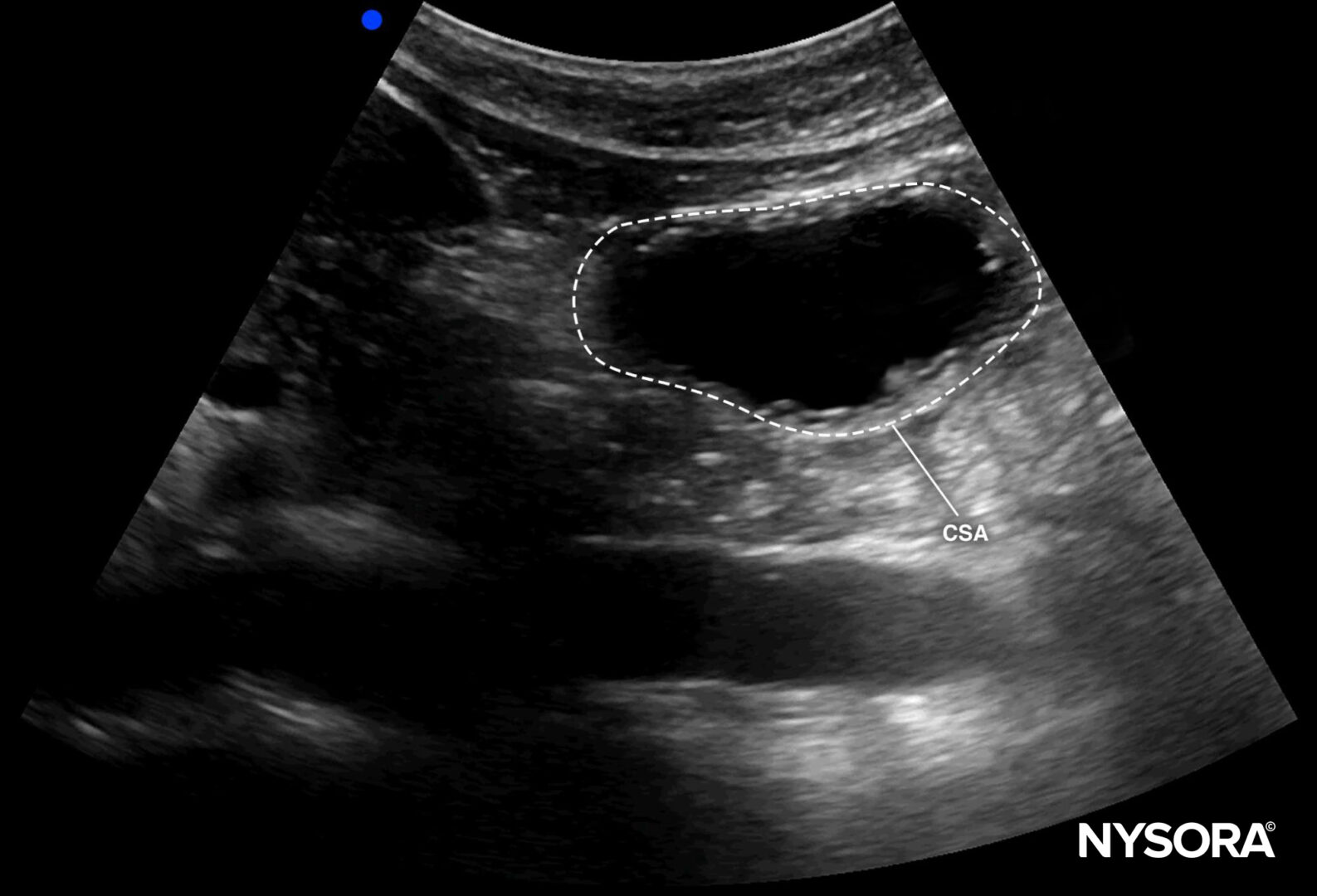
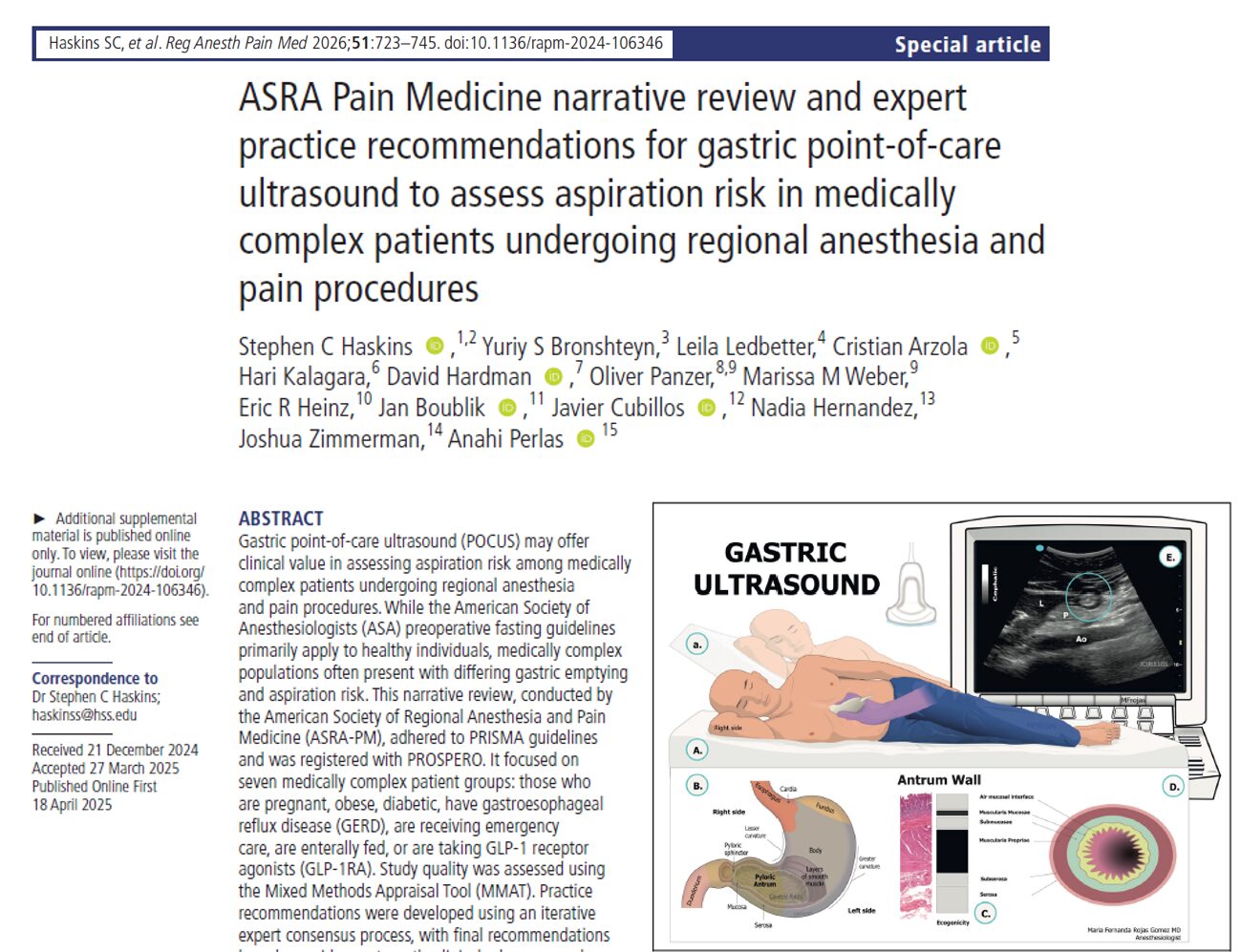
Gastric POCUS provides clinicians with a bedside method of assessing the gastric antrum and estimating whether the stomach is empty or contains clear fluid, thick fluid, or solid material. The new recommendations focus specifically on whether this information is useful for clinical decision-making in medically complex populations.
How gastric POCUS works
Gastric ultrasound generally involves imaging the gastric antrum, frequently with the patient in the right lateral decubitus position.
The guideline describes both qualitative and quantitative approaches.
Qualitative assessment identifies whether the stomach appears empty or contains fluid or solids. Quantitative assessment uses the cross-sectional area (CSA) of the gastric antrum to estimate gastric volume using mathematical models.
The Perlas qualitative grading system categorizes gastric findings according to ultrasound appearance:
- Grade 0: the antrum appears empty in both supine and right lateral decubitus positions.
- Grade 1: the antrum appears empty when supine but contains fluid in the right lateral decubitus position.
- Grade 2: fluid is visible in both positions.
- Grade 3: solid material or thick fluid is present, representing a full stomach and increased aspiration risk.
Importantly, ultrasound findings represent only one component of aspiration-risk assessment.
Recommendations differ substantially by patient group
One of the most clinically useful features of the new article is that it does not make a universal recommendation for gastric ultrasound.
Instead, the evidence is divided according to the clinical population.
The authors’ high-level recommendations are:
- Support: selected pregnancy scenarios and diabetes.
- Conditional support: obesity, emergency care, enteral tube feeding, and GLP-1RA use.
- Not supported for routine use: non-laboring pregnant patients, elective cesarean delivery, and GERD.
These distinctions reflect differences in the quantity and consistency of evidence available for each group.
Gastric POCUS supported during active labor and high-risk pregnancy
Pregnancy presents a particularly complex situation because physiological changes and the circumstances surrounding labor and delivery can affect aspiration risk.
The authors support gastric POCUS for assessing gastric content and volume in several higher-risk scenarios:
- Active labor
- Urgent cesarean delivery when fasting status is uncertain
- Delayed gastric emptying associated with medications
- Hyperemesis gravidarum
- Pre-eclampsia or eclampsia
- Gestational diabetes
Research reviewed in the article demonstrates that gastric emptying can differ considerably depending on whether a pregnant patient is in labor and what has been consumed.
Studies involving solid food during labor demonstrated remaining gastric contents, while investigations involving clear liquids or carefully controlled fluid intake generally reported more favorable findings.
However, the authors specifically do not support routine gastric POCUS in non-laboring pregnant patients or patients presenting for elective cesarean delivery.
Current evidence suggests that gastric contents in non-laboring pregnant patients are broadly comparable with those of non-pregnant patients.
Diabetes receives stronger support
The recommendations also support gastric POCUS in patients with diabetes mellitus.
Several studies reviewed in the article found larger gastric antral CSA measurements and greater residual gastric volumes among patients with diabetes despite fasting.
One study involving 52 patients with diabetes and 50 without diabetes found a full stomach in 48% of patients with diabetes compared with 8% of those without diabetes.
The review also identifies factors that may be associated with higher-risk gastric findings, including:
- Diabetic retinopathy
- Longer duration of diabetes
- HbA1c above 7
- Peripheral neuropathy
Not all studies produced identical findings, however.
Some found no significant difference in gastric volume between patients with and without diabetes, and the incidence of solid gastric contents after appropriate fasting was relatively low in several studies.
Most of the available research also involved type 2 diabetes, meaning additional research is needed in people with type 1 diabetes.
Despite these limitations, the authors conclude that gastric POCUS can help identify higher-risk patients with diabetes and can provide useful bedside information when tailoring anesthetic management.
Emergency patients may have a full stomach despite prolonged fasting
Some of the most striking findings in the article involve patients requiring emergency surgery.
In a prospective observational study involving 440 patients, gastric POCUS was feasible in 89%. A full stomach was identified in 56% of emergency patients compared with only 5% of elective patients, despite prolonged fasting.
Factors independently associated with a full stomach included:
- Emergency surgery
- Obesity
- Diabetes mellitus
- Preoperative morphine use
Another study evaluated 300 emergency surgical patients who had fasted for at least six hours.
Despite a median fasting duration of 16 hours, 35% had gastric antral measurements consistent with a full stomach.
These results demonstrate an important limitation of relying exclusively on reported fasting duration in emergency care.
The authors therefore conditionally support gastric ultrasound in emergency patients to assist with aspiration-risk assessment and anesthetic planning.
GLP-1 receptor agonists are an emerging concern
The rapid increase in GLP-1RA use has created another important question for anesthesiologists because these medications can delay gastric emptying.
The review identified three relevant publications from 2023 to 2024.
In one small prospective study, 10 semaglutide users and 10 controls underwent gastric POCUS after a standard eight-hour fast.
Solid food was detected in the right lateral decubitus position in 90% of semaglutide users compared with 10% of controls.
Another study compared 62 patients taking a once-weekly GLP-1RA with 62 non-users after standard institutional fasting.
Residual gastric content was found in:
- 56% of GLP-1RA users
- 19% of non-users
Residual gastric content in that study included solids, thick liquids, or more than 1.5 mL/kg of clear liquid detected on ultrasound.
Because the evidence base remains relatively small, however, the authors stop short of fully recommending routine gastric POCUS in this population.
Instead, they conditionally support its use in patients taking GLP-1RAs.
Obesity receives conditional support
The guideline similarly gives conditional support to gastric POCUS in patients with obesity.
According to the article’s summary of evidence, gastric ultrasound can accurately assess gastric volume in patients with severe obesity.
Patients with obesity may have larger antral CSA measurements, while additional risk factors for gastroparesis may increase the likelihood of detecting solid gastric contents.
However, obesity alone does not automatically indicate delayed gastric emptying or a full stomach.
For that reason, gastric ultrasound should be considered as an additional individualized assessment rather than a universal requirement.
Enteral tube feeding creates another difficult fasting question
The authors also conditionally support gastric POCUS for patients receiving enteral tube feeding, particularly when clinicians need to tailor airway and anesthetic management.
Studies in critically ill patients show that gastric antral CSA correlates with aspirated gastric residual volume and that gastric POCUS can be performed with good inter-observer and intra-observer reliability.
One study involving 100 intubated, tube-fed ICU patients found that 26% had a full stomach at extubation, regardless of whether feeding had been withheld.
Fasting duration did not affect the incidence of a full stomach.
Another study involving mechanically ventilated patients receiving ongoing enteral nutrition found that only 7.7% had a low-risk stomach on qualitative assessment, while 75% had an estimated gastric volume above 1.5 mL/kg.
These findings suggest that conventional fasting assumptions may be unreliable in some critically ill patients.
Routine POCUS is not supported for GERD
Interestingly, the recommendations do not support routine gastric POCUS solely because a patient has GERD.
The authors found insufficient and conflicting evidence in this population.
Although gastric POCUS can technically be performed in patients with GERD, the available studies did not provide sufficiently consistent evidence to support routine use based on GERD alone.
This illustrates an important distinction in the recommendations: having a condition traditionally associated with aspiration concerns does not automatically mean gastric ultrasound provides additional clinical value.
How clinicians can use gastric POCUS
When gastric contents or fasting status are uncertain, the recommendations suggest that gastric ultrasound can contribute to individualized decision-making.
A practical assessment may involve:
Review the patient’s fasting history: Determine the timing and type of the patient’s most recent oral intake.
Identify factors that may delay gastric emptying: Consider diabetes, pregnancy and labor, obesity, GLP-1RA use, medications, emergency presentation, and enteral feeding.
Perform gastric POCUS when clinically appropriate: Assess the antrum qualitatively and, when necessary, quantitatively.
Interpret the findings in context: An empty stomach, clear fluid, thick fluid, and solid gastric contents have different implications for aspiration risk.
Combine ultrasound with the full clinical picture: Gastric POCUS should complement rather than replace history, examination, and clinical judgment.
Tailor management: Findings may contribute to decisions about airway management, anesthesia technique, or procedural timing.
What the recommendations mean for anesthesia practice
The new recommendations position gastric POCUS as a selective bedside risk-assessment tool rather than a universal screening test.
Its potential value appears greatest when conventional fasting history may not reliably indicate what is actually in the stomach.
The recommendations support use in selected pregnant patients and patients with diabetes, while offering conditional support for patients with obesity, emergency presentations, enteral tube feeding and GLP-1RA use. Routine use is not supported for non-laboring pregnancy, elective cesarean delivery or GERD.
The authors also stress important limitations. Gastric POCUS is operator dependent, requires training, may be technically challenging in patients with obesity or pregnancy, lacks complete standardization, and may be limited by equipment availability and time. The underlying evidence also remains limited in several of the populations examined.
For that reason, these recommendations do not establish a standard of care and are not intended to replace clinical judgment. Rather, gastric POCUS can provide additional information when gastric content and aspiration risk remain uncertain and that information could influence anesthesia, airway management or procedural timing.
For more information, refer to the full article in RAPM.
Haskins SC, Bronshteyn YS, Ledbetter L, et al. ASRA pain medicine narrative review and expert practice recommendations for gastric point-of-care ultrasound to assess aspiration risk in medically complex patients undergoing regional anesthesia and pain procedures. Reg Anesth Pain Med. 2026;51(7):723-745.
Explore the NYSORA POCUS App for practical, step-by-step guidance on gastric ultrasound and other point-of-care ultrasound applications to support bedside assessment and clinical decision-making.