 Nerve Blocks App
 Anesthesia Assistant App
 Ultrasound Pain App
 Pain Medicine Assistant App
 POCUS App
 IV Access App
 MSK Knee App
 VetRA App

 Nerve Block Manual 2027
 Nerve Block Manual
 Regional Anesthesia Updates
 Anesthesiology Manual
 Anesthesiology Review
 Anesthesia Updates 2025
 Anesthesia Updates 2026
 Pediatric Anesthesia Updates
 Airway Management Updates
 US Interventional Pain Manual
 Pain Medicine Updates
 Mastering Difficult IV Access
 PACU Nursing Manual
 RA Veterinary Manual
 Books
 About

 Back to News
 7 min read
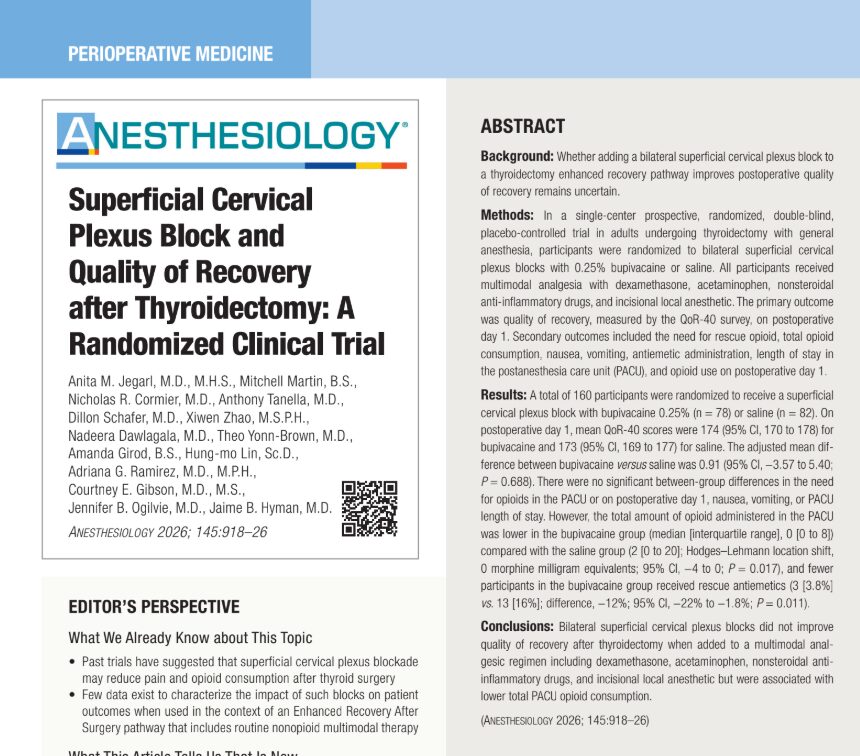
Regional anesthesia plays an important role in modern perioperative pain management, helping reduce opioid consumption, improve patient comfort, and support postoperative recovery. In thyroid surgery, bilateral superficial cervical plexus blocks (SCPBs) have traditionally been used alongside general anesthesia to provide additional analgesia and reduce postoperative opioid requirements.
Previous studies have demonstrated that SCPBs can improve pain control and decrease opioid consumption following thyroidectomy. However, many of these studies were conducted before the widespread adoption of Enhanced Recovery After Surgery (ERAS) protocols, which emphasize standardized, multimodal, opioid-sparing analgesia.
Today, patients undergoing thyroidectomy frequently receive combinations of acetaminophen, nonsteroidal anti-inflammatory drugs (NSAIDs), dexamethasone, and local anesthetic infiltration. These interventions already provide effective postoperative pain relief, raising an important clinical question: Does adding a superficial cervical plexus block provide meaningful benefits when comprehensive multimodal analgesia is already in place?
A randomized clinical trial by Jegarl and colleagues, published in Anesthesiology in October 2026, investigated this question by evaluating postoperative quality of recovery following thyroidectomy. Rather than focusing exclusively on pain scores or opioid consumption, the researchers assessed patients’ overall recovery experience, including physical comfort, emotional well-being, independence, and pain.
Methods
The primary objective was to determine whether adding bilateral ultrasound-guided SCPBs with 0.25% bupivacaine to an established thyroidectomy ERAS pathway improved recovery quality on postoperative day one compared with placebo. Researchers conducted a prospective, randomized, double-blind, placebo-controlled superiority trial between November 2023 and February 2026 at two ambulatory surgical sites affiliated with Yale University.
Study characteristics
- Study population: 160 adult patients undergoing thyroidectomy under general anesthesia.
- Patient eligibility: Adults aged 18 years or older with ASA Physical Status I–III.
- Study design: Prospective, randomized, double-blind, placebo-controlled trial.
- Treatment groups: Bupivacaine (n = 78) versus saline placebo (n = 82).
- Primary assessment: Postoperative day one (POD 1).
- Primary outcome: Quality of Recovery-40 (QoR-40) score.
Interventions
Patients were randomly allocated to one of two groups:
- Bupivacaine group: Bilateral ultrasound-guided SCPB using 10 mL of 0.25% bupivacaine per side.
- Placebo group: Bilateral ultrasound-guided SCPB using an equivalent volume of 0.9% saline.
We performed blocks after induction of general anesthesia, placing injections in the subcutaneous plane along the posterior border of the sternocleidomastoid muscle.
All participants received a standardized ERAS pathway including preoperative acetaminophen (1,000 mg) and celecoxib (200 mg), intravenous dexamethasone (10 mg), total intravenous anesthesia with propofol and remifentanil, and surgeon-administered local anesthetic infiltration.
Postoperative analgesia included acetaminophen and ibuprofen, with limited oxycodone prescribed when appropriate.
Outcome measurements
The primary outcome was the QoR-40 score on postoperative day one. This validated patient-reported questionnaire evaluates five recovery domains: physical comfort, emotional state, physical independence, psychological support, and pain.
Secondary outcomes included:
- Rescue opioid requirements and total opioid consumption in the postanesthesia care unit (PACU).
- Postoperative nausea, vomiting, and rescue antiemetic administration.
- PACU length of stay.
- Opioid consumption through postoperative day one.
- Adverse events.
All 160 randomized participants completed follow-up.
Key findings
- No significant improvement in overall recovery
The primary outcome showed no statistically significant difference in postoperative recovery quality between the two groups.
On postoperative day one:
- Bupivacaine group: Mean QoR-40 score of 174 (95% CI: 170–178).
- Saline group: Mean QoR-40 score of 173 (95% CI: 169–177).
- Adjusted mean difference: 0.91 points (95% CI: −3.57 to 5.40; P = 0.688).
The minimum clinically important difference for the QoR-40 is approximately 6.3 points. The observed difference was substantially smaller, indicating that adding SCPB did not meaningfully improve patients’ overall recovery experience.
Clinical interpretation: When effective multimodal analgesia is already provided, adding bilateral SCPBs does not appear to improve global postoperative recovery after thyroidectomy.
- Reduced opioid consumption in the PACU
Although overall recovery scores were similar, patients receiving bupivacaine required smaller total opioid doses during their PACU stay (P = 0.017).
The proportion of patients requiring any rescue opioid was also numerically lower in the bupivacaine group (37% versus 50%), although this difference was not statistically significant (P = 0.102).
Interestingly, the higher opioid consumption observed among some patients in the saline group suggests that the opioid-sparing effect may have been concentrated among patients requiring larger rescue doses.
Clinical interpretation: SCPB may provide a modest opioid-sparing benefit, particularly among patients with higher postoperative analgesic requirements, even when overall recovery quality remains unchanged.
- Fewer patients required rescue antiemetics
A notable secondary finding was fewer rescue antiemetic administrations among patients receiving bupivacaine (P = 0.011). However, documented postoperative nausea and vomiting rates did not differ significantly between groups.
Furthermore, the secondary outcome analyses were not adjusted for multiple comparisons, so interpret this finding cautiously.
Clinical interpretation: SCPB was associated with fewer rescue antiemetic administrations, but the study does not establish that the block directly prevents postoperative nausea and vomiting.
- Minimal opioid consumption after discharge
Postdischarge opioid consumption was remarkably low in both groups.
- 10% of patients in the bupivacaine group used opioids through postoperative day one.
- 16% of patients in the saline group used opioids during the same period.
- Overall, 87% of participants required no opioids after discharge.
- Only five patients consumed more than one oxycodone tablet, all belonging to the saline group.
Between-group differences in postoperative opioid use were not statistically significant.
These findings reinforce the effectiveness of standardized multimodal analgesia in minimizing opioid requirements following thyroidectomy, regardless of whether an SCPB is performed.
- No reduction in PACU length of stay
Median PACU length of stay was:
- Bupivacaine group: 132 minutes (IQR: 106–183).
- Saline group: 118 minutes (IQR: 89–173).
- Statistical significance: P = 0.170.
Therefore, the modest opioid-sparing effect did not translate into faster PACU discharge readiness.
Adverse events were uncommon, and no clear block-related safety signal emerged. However, the study was not powered to detect rare complications.
Clinical implications
This trial highlights an important principle in contemporary regional anesthesia: the additional benefit of a nerve block depends on the effectiveness of the underlying analgesic regimen.
Earlier studies demonstrated meaningful analgesic benefits from cervical plexus blockade. However, when patients already receive acetaminophen, NSAIDs, dexamethasone, and incisional local anesthetic infiltration, the incremental benefit appears considerably smaller.
For routine ambulatory thyroidectomy, the findings suggest that bilateral SCPB should not automatically be considered essential for achieving high-quality postoperative recovery.
Nevertheless, the modest opioid-sparing effect may remain valuable for selected patients, particularly those who strongly prefer to avoid opioids or have previously experienced opioid-related adverse effects.
The results also emphasize the importance of shared decision-making, balancing expected analgesic benefits against procedural time, resources, patient preferences, and potential complications.
Importantly, these findings apply specifically to superficial cervical plexus blockade and should not automatically be extrapolated to intermediate or deep cervical plexus blocks, which differ in injection technique and potential risk profiles.
Clinical Pearls
- Optimize multimodal analgesia first.
- Opioid reduction does not necessarily mean better recovery.
- Consider individual patient priorities.
- Interpret secondary outcomes cautiously.
Conclusion
This randomized clinical trial shows that adding bilateral superficial cervical plexus blocks to a comprehensive multimodal analgesic pathway does not significantly improve overall recovery quality after thyroidectomy. Although SCPB was associated with reduced PACU opioid consumption and fewer rescue antiemetic administrations, these benefits were modest and did not translate into improved recovery scores or shorter PACU stays. Rather than suggesting that SCPB should be abandoned, the findings support a more selective, patient-centered approach.
Practical tip
Before routinely performing a bilateral SCPB, evaluate the planned multimodal analgesic regimen and the patient’s individual priorities. If a comprehensive ERAS pathway is already in place, consider SCPB as an optional opioid-sparing adjunct rather than an essential component of postoperative recovery. For patients with a strong preference to minimize opioid exposure, discuss the potential modest benefits of SCPB and incorporate shared decision-making into the perioperative plan.
For more information, refer to the full article in Anesthesiology.
Jegarl AM, Martin M, Cormier NR, Tanella A, Schafer D, Zhao X, Dawlagala N, Yonn-Brown T, Girod A, Lin HM, Ramirez AG, Gibson CE, Ogilvie JB, Hyman JB. Superficial Cervical Plexus Block and Quality of Recovery after Thyroidectomy: A Randomized Clinical Trial. Anesthesiology. 2026 Oct 1;145(4):918-926.
Get full access to the cervical plexus block in the NYSORA Nerve Blocks app: technique walkthroughs, PRO tips, clinical videos, and more.