 Nerve Blocks App
 Anesthesia Assistant App
 Ultrasound Pain App
 Pain Medicine Assistant App
 POCUS App
 IV Access App
 MSK Knee App
 VetRA App

 Nerve Block Manual 2027
 Nerve Block Manual
 Regional Anesthesia Updates
 Anesthesiology Manual
 Anesthesiology Review
 Anesthesia Updates 2025
 Anesthesia Updates 2026
 Pediatric Anesthesia Updates
 Airway Management Updates
 US Interventional Pain Manual
 Pain Medicine Updates
 Mastering Difficult IV Access
 PACU Nursing Manual
 RA Veterinary Manual
 Books
 About

 Back to News
 7 min read

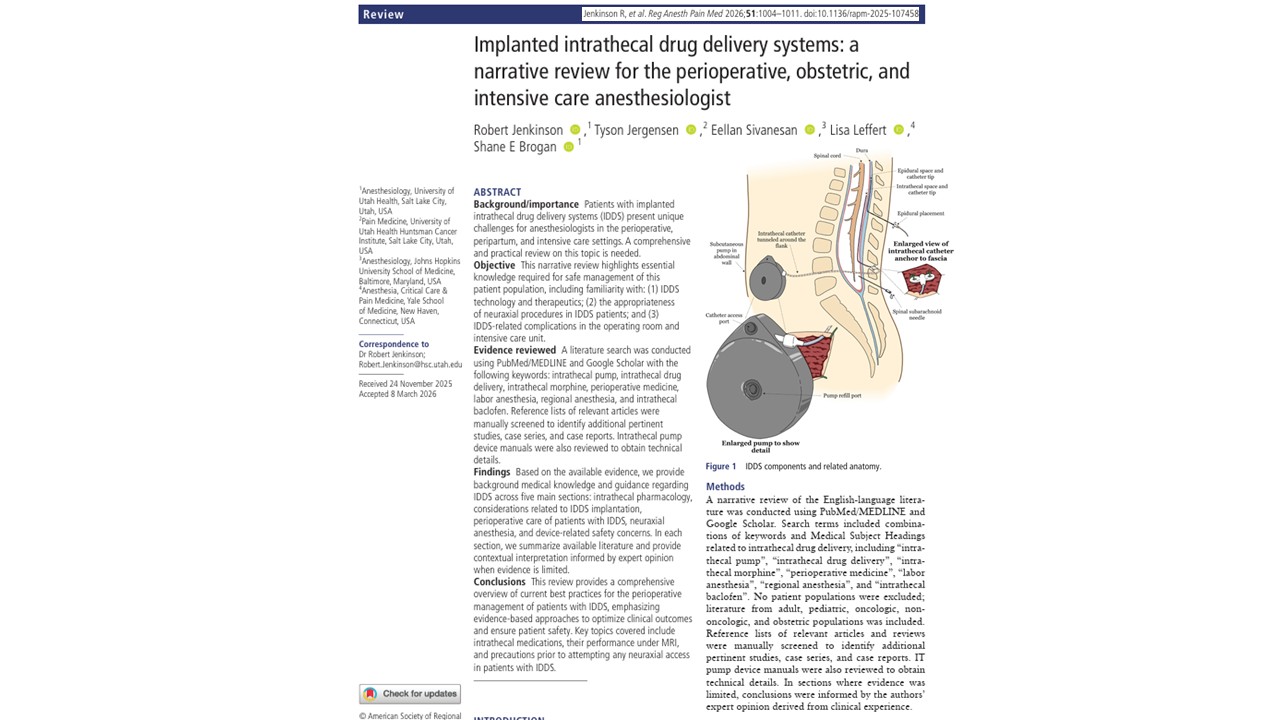
Implanted intrathecal drug delivery systems (IDDSs) have been used for more than three decades to manage chronic cancer and non-cancer pain and neurologic conditions such as severe spasticity. By delivering medication directly into the cerebrospinal fluid, these systems can achieve therapeutic effects with substantially lower doses than systemic therapy while reducing systemic exposure. But for anesthesiologists, the presence of an intrathecal pump introduces important questions: What exactly is being infused? Should the pump continue during surgery? Can an epidural or spinal anesthetic still be performed? What happens if the catheter is damaged? And how should the device be managed during MRI?
A 2026 narrative review by Jenkinson and colleagues in Regional Anesthesia and Pain Medicine brings these issues together into a practical framework for perioperative, obstetric, and intensive care clinicians. The authors focus on intrathecal pharmacology, implantation and perioperative management, neuraxial anesthesia, device failure, and imaging-related safety.
Study objective and methods
The objective of this narrative review was to summarize the essential knowledge needed to safely manage patients with IDDSs in the perioperative, obstetric, and intensive care settings. In particular, the authors aimed to address IDDS technology and pharmacology, the appropriateness of neuraxial procedures, and potentially serious device-related complications.
The authors conducted a narrative review of English-language literature using PubMed/MEDLINE and Google Scholar. The search:
- Included terms related to intrathecal pumps, intrathecal drug delivery, intrathecal morphine, perioperative medicine, labor anesthesia, regional anesthesia, and intrathecal baclofen.
- Included adult, pediatric, oncologic, non-oncologic, and obstetric populations.
- Incorporated relevant studies, case series, and case reports identified through reference lists.
- Included intrathecal pump device manuals to obtain technical information.
- Used expert clinical opinion where published evidence was limited.
This last point is important when interpreting the recommendations: this is a narrative review rather than a clinical trial or systematic review, and several aspects of IDDS management—particularly neuraxial anesthesia—remain supported by relatively limited clinical data.
Key findings
- Know what is inside the pump
An IDDS consists of a refillable reservoir and programmable pump connected to a tunneled intrathecal catheter. Because typical flow rates are very low, drug dispersion is generally limited to several spinal segments around the catheter tip.
Morphine, ziconotide, and baclofen are FDA-approved for IDDS use, while drugs including hydromorphone, fentanyl, bupivacaine, and clonidine are also commonly used off-label. Importantly, combinations of drugs may be present in the same reservoir.
The clinical consequences of overdose or interrupted delivery therefore depend heavily on the drug involved.
Intrathecal opioids can cause respiratory depression, and pump malfunction or interruption may cause opioid withdrawal. Ziconotide overdose can produce neuropsychiatric and neurologic symptoms, but withdrawal has not been described. Clonidine withdrawal can produce severe sympathetic hyperactivity, including rebound hypertension and tachycardia. Baclofen deserves particular attention because both overdose and abrupt withdrawal can be life-threatening. Severe baclofen withdrawal may progress to hyperthermia, marked rigidity, rhabdomyolysis, seizures, disseminated intravascular coagulation, and death.
- Do not assume the medication list tells you what the patient receives
Preoperatively, clinicians should determine the pump medication or medications, concentrations, daily dose, flex dosing schedule, patient-controlled bolus settings, pump manufacturer and model, catheter and pump location, and expected refill date.
One practical problem is particularly easy to overlook: intrathecal medications may not appear in the electronic medical record medication list. Pump interrogation, the patient’s remote-control device or latest interrogation report, and communication with the clinician managing the IDDS may therefore be necessary.
For most scheduled procedures, the authors consider it reasonable to continue baseline IDDS therapy. Multimodal analgesia and regional anesthesia are encouraged, while clinicians should remember that patients receiving intrathecal opioids may have substantial opioid tolerance. Conversely, patients receiving intrathecal baclofen may show greater-than-expected effects from systemic opioids because of drug synergism.
- An intrathecal pump is not an absolute contraindication to neuraxial anesthesia
This is perhaps the review’s most relevant message for regional anesthesiologists.
Formal guidelines for neuraxial anesthesia in patients with IDDSs are lacking, but the authors state that there are no absolute contraindications when the relationship between the implanted catheter and the intended neuraxial procedure is adequately understood.
The major concern is mechanically damaging the intrathecal catheter.
Before lumbar epidural or spinal access, clinicians should determine where the catheter enters and travels. Existing imaging and operative reports can help, and the lumbar scar may provide useful information. Ultrasound may also help identify a superficial catheter and confirm an appropriate access level. When catheter location remains uncertain, new imaging may be appropriate; in obstetric patients, the authors suggest that a single AP lumbar radiograph may be sufficient in some circumstances.
Most importantly, if the catheter’s exact location remains unclear, avoiding neuraxial anesthesia may be the safer choice.
The evidence base remains small. The review identified five reported cases of lumbar epidural placement for labor analgesia in patients with IDDS, and one reported spinal anesthetic for cesarean delivery. None of these reports described catheter damage, pump malfunction, unexpected neuraxial spread, or subsequent IDDS infection.
- Device failure can become an emergency
Catheter problems account for most reported delivery failures and include kinking, fracture, occlusion, migration, granuloma formation, and pump disconnection. Depending on the infused drug, interruption can result in worsening pain or spasticity or a potentially dangerous withdrawal syndrome.
Clinicians should therefore avoid treating a pump as an incidental implanted device. Unexplained postoperative pain, rapidly increasing spasticity, autonomic abnormalities, or other symptoms compatible with withdrawal should prompt consideration of IDDS malfunction.
A related complication is the “pocket fill”: medication intended for the reservoir is accidentally injected into the subcutaneous tissue surrounding the pump. Systemic absorption of concentrated opioids, local anesthetics, or clonidine can cause significant toxicity.
- MRI management is device-specific
Both systems discussed in the review—the Medtronic SynchroMed and Flowonix Prometra—are MRI conditional, but their management differs significantly.
For example, the Prometra pump should be emptied before MRI because magnetic fields may cause its valves to open and release reservoir contents, potentially causing a dangerous overdose. In contrast, emptying the SynchroMed reservoir before MRI is not recommended.
The magnetic field can also temporarily stop pump delivery during scanning. After MRI, manufacturers recommend confirming that therapy has resumed appropriately; definitive interrogation is particularly important in higher-risk situations such as intrathecal baclofen therapy.
Clinical implications
For regional anesthesiologists, the central lesson is that IDDS management should be individualized rather than automatically restrictive. An implanted pump does not necessarily prevent regional or neuraxial anesthesia, but proceeding safely requires more information than is needed in the average patient.
The catheter’s course matters just as much as the pump itself. The medication being infused determines what interruption, overdose, or interaction might mean clinically. And seemingly routine events—from positioning and electrocautery to MRI—require awareness of the implanted system.
Regional anesthesia may actually be particularly valuable because multimodal and regional approaches can reduce reliance on additional systemic opioids in patients who may already have substantial opioid tolerance.
Clinical pearls
- Identify the drug, dose, pump, and catheter location before surgery. Do not rely solely on the electronic medication list.
- Continue baseline IDDS therapy in most scheduled cases, unless there is a specific reason to modify it.
- An IDDS is not automatically a contraindication to spinal or epidural anesthesia. Know exactly where the catheter is before inserting a needle.
- Use existing imaging, operative reports, physical examination, and potentially ultrasound to establish the catheter trajectory.
- Think withdrawal when therapy is unexpectedly interrupted. Baclofen and clonidine withdrawal can be particularly dangerous.
- Protect the pump and catheter during positioning and avoid prolonged pressure, kinking, or mechanical damage.
- MRI safety is device-specific. Identify the manufacturer and model and follow its instructions rather than applying a generic “intrathecal pump” protocol.
Conclusion
Patients with implanted intrathecal drug delivery systems can safely undergo surgery, regional anesthesia, and—in appropriately selected circumstances—neuraxial anesthesia. But these devices require active perioperative planning.
The most important steps are deceptively simple: identify what the pump contains, understand its dosing, locate the pump and catheter, anticipate the consequences of therapy interruption, and recognize device-specific considerations such as MRI management. When considering neuraxial anesthesia, confidence in catheter location and a safe needle trajectory should drive decision-making.
For more information, refer to the full paper in RAPM.
Jenkinson R, Jergensen T, Sivanesan E, Leffert L, Brogan SE. Implanted intrathecal drug delivery systems: a narrative review for the perioperative, obstetric, and intensive care anesthesiologist. Reg Anesth Pain Med. 2026 Sep 8;51(9):1004-1011.
Read more about neuraxial anesthesia in our Regional Anesthesiology Module on NYSORA360 – an essential learning resource for residents with practical, up-to-date guidance.