 Nerve Blocks App
 Anesthesia Assistant App
 Ultrasound Pain App
 Pain Medicine Assistant App
 POCUS App
 IV Access App
 MSK Knee App
 VetRA App
 Nerve Block Manual
 Regional Anesthesia Updates
 Anesthesiology Manual
 Anesthesiology Review
 Anesthesia Updates 2025
 Anesthesia Updates 2026
 Pediatric Anesthesia Updates
 Airway Management Updates
 US Interventional Pain Manual
 Pain Medicine Updates
 Mastering Difficult IV Access
 PACU Nursing Manual
 RA Veterinary Manual
 Books
Books About
About
 Back to News
 8 min read
Chronic postsurgical pain (CPSP) remains an important challenge after cardiac surgery. Although attention in the immediate postoperative period naturally focuses on hemodynamic stability, respiratory recovery, and acute pain control, pain can persist long after the sternotomy has healed. Previous research suggests that CPSP affects approximately 30% of patients 3 months after cardiac surgery and around 15% at 12 months. Beyond discomfort, persistent pain can interfere with sleep, movement, coughing and deep breathing, emotional well-being, and overall quality of life.
One proposed strategy for reducing this burden is better control of acute postoperative pain. Acute pain is a recognized risk factor for CPSP, making effective perioperative analgesia a potential opportunity to interrupt the transition from acute to chronic pain. The erector spinae plane (ESP) block has become an increasingly used component of multimodal analgesia for cardiac surgery and can reduce acute pain and opioid requirements. But does better pain control during the first postoperative hours translate into less pain months later?
Dost and colleagues addressed this question in a prospective randomized controlled trial published in Regional Anesthesia & Pain Medicine. They compared bilateral ESP block with standard care in patients undergoing elective cardiac surgery through median sternotomy.
Study objective and methods
The investigators aimed to determine whether a single-shot bilateral ESP block could reduce the development and severity of CPSP following cardiac surgery, with the primary hypothesis that Brief Pain Inventory (BPI) scores at 3 months would differ between patients receiving an ESP block and those receiving standard care.
This prospective, randomized, controlled trial was conducted at a tertiary university hospital. Patients were adults aged 18–80 years with ASA physical status II–III undergoing elective on-pump open cardiac surgery through a full median sternotomy. Sixty-seven patients were randomized, and 63 were ultimately included in the analysis: 31 in the ESP block group and 32 controls. Baseline demographic and clinical characteristics were similar between groups.
Key elements of the protocol included:
- Intervention: bilateral ultrasound-guided ESP block at approximately T4, performed 30 minutes before surgery. Each side received 30 mL of 0.25% bupivacaine, without exceeding a maximum dose of 2.5 mg/kg based on ideal body weight.
- Control: standard perioperative care without regional anesthesia.
- Background analgesia: both groups received intraoperative morphine and paracetamol followed by postoperative paracetamol and morphine patient-controlled analgesia (PCA).
- Primary outcome: BPI score 3 months after surgery.
- Secondary outcomes: 24-hour morphine consumption, Numerical Rating Scale (NRS) pain scores at rest and during activity, rescue analgesia, postoperative nausea and vomiting (PONV), and BPI scores at 6 months.
- Long-term assessment: neuropathic pain was evaluated using the DN4 questionnaire, while anxiety and depression were assessed using the Hospital Anxiety and Depression Scale (HADS) at 3 and 6 months.
Importantly, chronic pain was defined according to ICD-11 criteria as pain developing or increasing after surgery, localized to the surgical area, persisting for at least 3 months, and distinct from preoperative sensations.
Key findings
The study showed a clear contrast between the short-term and long-term effects of bilateral ESP block. Patients receiving the block experienced better acute postoperative analgesia and required less morphine during the first 24 hours. However, these early benefits did not translate into a statistically significant reduction in chronic postsurgical pain (CPSP) at 3 or 6 months.
Chronic postsurgical pain
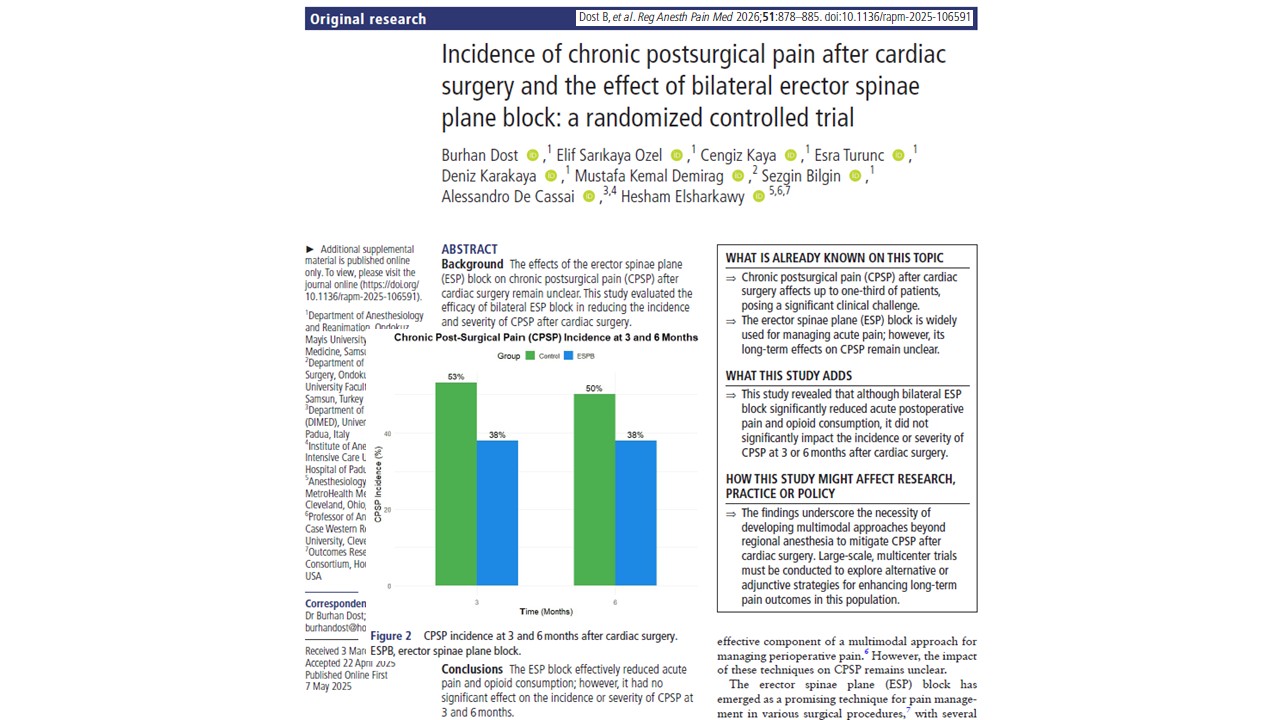
At 3 months, CPSP occurred in 38% (12/31) of patients in the ESP block group versus 53% (17/32) of controls (p=0.31). At 6 months, the rates were 38% versus 50%, respectively (p=0.45). Although numerically lower with ESP block, neither difference was statistically significant.
Brief Pain Inventory
The primary outcome also showed no significant long-term benefit. At 3 months, median total BPI scores were 0 (IQR 26) with ESP block versus 12 (IQR 31) in controls (p=0.16). At 6 months, scores were 0 (IQR 19) versus 7.5 (IQR 22) (p=0.20).
Opioid consumption
ESP block produced a significant opioid-sparing effect. Median cumulative morphine consumption during the first 24 hours was 8 mg versus 10.5 mg in controls (p<0.001).
Acute postoperative pain
Resting NRS scores were significantly lower with ESP block at extubation and at 3, 6, and 12 hours. During activity, pain scores were significantly lower at 3 and 6 hours. For example, activity NRS at 3 hours was 3 versus 4 (p<0.01).
Postoperative nausea and vomiting: PONV scores were significantly lower in the ESP block group at several time points, including 12 and 24 hours (both p<0.001).
Neuropathic pain
No significant difference was found at either follow-up. Neuropathic pain occurred in 9.7% versus 12.5% at 3 months (p=0.72) and 3.2% versus 12.5% at 6 months (p=0.17).
Overall, the results suggest that a single-shot bilateral ESP block offers meaningful acute analgesic and opioid-sparing benefits after cardiac surgery, but this trial provides no evidence that these benefits persist long enough to prevent CPSP. The numerical differences in chronic pain outcomes are worth further investigation, particularly because the relatively small sample may have limited the ability to detect smaller clinically meaningful effects.
Clinical implications
For clinicians using ESP blocks as part of enhanced recovery pathways, this study should not be interpreted as evidence that the block lacks value. Instead, it helps clarify what benefit clinicians can reasonably expect from a single-shot ESP block.
The intervention provided measurable improvements in early postoperative analgesia and reduced opioid exposure. These are relevant goals in their own right, particularly within an opioid-sparing multimodal analgesic strategy.
The study does not support using a single preoperative ESP block as a proven strategy to prevent CPSP. Better analgesia during the first postoperative hours did not automatically translate into significantly better pain outcomes months later.
That distinction matters because chronic postsurgical pain likely involves multiple interacting mechanisms, including peripheral and central sensitization, neuroinflammation, surgical factors, individual pain sensitivity, and psychological factors. A regional block lasting hours may therefore address only one component of a much longer biological process.
Clinical pearls
- ESP block works for acute analgesia: 24-hour morphine consumption and several early NRS pain scores were significantly reduced.
- Acute benefit does not equal chronic pain prevention: no statistically significant reduction in CPSP was demonstrated at either 3 or 6 months.
- CPSP remained common: even with ESP block, 38% of patients met the study criteria for CPSP at both follow-up points.
- Look beyond pain intensity: BPI, DN4 and HADS assessments emphasize that chronic postoperative pain involves functional, neuropathic, and psychological dimensions.
- Think multimodal and longitudinal: preventing the transition from acute to chronic pain may require strategies extending beyond a single regional anesthetic intervention.
Future research
Several unanswered questions remain. This was a relatively small, single-center trial, and the authors acknowledge that it may have been underpowered to detect smaller but potentially clinically meaningful differences. Larger multicenter trials are therefore needed before excluding a possible long-term benefit.
Duration may also matter. This study evaluated a single-shot ESP block. Future studies could determine whether continuous catheter techniques, longer-lasting regional analgesia, or combinations of fascial plane blocks alter CPSP risk.
Follow-up beyond 6 months would provide a more complete picture, while standardized chronic pain outcomes could improve comparison between studies. Future trials should also account systematically for analgesic use after hospital discharge—an important limitation of the current study—and investigate patient-specific risk factors, quantitative sensory testing, biomarkers, and other measures that may help identify patients most likely to develop persistent pain.
Ultimately, the most promising direction may be to investigate ESP block as one component of a sustained, multimodal CPSP-prevention pathway, rather than expecting a single regional technique to prevent chronic pain on its own.
Conclusion
This randomized controlled trial provides a useful reality check for perioperative pain management. Bilateral ESP block significantly reduced acute pain and 24-hour morphine consumption after cardiac surgery, demonstrating meaningful short-term analgesic efficacy. However, it did not significantly reduce CPSP incidence, BPI scores, neuropathic pain, or psychological outcomes at 3 or 6 months.
The message is therefore not that ESP block fails, but that its demonstrated benefits appear predominantly acute. Chronic postsurgical pain is a complex, multifactorial condition, and preventing it will likely require interventions that extend beyond the operating room and beyond a single regional anesthetic.
Practical tip
When discussing ESP block with cardiac surgery patients or incorporating it into an enhanced recovery pathway, separate the acute and long-term goals. Consider the block for improving early analgesia and reducing opioid requirements, but do not present a single-shot ESP block as an established method of preventing chronic postsurgical pain. Patients with persistent or high-risk pain may benefit from structured follow-up and, where available, multidisciplinary or transitional pain services.
For more information, refer to the full article in RAPM.
Dost B, Sarıkaya Ozel E, Kaya C, et al. Incidence of chronic postsurgical pain after cardiac surgery and the effect of bilateral erector spinae plane block: a randomized controlled trial. Reg Anesth Pain Med. 2026;51(8):878-885.
Get full access to the erector spinae plane block in the NYSORA Nerve Blocks app: technique walkthroughs, PRO tips, clinical videos, and more.