 Nerve Blocks App
 Anesthesia Assistant App
 Ultrasound Pain App
 Pain Medicine Assistant App
 POCUS App
 IV Access App
 MSK Knee App
 VetRA App
 Nerve Block Manual
 Regional Anesthesia Updates
 Anesthesiology Manual
 Anesthesiology Review
 Anesthesia Updates 2025
 Anesthesia Updates 2026
 Pediatric Anesthesia Updates
 Airway Management Updates
 US Interventional Pain Manual
 Pain Medicine Updates
 Mastering Difficult IV Access
 PACU Nursing Manual
 RA Veterinary Manual
 Books
Books About
About
 Back to News
 4 min read

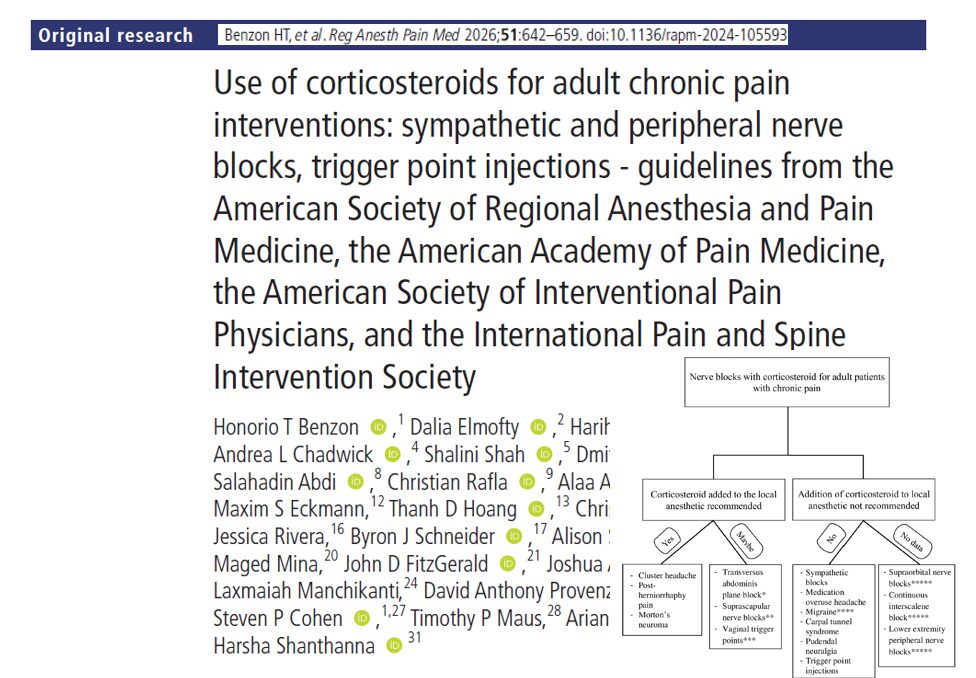
New multidisciplinary guidelines published in Regional Anesthesia and Pain Medicine are challenging the routine use of corticosteroids in sympathetic nerve blocks, peripheral nerve blocks, and trigger point injections for adults with chronic pain.
Developed by experts from ASRA Pain Medicine, the American Academy of Pain Medicine, the American Society of Interventional Pain Physicians, and the International Pain and Spine Intervention Society, the guideline concludes that corticosteroids provide meaningful benefit only in selected conditions.
The strongest support was found for greater occipital nerve block in cluster headache, injections for chronic post-herniorrhaphy pain, and Morton’s neuroma. In contrast, corticosteroids are not recommended for several other commonly performed procedures.
Why steroid use is being reconsidered
Corticosteroids are often added to local anesthetics because of their anti-inflammatory effects. However, they may also cause:
- Hyperglycemia
- Hypothalamic-pituitary-adrenal axis suppression
- Reduced bone mineral density
- Soft tissue atrophy
- Alopecia and skin pigmentation changes
- Infection
- Cushing syndrome
- Neuropsychiatric effects
- Rare neurological injury after vascular injection
The guideline, therefore, asks whether the additional benefit justifies the added risk.
Where corticosteroids are recommended
Cluster headache
Randomized trials suggest that adding corticosteroid to local anesthetic during a greater occipital nerve block can reduce cluster headache attacks and prolong relief.
The guideline recommends corticosteroid addition for this indication.
Post-herniorrhaphy pain
Corticosteroid-containing ilioinguinal, iliohypogastric, and genitofemoral nerve blocks may provide sustained analgesia in patients with chronic pain after inguinal hernia repair.
Morton’s neuroma
The guideline recommends corticosteroids with a local anesthetic for Morton’s neuroma injections.
Ultrasound guidance is also preferred because it improves injection accuracy and clinical outcomes.
Where corticosteroids are not recommended
The guideline advises against routine corticosteroid use for:
- Sympathetic nerve blocks
- Greater occipital nerve block for migraine
- Greater occipital nerve block for medication-overuse headache
- Pudendal nerve block for pudendal neuralgia
- Carpal tunnel injections
- Trigger point injections
In these procedures, local anesthetic alone often provides similar benefit without unnecessary steroid exposure.
Trigger point injections
For myofascial pain, studies have not shown meaningful superiority from adding corticosteroid to local anesthetic.
The guideline recommends considering a local anesthetic alone.
Ultrasound may improve safety when injections are performed near the pleura, blood vessels, nerves, or abdominal organs.
Imaging guidance improves safety
Ultrasound and fluoroscopy play an increasingly important role in chronic pain procedures.
Ultrasound can help clinicians visualize:
- Nerves
- Blood vessels
- Pleura
- Fascial planes
- Abdominal organs
- Real-time needle position
The guideline supports image guidance for stellate ganglion blocks, lower extremity peripheral nerve blocks, greater occipital nerve blocks, transversus abdominis plane blocks, chest wall injections, and selected trigger point injections.
Particulate steroids require caution
Particulate corticosteroids may cause embolic neurological injury if accidentally injected into an artery.
The guideline favors non-particulate corticosteroids for higher-risk procedures near critical vascular structures, including proximal intercostal and paravertebral injections.
Evidence remains limited for several blocks
The available evidence is insufficient to determine whether corticosteroids add meaningful benefit in:
- Transversus abdominis plane blocks
- Suprascapular nerve blocks
- Supraorbital nerve blocks
- Some chest wall blocks
- Vaginal trigger point injections
- Several other peripheral nerve procedures
The authors call for larger randomized trials and better dose-response studies.
Clinical implications
Clinicians should:
- Confirm that corticosteroid use is supported for the specific diagnosis.
- Use image guidance when appropriate.
- Prefer local anesthetic alone when steroids offer no proven benefit.
- Avoid particulate steroids near critical vascular structures.
- Track cumulative corticosteroid exposure across procedures.
Conclusion
The new guideline marks a shift away from routine corticosteroid use in chronic pain injections.
Steroids remain valuable for selected indications, particularly cluster headache, chronic post-herniorrhaphy pain, and Morton’s neuroma. However, they should generally be avoided in sympathetic blocks, migraine-related occipital nerve blocks, pudendal nerve blocks, carpal tunnel injections, and trigger point injections.
The broader message is that corticosteroids should be used selectively, with careful attention to diagnosis, dose, imaging guidance, and cumulative exposure.
For more information, refer to the full article in Regional Anesthesia & Pain Medicine.
Benzon HT, Elmofty D, Shankar H, et al. Use of corticosteroids for adult chronic pain interventions: sympathetic and peripheral nerve blocks, trigger point injections – guidelines from the American Society of Regional Anesthesia and Pain Medicine, the American Academy of Pain Medicine, the American Society of Interventional Pain Physicians, and the International Pain and Spine Intervention Society. Reg Anesth Pain Med. 2026;51(6):642-659.
Explore the Ultrasound-Guided Interventional Pain Procedures Manual and the Deluxe Edition for expert instructions on denervation, peripheral nerve interventions, joint injections, and more evidence-based pain management strategies.