 Nerve Blocks App
 Anesthesia Assistant App
 Ultrasound Pain App
 Pain Medicine Assistant App
 POCUS App
 IV Access App
 MSK Knee App
 VetRA App
 Nerve Block Manual
 Regional Anesthesia Updates
 Anesthesiology Manual
 Anesthesiology Review
 Anesthesia Updates 2025
 Anesthesia Updates 2026
 Pediatric Anesthesia Updates
 Airway Management Updates
 US Interventional Pain Manual
 Pain Medicine Updates
 Mastering Difficult IV Access
 PACU Nursing Manual
 RA Veterinary Manual
 Books
Books About
About
 Back to News
 8 min read
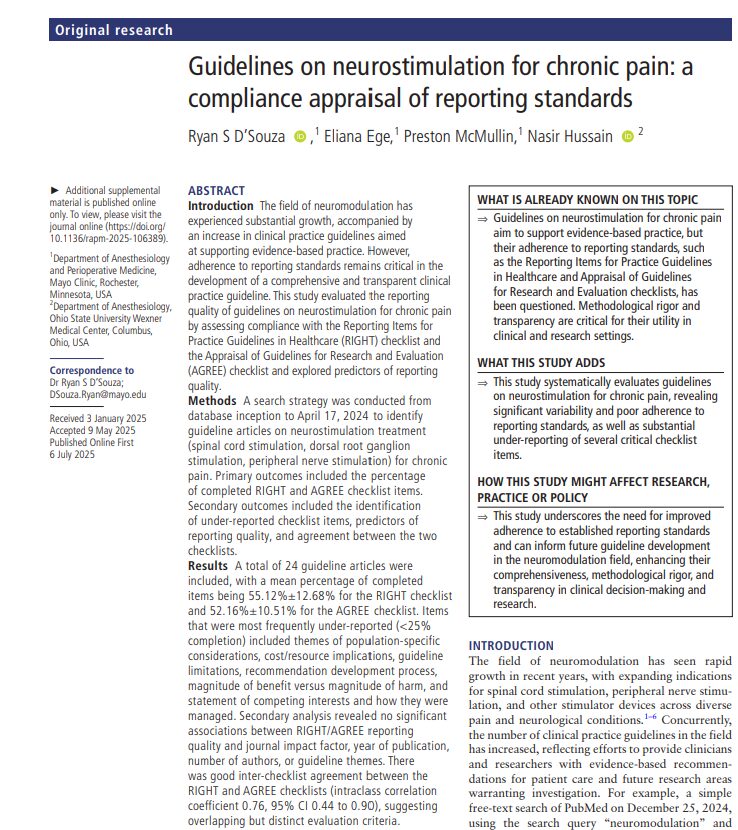
Clinical practice guidelines are intended to turn medical evidence into practical recommendations. But a new appraisal of guidelines covering neurostimulation for chronic pain suggests that many published recommendations do not fully report important information needed to judge their rigor, transparency and applicability.
The study, led by Ryan S D’Souza and colleagues and published in Regional Anesthesia and Pain Medicine, evaluated 24 clinical practice guidelines involving spinal cord stimulation, dorsal root ganglion stimulation and peripheral nerve stimulation. Researchers assessed each guideline using two established reporting frameworks: the Reporting Items for Practice Guidelines in Healthcare (RIGHT) checklist and the Appraisal of Guidelines for Research and Evaluation (AGREE) reporting checklist.
The findings were striking. On average, guidelines completed only 55.12% of RIGHT items and 52.16% of AGREE items. Important topics, including patient values and preferences, costs and resource requirements, guideline limitations and competing interests, were among the areas that were frequently under-reported.
Why neurostimulation guidelines matter
Neurostimulation has become an increasingly important component of chronic pain management. The interventions covered by the study included spinal cord stimulation, dorsal root ganglion stimulation and peripheral nerve stimulation.
Such therapies may be considered across several chronic pain conditions. The investigators specifically identified conditions commonly addressed by neurostimulation guidelines, including persistent spinal pain syndrome, complex regional pain syndrome, painful diabetic neuropathy, phantom limb pain, angina and ischemic limb pain.
As neurostimulation has expanded, the number of guidelines intended to help clinicians select patients and deliver treatment has also increased.
The authors illustrate this growth with a PubMed search: a search combining “neuromodulation” and “guideline” produced six citations covering 1963–2010, compared with 137 citations between 2011 and 2024.
More guidelines, however, do not necessarily mean better reporting.
The researchers argue that guidelines need sufficient methodological detail for clinicians, researchers, editors and other stakeholders to understand how recommendations were developed and how confidently they should be applied.
How researchers assessed the guidelines
The investigators searched multiple databases from inception through April 17, 2024. The search covered MEDLINE, EMBASE, the Cochrane Database of Systematic Reviews and Scopus.
After deduplication, 840 publications were identified. Thirty-two proceeded to full-text assessment and 24 guideline articles ultimately met the inclusion criteria.
The included guidelines were published between 2007 and 2023 across 13 journals. Most, 18 of 24, or 75%, concerned best practices or patient selection.
Researchers independently evaluated reporting using two frameworks:
- RIGHT checklist: 22 sections comprising 35 individual items
- AGREE reporting checklist: 23 sections comprising 87 individual items
Two independent reviewers assessed the guidelines and resolved differences until consensus was reached.
Only around half of RIGHT reporting items were completed
Across the 24 guidelines, the mean proportion of completed RIGHT items was:
55.12% ± 12.68%.
Performance varied considerably between individual guidelines. As shown in table 1 on page 4, RIGHT completion ranged from 34.28% to 77.14%.
Seven of the 35 RIGHT items were reported by fewer than 25% of the evaluated guidelines.
These particularly under-reported areas included:
- Year of publication in the guideline title
- Intended clinical setting
- Values and preferences of the target population
- Cost and resource implications
- Contextual factors such as equity
- Quality-assurance measures
- Limitations of the guideline
The lack of information about patient preferences and resources may be especially relevant to clinical implementation.
The authors note, for example, that inadequate consideration of costs and resources could make guidelines more difficult to apply in resource-limited settings. Similarly, failure to incorporate patient values and preferences may limit the ability of recommendations to address diverse populations and real-world clinical needs.
AGREE assessment produced a similar picture
Results were comparable when researchers applied the more extensive AGREE reporting checklist.
The average completion rate was:
52.16% ± 10.51%.
More than one-third of the checklist was particularly problematic: 28 of 87 AGREE items, or 32.18%, were reported in fewer than 25% of the guidelines.
The paper highlights several examples.
Information describing how gathered evidence was used in developing recommendations was inadequately reported. Complete literature-search strategies were also frequently missing.
Another under-reported area concerned limitations in the methodology of studies informing the guidelines, including issues involving sampling, blinding, allocation concealment and analytical methods.
Reporting related to costs and competing interests was also deficient.
According to the authors, omission of these details can make it harder for clinicians and other stakeholders to evaluate how recommendations were generated and determine their reliability and applicability.
Bigger journals did not guarantee better reporting
The investigators also examined whether certain characteristics predicted better reporting.
They tested four potential factors:
- Journal impact factor
- Publication year
- Number of guideline authors
- Guideline topic or theme
None showed a statistically significant association with RIGHT reporting performance.
The same was true for AGREE scores.
This means the analysis found no evidence that guidelines published in higher-impact journals were more completely reported. Having more authors was not associated with better reporting either.
Perhaps surprisingly, publication year also was not significantly associated with reporting quality.
The authors argue that the findings support improving reporting requirements across journals rather than assuming that publication prestige will ensure methodological transparency.
RIGHT and AGREE generally agreed
Despite assessing guideline reporting in somewhat different ways, RIGHT and AGREE produced reasonably consistent results.
Researchers calculated an intraclass correlation coefficient of 0.76, with a 95% confidence interval of 0.44 to 0.90.
This was classified as good inter-checklist agreement.
The finding suggests that RIGHT and AGREE overlap substantially while retaining complementary characteristics.
The authors therefore see value in using these established frameworks when developing and evaluating future neurostimulation guidelines.
What could improve future neurostimulation guidelines?
The study does not conclude that the clinical recommendations contained in the evaluated guidelines are necessarily incorrect.
That distinction is important.
The research assessed reporting compliance, not whether every clinical recommendation was valid or whether following a particular guideline produces better or worse patient outcomes.
A low reporting score can also reflect incomplete documentation rather than a poorly conducted guideline-development process.
Nevertheless, transparent reporting gives clinicians and other readers the information necessary to evaluate how recommendations were produced.
Based on the problems identified, several practical measures are discussed in the paper:
- Require reporting checklists at submission. Journals could require guideline authors to submit completed RIGHT and/or AGREE checklists and identify where individual requirements are addressed.
- Integrate reporting standards into peer review. Structured reviewer templates could explicitly incorporate important RIGHT or AGREE elements.
- Improve reviewer training. Reviewers could receive additional guidance on evaluating completeness and transparency in guideline manuscripts.
- Increase involvement of professional societies. Organizations developing clinical guidelines could provide clearer instructions and resources for applying standardized reporting frameworks.
- Explicitly report unavailable evidence. Where evidence concerning cost, patient satisfaction or long-term outcomes is lacking, authors can transparently acknowledge those limitations rather than leave the issue unclear.
The researchers emphasize that responsibility should not rest solely with guideline authors. Editors, peer reviewers, journals and professional organizations all have potential roles in improving reporting.
Important limitations of the study
The appraisal itself has limitations.
Only English-language guidelines were included, which may limit the generalizability of the findings internationally.
The study was also restricted to neurostimulation for chronic pain. Its results therefore cannot automatically be extended to guidelines addressing neurostimulation for other indications.
Some guidelines may have received lower scores because methodological details were not reported rather than because those methodological steps were never performed.
The researchers also acknowledge an important historical issue: several guidelines were published before the RIGHT and AGREE reporting checklists were developed. Judging older publications against subsequently introduced standards therefore requires appropriate context.
Finally, checklist assessment contains a degree of reviewer judgment, although the researchers used independent reviewers and consensus discussions to reduce variability.
What does the study mean for patients and clinicians?
For clinicians, the results reinforce the importance of looking beyond the recommendation itself.
When evaluating a neurostimulation guideline, readers may benefit from asking whether the document clearly describes the evidence-search process, recommendation-development methods, patient preferences, resource implications, methodological limitations and competing interests.
For patients, the study should not be interpreted as evidence that spinal cord stimulation, dorsal root ganglion stimulation or peripheral nerve stimulation is ineffective or unsafe.
It evaluated how guidelines about these therapies were reported, rather than testing the clinical efficacy or safety of the treatments themselves.
The central concern is whether clinicians have enough transparent information to understand how guideline recommendations were produced.
The bottom line
The appraisal highlights a substantial gap between the growing importance of neurostimulation guidelines and the completeness with which their development is reported.
Across 24 chronic pain guidelines, fewer than 60% of RIGHT and AGREE reporting items were completed on average. Patient preferences, resource implications, limitations and transparency surrounding competing interests were among the notable weaknesses.
The findings point toward a practical opportunity for improvement: systematic use of reporting frameworks during guideline development, manuscript submission and peer review.
As neurostimulation continues to evolve, the authors argue that better reporting can make future guidelines more comprehensive, transparent and methodologically rigorous, and make it easier for clinicians and other stakeholders to determine how much confidence to place in their recommendations.
Reference: D’Souza RS et al. Guidelines on neurostimulation for chronic pain: a compliance appraisal of reporting standards. Reg Anesth Pain Med. 2026;51:902-910.
For more literature highlights like this, NYSORA’s Pain Medicine Assistant app is the resource to stay up-to-date in pain medicine!