 Nerve Blocks App
 Anesthesia Assistant App
 Ultrasound Pain App
 Pain Medicine Assistant App
 POCUS App
 IV Access App
 MSK Knee App
 VetRA App

 Nerve Block Manual 2027
 Nerve Block Manual
 Regional Anesthesia Updates
 Anesthesiology Manual
 Anesthesiology Review
 Anesthesia Updates 2025
 Anesthesia Updates 2026
 Pediatric Anesthesia Updates
 Airway Management Updates
 US Interventional Pain Manual
 Pain Medicine Updates
 Mastering Difficult IV Access
 PACU Nursing Manual
 RA Veterinary Manual
 Books
 About

 Back to News
 10 min read
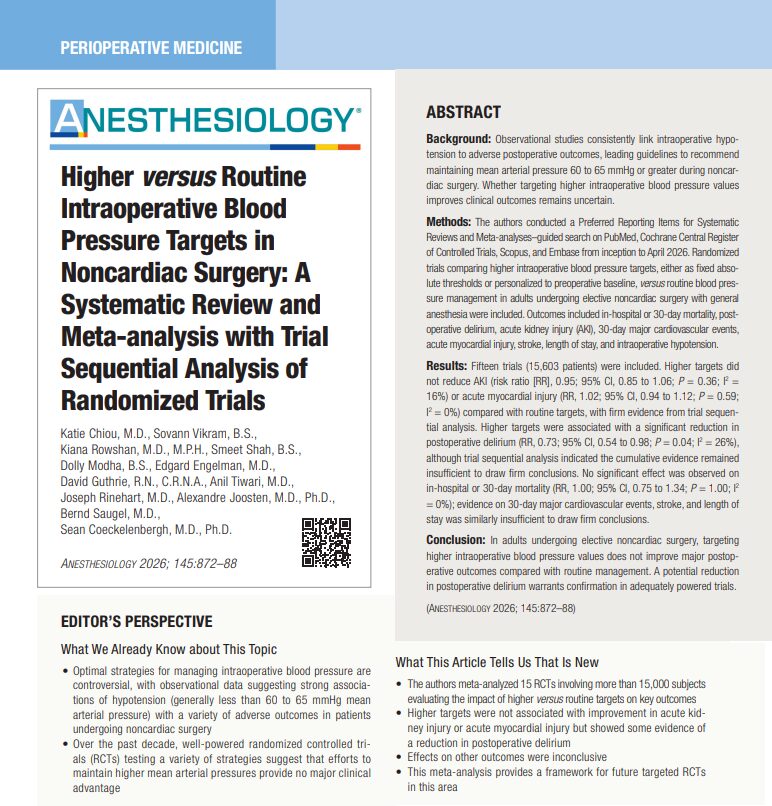
A comprehensive systematic review and meta-analysis published in Anesthesiology challenges the assumption that maintaining higher intraoperative arterial pressures necessarily improves postoperative outcomes.
The study, led by Katie Chiou and colleagues, analyzed 15 randomized controlled trials involving 15,603 patients undergoing elective noncardiac surgery under general anesthesia.
The findings suggest that targeting higher mean arterial pressure (MAP) values provides no additional protection against major postoperative complications when compared with routine blood pressure management.
Importantly, although higher targets consistently reduced intraoperative hypotension, this physiological improvement did not translate into a measurable reduction in acute kidney injury or myocardial injury.
Why intraoperative blood pressure management matters
Maintaining adequate organ perfusion during general anesthesia is a fundamental component of perioperative care.
Numerous observational studies have demonstrated associations between the severity and duration of intraoperative hypotension and postoperative complications, including:
- Acute kidney injury (AKI)
- Myocardial injury after noncardiac surgery
- Cerebrovascular complications
- Postoperative mortality
- Postoperative neurocognitive complications
These observations have contributed to contemporary recommendations to maintain intraoperative MAP at approximately 60–65 mmHg or higher.
However, an important clinical question remains: Does increasing MAP beyond these routinely recommended thresholds provide additional protection against organ injury?
Observational associations do not necessarily establish causality. Patients who experience intraoperative hypotension may also have underlying cardiovascular disease, greater surgical complexity, or other factors contributing to postoperative complications.
Randomized controlled trials are therefore essential to determine whether actively targeting higher arterial pressures improves patient-centered outcomes.
Study design: 15 randomized trials evaluated
Chiou and colleagues conducted a systematic review following PRISMA recommendations, searching PubMed, Cochrane CENTRAL, Scopus, and Embase through April 2026.
The analysis included adult patients undergoing elective noncardiac surgery under general anesthesia.
Researchers compared two strategies:
- Higher blood pressure targets: Fixed MAP thresholds, commonly between 70 and 100 mmHg, or individualized targets based on preoperative blood pressure.
- Routine blood pressure management: Standard protocols generally targeting MAP of at least 60–65 mmHg.
Seven trials involving 13,213 patients evaluated fixed targets, while eight trials involving 2,390 patients investigated personalized blood pressure management.
Among studies reporting numerical achieved MAP values in both groups, the average between-group difference was approximately 6.8 mmHg.
The investigators assessed mortality, postoperative delirium, acute kidney injury, major cardiovascular events, myocardial injury, stroke, hospital length of stay, and intraoperative hypotension.
They also performed trial sequential analysis (TSA), a statistical method used to determine whether accumulated evidence is sufficiently robust to support or exclude clinically meaningful treatment effects.
Higher blood pressure targets do not prevent acute kidney injury
One of the most important findings concerns postoperative acute kidney injury.
Twelve randomized controlled trials involving 14,790 patients contributed data to this analysis.
Higher intraoperative blood pressure targets did not significantly reduce the incidence of AKI compared with routine management (risk ratio [RR] 0.95; 95% confidence interval [CI] 0.85–1.06; P = 0.36).
The findings were supported by trial sequential analysis, which demonstrated that the accumulated sample exceeded the required information size.
This allowed the investigators to exclude a relative risk reduction of 20% or greater under the prespecified statistical assumptions.
The GRADE assessment classified the evidence for AKI as high certainty.
These results suggest that routinely increasing intraoperative arterial pressure above standard targets does not provide substantial additional renal protection in the overall population undergoing elective noncardiac surgery.
Could higher targets benefit patients at increased risk?
A post hoc subgroup analysis restricted to trials explicitly enrolling patients with American Society of Anesthesiologists (ASA) Physical Status II or greater suggested a possible reduction in AKI.
In this subgroup of 1,310 patients, higher blood pressure targets were associated with a statistically significant reduction in AKI (RR 0.83; 95% CI 0.70–0.98; P = 0.02).
The association appeared more pronounced with personalized blood pressure targets (RR 0.70; 95% CI 0.53–0.91).
However, sensitivity analysis excluding one influential trial attenuated the overall association to statistical nonsignificance.
Therefore, these exploratory findings cannot establish that higher targets improve renal outcomes in higher-risk patients.
No additional protection against myocardial injury
The investigators also examined whether higher intraoperative blood pressure targets could reduce acute myocardial injury.
Seven trials involving 11,102 patients contributed data to this outcome.
The pooled analysis demonstrated no significant difference between higher and routine blood pressure targets (RR 1.02; 95% CI 0.94–1.12; P = 0.59).
Neither fixed nor personalized higher-target strategies significantly reduced myocardial injury.
Trial sequential analysis confirmed that sufficient statistical information had accumulated to exclude a clinically meaningful 20% relative risk reduction.
The certainty of evidence was classified as high.
These findings challenge the assumption that increasing arterial pressure beyond routine thresholds necessarily improves myocardial protection.
The authors suggest that once adequate perfusion pressure is maintained, additional MAP elevation may offer limited benefit against structural organ injury.
They also emphasize that organ perfusion depends on multiple hemodynamic factors beyond arterial pressure alone.
Potential reduction in postoperative delirium
Perhaps the most interesting finding concerns postoperative delirium.
Delirium is an important complication following major surgery, particularly among older patients and those with preexisting cognitive impairment or frailty.
It is characterized by an acute disturbance in attention, awareness, and cognition, often with a fluctuating clinical course.
Nine randomized trials involving 5,254 patients evaluated postoperative delirium using validated assessment tools, including the Confusion Assessment Method (CAM) and CAM for the Intensive Care Unit (CAM-ICU).
Higher intraoperative blood pressure targets were associated with a statistically significant reduction in postoperative delirium (RR 0.73; 95% CI 0.54–0.98; P = 0.04).
This corresponds to an estimated 27% relative reduction in delirium risk.
Personalized targets may offer neurological benefits
Subgroup analysis suggested that personalized blood pressure management might be particularly relevant.
Personalized higher targets were associated with a significant reduction in postoperative delirium (RR 0.54; 95% CI 0.31–0.94; P = 0.03).
In contrast, fixed higher targets did not demonstrate a statistically significant benefit (RR 0.79; 95% CI 0.51–1.22).
However, the difference between these subgroups was not statistically significant, meaning that superiority of personalized strategies over fixed targets has not been established.
Furthermore, trial sequential analysis demonstrated that the accumulated evidence was insufficient to confirm a definitive benefit.
The available sample represented approximately 26% of the required information size.
The authors also highlight the possibility that differences in anesthetic management may have contributed to the observed findings.
For example, deeper anesthesia and higher anesthetic doses may influence both intraoperative blood pressure and postoperative delirium risk.
Unfortunately, anesthetic depth monitoring and electroencephalographic burst suppression were not consistently reported across the included trials.
Consequently, the observed association should be interpreted cautiously.
Further randomized trials specifically powered to evaluate postoperative delirium are needed.
No significant improvement in mortality or cardiovascular outcomes
The meta-analysis also evaluated mortality, major cardiovascular events, stroke, and hospital length of stay.
Ten trials involving 14,993 patients reported in-hospital or 30-day all-cause mortality.
Higher blood pressure targets did not reduce mortality compared with routine management (RR 1.00; 95% CI 0.75–1.34; P = 1.00).
The overall mortality rate was approximately 1.2%, making it difficult to detect clinically meaningful differences without substantially larger patient populations.
Trial sequential analysis confirmed that the available evidence remained insufficient to exclude an important mortality effect.
Similarly, no significant differences were observed for:
- Major cardiovascular events: RR 0.99; 95% CI 0.90–1.09.
- Stroke: RR 1.11; 95% CI 0.63–1.97.
- Hospital length of stay: Mean difference 0.04 days; 95% CI −0.15 to 0.22 days.
Although these findings did not demonstrate additional benefits from higher blood pressure targets, the evidence for some outcomes, particularly mortality and stroke, remained imprecise.
Therefore, the absence of statistically significant differences should not be interpreted as definitive proof that clinically important effects are impossible.
Reducing hypotension does not necessarily improve clinical outcomes
An important observation from the meta-analysis was that higher blood pressure targets consistently reduced intraoperative hypotension.
Across trials reporting hypotension-related measurements, higher-target strategies achieved higher arterial pressures and reduced exposure to hypotensive episodes.
Nevertheless, these physiological improvements did not translate into significant reductions in most major postoperative complications.
This distinction is clinically important.
Although intraoperative hypotension is associated with adverse outcomes in observational studies, increasing arterial pressure beyond routine thresholds may not necessarily improve organ perfusion or prevent tissue injury.
The authors discuss physiological autoregulation as one possible explanation.
Within certain pressure ranges, organs such as the kidneys and heart can maintain relatively stable blood flow despite changes in systemic arterial pressure.
Consequently, increasing MAP may provide limited additional benefit when organ perfusion is already adequate.
However, autoregulatory thresholds vary between individuals and may be altered by chronic hypertension or underlying vascular disease.
Clinical implications for anesthesiologists
The findings have several important implications for contemporary perioperative practice.
First, avoiding clinically significant hypotension remains essential.
The meta-analysis compared higher blood pressure targets with routine management, not with permissive or untreated hypotension.
Therefore, the findings do not support allowing prolonged or profound intraoperative hypotension.
Second, routinely targeting substantially higher MAP values may not improve postoperative outcomes.
The available randomized evidence does not demonstrate additional renal or myocardial protection from universally higher blood pressure targets.
Third, individualized blood pressure management remains an important research priority.
Patients with chronic hypertension, cerebrovascular disease, altered autoregulation, or significant frailty may have different physiological requirements.
However, the present analysis does not establish specific optimal MAP thresholds for these populations.
Fourth, hemodynamic optimization should extend beyond arterial pressure alone.
Cardiac output, circulating blood volume, vascular resistance, and tissue perfusion are all relevant components of perioperative hemodynamic management.
Finally, the possible association between higher blood pressure targets and reduced postoperative delirium deserves further investigation.
Future studies should evaluate whether personalized strategies can improve neurological outcomes while accounting for anesthetic depth, baseline cognitive function, and other perioperative risk factors.
Strengths and limitations of the evidence
The meta-analysis has several methodological strengths.
It included 15 randomized trials involving more than 15,000 patients, assessed multiple clinically relevant outcomes, and incorporated trial sequential analysis to evaluate the robustness of its findings.
Thirteen trials were classified as having a low risk of bias, while two raised some concerns.
Nevertheless, several limitations should be considered.
Protocol adherence varied between trials, and the actual differences in achieved intraoperative MAP were relatively modest in many studies.
The POISE-3 trial contributed approximately half of the pooled patient population across outcomes, giving it considerable influence on the overall estimates.
Additionally, the analysis combined trials using fixed and personalized blood pressure targets, despite potential physiological differences between these approaches.
Patient-level characteristics, including chronic hypertension, cerebrovascular disease, and perioperative antihypertensive medication use, were not consistently reported.
Finally, the analysis was restricted to elective noncardiac surgery under general anesthesia. The findings cannot automatically be extrapolated to emergency surgery, cardiac surgery, or patients with severe perfusion-limited conditions.
Conclusion
This comprehensive systematic review and meta-analysis provides important evidence regarding optimal intraoperative blood pressure management in adults undergoing elective noncardiac surgery.
Across 15 randomized trials involving 15,603 patients, targeting higher intraoperative blood pressure values did not significantly improve major postoperative outcomes compared with routine management.
The findings were particularly robust for acute kidney injury and acute myocardial injury, where trial sequential analysis excluded substantial clinical benefits.
A potential reduction in postoperative delirium represents an important area for future investigation, particularly regarding personalized blood pressure strategies.
Overall, the findings support an approach focused on maintaining adequate perfusion and preventing clinically significant hypotension rather than routinely pursuing higher arterial pressures in all patients.
Further research is needed to identify whether specific patient populations may benefit from individualized intraoperative blood pressure targets.
Reference: Chiou K et al. Higher versus Routine Intraoperative Blood Pressure Targets in Noncardiac Surgery: A Systematic Review and Meta-analysis with Trial Sequential Analysis of Randomized Trials. Anesthesiology. 2026;145:872-888.
Get practical, evidence-based guidance for everyday anesthesia practice with the NYSORA Anesthesiology manual.